Wednesday, May 16, 2012

People and Places

Just Travelling in the city can fill you up so many questions of where, whats and whys. These days I am doing rounds of te city to fin out information about scholarships and loans. Buildings that seemed everyday and were overlooked in the precinct of old Mumbai have become suddenly important now. Statues around the city and in the buildings that seemed useless seem important because you realize that they built the city and are still pumping in money.


But apart from that, these historical buildings suck you into a completely different space. The quality of light, the smells of offices and the scale of spaces you encounter fill you will a sense of pride and certain lavishness. You breathe deeper and walk with an air of control. Such feeling makes one ponder of the lives which lived in these buildings.


Apart from all these, I have encountered several people, a similar kind of people I must say in these places. Firstly, making a list of scholarship trusts and then visiting them one by one has made me realize that most of them are Parsis - Godrej, Tata, Netarwala, Davars...all are actually Parsis. Then, the buildings in which they are housed also have a distinct Parsi feel - orderly, quiet, not necessarily neat places. However, the most noticeable of all Parsis is their distinct way of greeting and welcoming:

1. The space itself quietens you down. If not, the Parsi ladies or gents will sneakily look at you hinting you to sit down. If you look impatient, they will order you to sit down. Making you sit down is almost ritualistic. 
2. After you compulsorily sit down, you will be asked to wait. 
3. When the waiting time is over, you shall be asked to put your plea. 
4. Then you will be given an answer, almost as if you posed it to an answering machine. You wont know whether to feel scared or elated. 


Most Parsis / people in Parsi setups whom I have come across for official purposes in their offices behave in a very typical manner - under a strong code of conduct stipulated for them presumably by their forefathers. They transcend you into a different world - mystical and magical. But their quintessence is something that is also adorable. As they talk to you with so much promptness, you feel they almost know your future and are just exactly expecting you to say what you would say anyway. Their expressions are exaggerated and they use every muscle on their face to express amusement. All this makes interaction with them really interesting. 


Suddenly a thought came: whether it would have been different if I didnt have to encounter Parsis for all such affairs. But this led to another big question - how are most philanthropic institutions parsis? Where did parsis get so much money from? Who left them so much money? Why hasnt it exhausted yet?


With this I am reminded of Ranjit (kandalgaonkar's) project on philanthropic institutions and trust buildings in Mumbai. I shall ask him how is it so...?

Baghban VI

There comes a time often when we think critically of our relationships. It's a time when we ponder over what more can we draw out of the relationship that we nurture. We mostly fall into a relation because we need it - socially, psychologically or physically...but there comes a time when this 'use value' of the bond is over. 


However, on the other hand, relationships can grow with time. Maturing relationships are satisfying and keep things going, since there is something to gain from it all the time. If nothing, one can look forward to sharing vulnerabilities in a maturing relationship. Our relationships with parents seldom grow with time - or atleast it happens so in my case? Or I am not really sure. For example, I think a boy doesnot need a father after a certain age - say about 25 years, or may be it varies from person to person. But at that age, one looks for a new dimension in that relationship. This new dimension allows to explore life from a new standpoint. A relationship has to be able to offer a lens that allows such perspective. Otherwise it can become hindering. Two issues are involved here - one is the condition of a maturing mind and the othr is the hegemonic parental purview.


Children are often looking up to find people to discuss their newer problems, and newer dimensions of life with someone, during their changing or liminal ages. Parents seldom become mediators in such ages. That's why we take on to friends - whom we believe to be in the same boat as ourselves and who seem to be equally concerned and affected by the circumstances that influence us. Contrastingly, parents are always wanting to 'show us the way' implicitly commanding a hold over the 'moral' ways of dealing with a situation rather than exploring it. Exploration of a situation is important to be able to learn from it. Exploration is the very nature of an evolving mind - just like we explore objects as toddlers. The exploration of the intangible becomes more fascinating in our young years like the tangible during infancy. We want to deduce our own results or formulas of dealing with the kinds of situations we fall in. We also experiment ourselves with putting ourselves in new kinds of situations.


But the instituion of parenting is about getting the end results of all the situations 'right'. Although we need to understand that our elders too may have gone through such situations. What one needs to extract is the mental landscape of our elders during fresh situations of their times. In the realm of the intangible, often the basic nature and structure of interrelationships between people remain unchanges. The manifestations they result from and result into may be different. Parents could do a great deal if they share their life with heir children. This helps the children to feel about their parents as their friends. It also gives the children confidence to share internal conflicts with them.


This again brings me to my age old theory on expression. It may be difficult to express for a lot of people - into words. Many people write, very few draw. Most people express through the tangible world. It may be very difficult for some people to articulate their experiences. There exists no institutions on releasing formula for expressing oneself. Expression in our society gets suppressed to an extent that it may manifest into material life. The material life around us thus gets coded with such values and expression. Therefore it becomes very difficult to detach from the material life. This kind of relationship with the material is complete contrast of the consumerist. It is a relationship similar to that we develop with a certificate or a medal. But in our real lives, would materials be able to hold us down to our relationships?


I do not know. But larger ideas with maintaining relationships are related to ideas of freedom and independence. I do not feel mature enough to deal with it. Hence it will be only wise to stop here.

Earlier threads of 'baghban' can be searched at "Search This Blog" Section (Type Baghban)

Monday, May 14, 2012

Appliances and Music

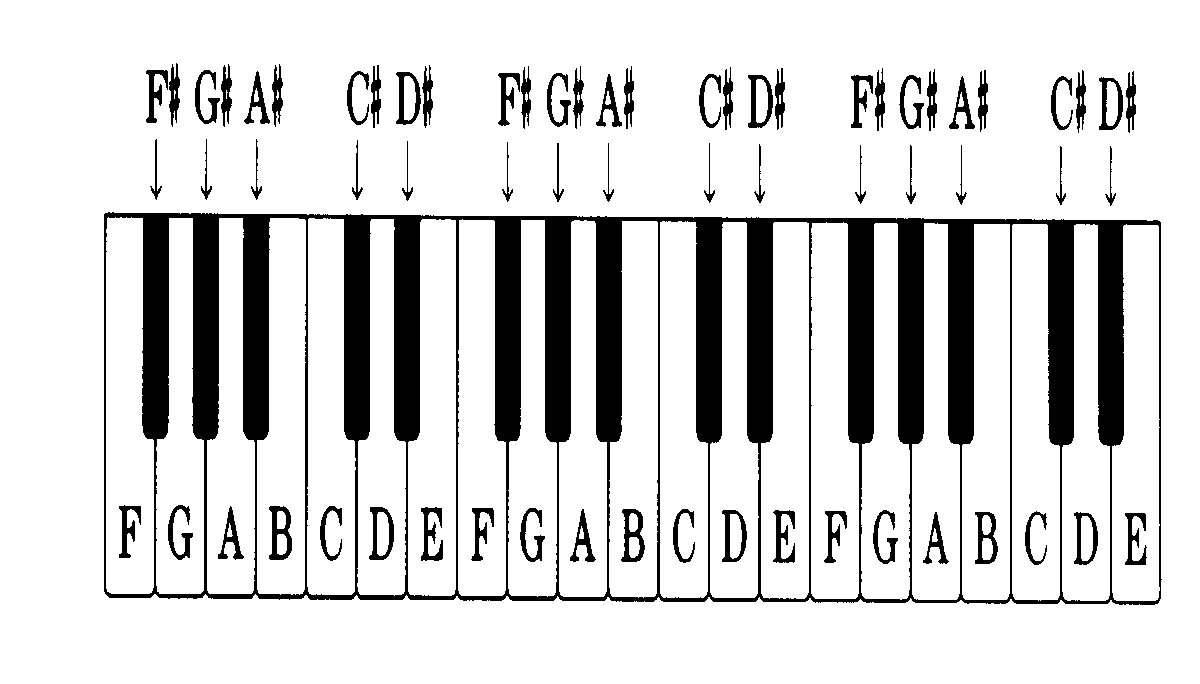
I found out today that the musical pitch the exhaust fan in my bathroom produces due to its vibration is 'E'.

For a long time I wondered how I could perfectly attune myself to any song in my bathroom. Why would I feel so comfortable singing any song in the drone of my bathroom? Today, it occurred to me that I must try and tally it with the notes on the Tanpura app that I downloaded on my mobile some time ago. And to my surprise, the resonance was the same!!

Although I am not a bathroom singer, bathroom almost becomes my singing room - not only for the bathroom tenor, but also due to the drone of the exhaust fan - Every space has a frequency! Similarly, the tubelight at Opolis architects where I used to work used to make a distinct hum. I would occassionally reach office early, and switch on the tubelights without the fans to have that resonance in the space. In the absence of any one, I would be humming along songs comfortably. I am sure it too must be on a similar pitch. 

Chaitanya had helped me find out my pitch recently when we met for a singing session. He suggested me to sing at E, which is generally the pitch for male voices. It was E! 

How interesting it is to find out such trivialities around our everyday lives. Some great coincidences! I will try to record the hum of my exhaust fan and put it here. Some great intersections of men and machines.

Till then, happy singing!

Sunday, May 13, 2012

Unfinished Poems

The following examples trace how it became more and more difficult for me to write poems as I indulged more and more into architecture. 

After finishing first year of Architecture, 2004
Rajasthan Study tour, 2006-7; On the sand dunes, Jaisalmer.


But there are many examples and I shall be embarrassed if I put them all here.
I shifted to prose over the last 8 years, gradually.
Poetry now translated into architecture.


Objectification & Nuance


notes from Chaitanya Karnik's class.
Interior Design, 2011-12

Friday, May 11, 2012

Software Photography

Often, the real world that we see around does not seem something that one would want to capture in a frame. The real world is a default mixture of colours, textures and materials. On the other hand, photography is the careful measurement of colours, textures and materials in a frame that creates & gives visual pleasure. We encounter a lot of visual content today as we live our everyday lives. Therefore, one may not always be able to find an appropriate frame to capture through a camera. Everyday lives thus secure a relegated position in our social set-ups. The aesthetic of the everyday lives is rejected since it is difficult to measure the right amount of it for a perfect visual frame.

In this context, the introduction of the handy digital cameras and further the mobile phone cameras have enabled a huge mass to experiment with visuals. In order that photography becomes accessible, what a photographer normally 'adjusts' has been converted into a kind of implicit 'code'. Thus we have phones with numerous embedded camera softwares which are able to change the captured photographs (which would otherwise hold no aesthetic value) into something that appeals everyone's eyes.

Recently, I decided to engage in these photo software applications that I downloaded on my phone over the Android Market. Having studied the effect of the photographs I took, I invariably found myself clicking everywhere around. Even the most mundane scene around me would be changed into a stunningly interesting palette. Sepia, black and white, varied frames, etc, reduce the number of decisions you need to make (regarding frame, colour, light, etc.) and yet give out interesting results.

However, looking back at the whole process, I believe the escape from colour by choosing to click pictures in a black and white mode allowed me to study 'form' in greater detail than the colour. As architects, we are always more interested in form than the colour. With colour photographs, one has to be sure if it's being taken in the right kind of light. Places become photogenic because of their natural light conditions. In some places (as I once discussed with my colleagues), the light conditions throughout are so beautiful that any frame you capture gives a pleasing result. The camera otherwise, is not able to capture always, what you see with your naked eye. That can be really disturbing. Thus, the absence of colour in a black & white photograph creates shades of greys that always supplement the content of the frame. Moreover, this mode defines the diagram of things, rather than distracting you in its visual content. Further, the softwares help emphasize this diagram by strategically enhancing the tones that heighten the sense of perceiving a picture. That is the reason why you have camera 'modes'

Thursday, May 10, 2012

Clouds

a fairy tale:

There exists very little social significance of clouds in our history. We talk of stars, we talk of planets - even the moon and others. But do we have extensive texts on the clouds?

Clouds give a much needed texture to the otherwise blue sky. Have you ever imagined the size of the sky - how big is it? It is the clouds that vanish and become the sky. Perhaps the intermediary phase between the sky and the earth (as per the big bang). They come together and go apart. They give us a focus to look at the otherwise infinite sky. We stare at clouds - deformed lumps of gas - and imagine multiple shapes through our gestalts. Sometimes fields of cotton, sometimes angels flying across, sometimes mountains or sometimes letters in the air. Clouds make us realize that we flow in time. That we move.

In summers, winters and rains, it does its job interestingly well. In its density, it consumes the scorching summer sun. Through its voids, it shows how light beams reach the earth. Through its threshold, it softens the light. In the rains, it contains water. Unlike the suns, moons or the planets, it holds no ego. It is ready to dissolve and melt. It is generous to take every one in. It leaves no room to explore. The planes dash through it. The birds fly within it.

And sometimes, they bring out unknown colours of the sky. Orange, yellow, purple - and the grey-black-white of the cloudy nights. All so titillating. It gives meaning to the 'wait' on specific festival days, by hiding the moon.

Marianna Hillmer, my German friend, after reading this post further added that I must see William Turner's paintings - and how beautifully it fits this post. Here are some paintings borrowed from various sites:


Historically, clouds have always been associated with confusion, unsurity and unclarity. They depict the storm, rough times, and unstable environment. It is only through the clouds that the sky can be moulded, twisted, skewed...Interestingly, it fits in the modern day terminologies of information technology - after the chaos theory. We today extensively use 'cloud computing' for communication purposes. It refers to a diverse set of end users that the computing caters to.

In modern plays, clouds are used to hide you, make you invisible or secretly bring up a character on stage. Thus they are associated with mystery and magic. Conceptually, they refer to something that 'appears from thin air'. They appear and disappear. Thus they allow time for magic to happen on stage.

And one could keep counting. Now am I romanticizing a bit too much?

PDF Trial

I am trying to look at options to transferring this blog to wordpress. I am bored of the formats of Blogger. I tried and found out ways to do that too, and I might do it some day. But, today I thought I must try out if I could do things that I want to do in wordpress, in blogger itself. One of them was attaching a pdf document. I did find some makeshift solution. Although I am not really happy with this ugly baby window, it serves the purpose.Try out making a sketch book by printing these papers. These grids will never let your falter in your 3d drawings!

Fore more, go to www.printablepaper.net
Grid Papers

Monday, May 07, 2012

Gift


What a perfect book to get at a time when I leave the architecture school.
Thank you Narwekar Sir.

The guilt of vacation

earlier title "On Defensiveness"


Now a days, students are extremely defensive. When you give them suggestions, they immediately have an answer that 'but i dont want to do this'. In the past few weeks I have experienced this multiple times from multiple students. Many come over the vacation to ask how they must best make the use of it. Generally I suggest them to go out an explore different programs outside the architecture school, meet people outside their domain and see if they can find any interest in things more than architecture. When I tell people that one could try photography, music or learn even sketching at home, they do not see any value in it. They discard the idea right at the outset. They portray as if they know what they want to do. But if that was the case, they would never come to seek guidance from you. Then, the questions that arise are whether they really want to engage themselves in something or whether they just want to portray that they are concerned about the free time they have and that they must make some productive use of it. 


Try giving them an option of going for an exhibition or a free film screening and they will be all ready with excuses of escaping the idea. I guess, psychologically they are looking for people with whom they can spend time chatting or gossiping. Hence they approach a number of people to talk about heir pseudo dilemma. The talk is strained and stretched through the discussion of why an how they would not prefer a suggestion you open up for them. At the end they would say: okay I will think about it; and then they would leave.


When you look back at the situation, you feel you helped someone clarify. But most of these people donot bother about the content of the long talk you have with them. Actually, they have just had a good chatting time with you. But one wonders if your suggestions have confused them or helped them towards making a decision... 


Lastly, when confused, I have always blindly followed people whom I respect and seek guidance from. I do not question my guide when I am confused myself. I agree and execute the suggestion given to me. It may so happen that you do not end up liking what you did. But the engagement definitely leaves you with an experience and some amount of skill which reflects subconsciously in any work you take up in the future.


If as students, we understand our position as students, it would be so much more beneficial. Whats the point of arguing over an aspect that we ourselves are unsure of? Or else we must make ourselves clear of our agenda to kill time during the vacation. It is legitimate to do so for vacations an must not induce any factor of guilt.

Saturday, May 05, 2012

Ando in Mumbai

Hurriedly people were called, and there were far too many people who missed the function. Still, the auditorium was full and there were quite a few people who didnot get a place to sit. Tadao Ando was in India, more specifically in Mumbai, Vikhroli - Godrej Compound. This was not the first time he was here. As Ando stated, he came to India for 8 consecutive years after 1976 to study modern architects' work in India - works of Le Corbusier, Louis I Kahn, etc. In his present visit, he was taken for a helicopter ride over the left over mangroves of the city by the Godrejs.

The anchor Parmesh Shahani informed that Tadao Ando was the only architect to have won four of the most coveted titles in architecture: The Pritzker, the Premium Imperiale, Gold Medal AIA and France. Ando spoke in Japanese, which was translated to us in English by a hurried translator. It was amusing to find that even the proper nouns that Ando took in Japanese, sounded Japanese! And I also wondered how the translator could pronounce the Japanese proper nouns in such good English! Ando presented some of his projects - two slides each. He didnot speak anything about his way of working. That is more evident in his monographs, authored by others! His monograph was on sale for Rs. 2500/- only. It sold like hot cakes. Apparently, Ando would personally sign them at the end for 20 minutes - but only the monograph, no signatures on diaries!

As I entered the lobby, I saw a bunch of Japanese delegates: all looked Andos. Ando too looked like one of them as he stood on the stage - short, meek, but sharp and crisp. After all, he's a boxer; not an architect. Well that's what he confirmed - he never went to an architecture school. The interesting aspect, or view point that he brought to the presentation was that although Japan got multiple chances to re-organize itself, it never laid any focus on building green spaces. Japan depends heavily on other countries for natural resources. Showing the picture of a Japanese city, he claimed that Japan doesnot have enough green spaces, those which have almost become landmarks in other cities like New York (Central Park) or Mumbai (Sanjay Gandhi National Park). The other interesting thing he said was that buildings bring people together.

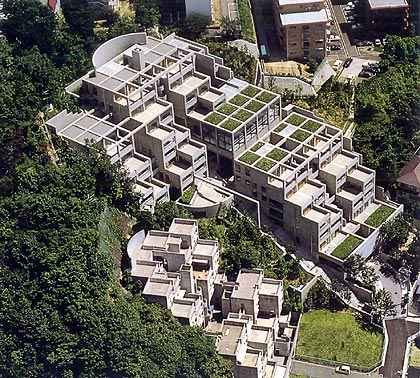
He appeared to be a frantic builder. It seems he loved to build, propose buildings. This was very evident from his subsequent proposals after he built his first project at the Mount Rokko - which too was a part of his 'building desire'. As he went on to explain the Rokko development, he said that he took up the immediate next project on Rokko hesitatingly; and the next three to placate his urge to construct on the mountain. Thus, one could call the mountain and Mount Ando instead of Mount Rokko. None of the monographs mention this aspect of his building spree. A ritualistic aspect of all big architects is to have been selected to contribute for the Olympic / Commonwealth games in their countries. Ando is selected too. He would build the stadium for the Olympics 2020 in Japan.

One can see the 4 projects Ando built on Mount Rokko in the above image


Ando kept on iterating his concern or interest for the mangroves abruptly throughout his presentation. His idea was to make it an icon of the city. Needless to say, he imagined only through what he saw. The National Park or the Mithi was never a part of his public address. The helicopter would only help him to see from the top, the place where it is allowed to hover! Anyway, I think there is a formula for a successful presentation in a foreign city. I would try to spell it out here:

1. Absorb the feel of the city you visit. Summarize the experiences of the place quickly. These experiences have to be projected as the positive aspects of the place for the people.
2. Tell the people that they are lucky to be in the kind of place they are in. Tell them that you have visited 'n' number of places in their country and thus you know about their place. This way they like you.
3. Tell the people about the negative aspects of the place you live in. This way, you strengthen point no. 2
4. Green (understood as sustainable) is the  mantra today. Tried and tested. No one would reject greenery around them. If there is nothing you can talk about, say that you are proponent of nature and trees.
5. Don't allow for questions or answers sessions. If there is one, and it goes in unexpected direction, make reference to point 1 and dissolve the conversation.

Ando did all of the above. Business.
In the end, he urged Godrejs to give him an opportunity to work with them. We heard that he would do a project for them in India!

India remains the hot spot for most architects around the world today. Some time ago, I attended a lecture on "Urban Futures" hosted by Studio X (a Columbia University initiative) inviting SOM, HOK and Perkins and Eastman to present their work. It was a disastrous event. And needless to say, Mark Wigley - the dean of Columbia (?) used the 5 points above to establish his business hold in the city / country.

Foreign architects do not understand much about the dynamics of our country and cities. They use most of us as their hands - as donkeys. We work for them because they are able to pay us a little more than what we would have otherwise earned. However, what we can definitely learn from them is professionalism. We fall in for them since they are able to give an image to our aspirations (physically). They are able to give a physical dimension to our desires. They have the technology and expertise to do so.

Thursday, May 03, 2012

Camera Fun

These days I am just going berserk with the photo tools I have downloaded on my phone. The camera(s) gives me so many possibilities and great effects that it has become almost a compulsive habit to check how something that I see in real would look through a particular effect! Most of the times, the camera makes the scene automatically look interesting. As if photography happened automatically! The black and white, the sepia tones, the old effects - all are so engrossing. I keep taking pictures just for amusement of the self! Following are pictures in different sizes, borders, shapes, colours, effects and what not! I just told to myself - rather than running away from the plethora of choices available, lets indulge! It's giving me pleasure!

I have added a lot to my photo-archive. In the past two months, the amount of photos that I have clicked have almost doubled or tripled! I don't know if this is the new camera phenomenon or the need to document. I don't think it's the latter! These photographs seldom have any documentation value. The value they may be counted for is aesthetic. But I did not create the aesthetic! It's the software at work!!


So with these effects, I started strategising. I speculate what effect would suit what kind of environment and try out various possibilities of the same frame. I haven't mastered it though! Thus I have multiple versions of the same photo! I keep them and study what goes wrong in each of them. Most of the times, it is the screw up of light. Light conditions are terrible. Sometimes, it feels to capture the frame as the eye sees it, but the camera does not see exactly like that! That is when one wonders to have a professional camera! Meanwhile, here are experiments from handy software cameras:


The production of Metaphor

The fractured evolution of modernity in developed ing countries allows for the production of a language that is not as rational as the language of modernism. In other words, the rational language of modern period remains insufficient to give a description of a developing country. This new language creates metaphors which allow poetry and infuse new meanings into spaces we inhabit. In such language lies the unclarity within which people operate tactically.


idea under construction

Institutions and their Idiosyncrasies

Institutions are intimidating. I always fear them initially. They have their own rules and codes of conduct and they expect you to know them before you engage with them. I wonder if it would be different in case we knew the conceptual operation of any institution we want to interact with. Nevertheless, the lack of knowledge that you are made to feel when you enter institutions is what makes you feel miniscule. Each institute has its own language - own terms and its own grammar. They always take advantage of this language and operate within the loopholes sometimes for their advantage.


People working in any institutions have mastered their own languages and operate in idiosyncratic ways. Sometimes they surprise you, sometimes they amuse you - but most of the times, they make you angry. This anger is towards institutionalized ways in which they behave and expect you to behave.


I have been running around banks these days to get some papers arranged for my financial records. And the more they ask me to wait for simple things, the more I get irritated. So I started recording idiosyncratic behaviours of people in bank. The following is very judgmental, sarcastic and has to be read in the frame of my mind in the bank, waiting for a simple letter stating my account balance in another currency:


"Most women in banks work like housewives. The way they handle paper, the way they write on official documents and the way they interact with machines (printers, computers, scanners, etc) is absolutely like they are cooking food. Basically they mishandle everything. The last thing they would think of is a misreading that could occur due to their bad handwriting, erasure or damage that may be caused due to their improper handling or trouble that customers may land with due to non functionality of machines. But this is not only true of women, most men too behave so. I don't know if this critique comes from my institutionalized aesthetic towards paper or because of the values instilled in me during my upbringing. But one thing that I am certain of is that the above errors I pointed out are purely functional and have no aesthetic implications. Each act at the bank involves figures which relate to money. And one may not disagree that all matters relating to money have to be handled with utmost care and discretion. 


This woman poked multiple pins in the document that she was supposed to finally hand me over. Not only that, in order to poke the pin, she folded, almost pinched and crumpled the paper spoiling its entire crease. Forget the crease, the way she put the bank's rubber stamp on the paper was so hard, that the ink blurred and the stamp print appeared like an impressionist painting. No one in their lives could ever understand which bank I hold an account with. The whole purpose of getting a bank stamp, I feel is lost. Now, it just remains as a blue stain on the paper, completely disregarding its own content and all information that lay below its ink. Inspite of sufficient white space on the paper, this woman official chooses to bang the stamp on the most irrelevant space. Banging the stamp to get an impression on a document is like a ritual - it has to be accompanied by the loud sound. Somehow I think, these officially relate a 'good' print to the loud noise that is produced while the perform the act of printing. And a compulsory part in the sequence of all this conundrum is the ritualistic mess up with the prefixes 'Mr.' & 'Mrs.' with the names. Quite obediently, this person committed this mistake too.

The handwritings of bank officials are prophecies by the pen they use. It feels as if some divine intervention occurs through the ball point of the pen. The words they write are least legible and can only be understood by who wrote it. Handwriting specialists may make theories out of such coded writing. For others, they are squiggles on the paper. Although they must be considered very valuable. It matters what transcends from the ball pen to the paper through their hand. For the bankers on the other side of the table, it's almost an ordinary job done. The value of the work is only to be understood by the client, not the worker. 


In such ways, institutions hone their staff. They perhaps employ staff who are ready to take endless pressure and perhaps express all the frustration on the tools they use or work they do. The work is an artifact - a signifier of their frustrated lives. One can curate a potential art exhibition of it! I am afraid I am not an expert. But it would involve an elaborate team of specialists, psychiatrists and artists to give more profound meaning to the otherwise quotidian work that the institution employees produce.

Saturday, April 28, 2012

Architectural Drawing: An Inquiry III

Is it out of nostalgia, the love for the past or the critique of the present, I dont know. Why do we always find our pasts comfortable than the present? This post is a continuation of the dialogue on drawing as an act. And in this section, I am thinking of the tools we used to draw, versus those used today.

I am perhaps trying to document shift in a certain kind of drawing culture. The shift has caused changes, and through my own bias, I undervalue them. Shift in culture of doing things changes values we associate with them. 

(Typing has become boring and in my note book, I make very diagrammatic notes - like concrete poetry. The interface of a blog in its conventional format does not allow it. So these days, most of my posts end up becoming very fractured and without elaboration. Pardon for that - that is also a culture shift). However, I will try to explore diagrammatic writing on this interface. 

Below is a list of activity > old tool > new tool list. All activities are related to drawing:

Activity
Old tool
New Tool
Remarks
Drawing a line
Lead wooden pencils: minimum grades
Lead wooden pencils: multiple grades
Clutch pencils with different points
Students use different pencils to draw different intensities of lines.
Sketching
Coal / Coke sticks
Charcoal pencils
The way in which one handled a charcoal stick changes, hence the way in which one draws changes
Erasing
Conventional cubic erasers
Pencil erasers
Erasing shields
Students take lesser care in the first step of drawing
Inking
Rotring pens
Microtip rotrings
Stabillo
The care taken to make edges meet is lesser. The care taken to preserve the tool is lesser.
Straight lines
Foot rule, drafter
Rolling scales, adjustable setsquares, stencils, etc
Things happen faster and the culture of cross checking dimensions is fading away.
Sharpening
Cutters / blades
Sharpeners, electronic sharpeners, etc
Sharpeners are becoming redundant with the coming of clutch pencils.


Students now carry different pencils to achieve different grades of lines. Back in our times, our professors taught us to use a single pencil to create a variety of line intensities just by correct application of pressure. Is it too late to re-instill in students this value - since the uses of using only on pencil are purely logistical - it saves the time you spend in switching tools and it saves the space the new tools would otherwise occupy. It also avoids chances if losing or buying expensive items.

Tools are always devised to overcome shortcomings. Few baseline shortcomings can be underlined as the issue of speed and the issue of facility. These ideas take larger meanings over time, than just their functional values and tools become objects to possess. 

In the remarks column, all statements point at a certain way in which value system is changing. Our ways of looking at a drawing versus the students way of looking at a drawing must be imagined through the process in which the current generation is operating. Otherwise, we may leave ourselves dissatisfied with the kind of product the students are offering us.


-----


WORKING QUESTIONS:
Do our tools control us? 
Or has the possession of these tools become a style statement?
Or are there new deficiencies of skill which have devised new tools? What does it say of our culture? Do we belong to a culture that capitalizes upon every kind of human activity - whether efficient or deficient? 

Wednesday, April 25, 2012

Newness

In the first year of architecture, it is so difficult to make students understand the idea of the 'new'. Students gyrate to nake something familiar. Something that they have already seen. Most methods to make them understand or take towards the unfamiliar are resisted. Under such cases, we see cliches. This is where the production of kitsch happens. To imagine the already seen out of some thing that has been a part of the everyday and has been used to create the seen thing earlier produces a kitsch.

The process of instilling the 'new' for us is pedagogically addressed as 'unlearning'. Unlearning is the notion of undoing thinking in the structures in which we are made to think by far in our life. At many instances I have wondered why must architects think absolutely out of the world? In the deep thoughts of our mind, we all want to be different, we all want to create different-'looking' things, we all want to create different things that what already exist. And after doing that, we want to debate about culture.

Culture heavily looks at familiarity and tries to root you in your context. Something that is completely contrasting to the above! These thoughts keep crossing my mind! It's funny, since I want to study culture to offer 'new' solutions! Sometimes, Dushyant's philosophies haunt me. But I have decided for myself that I am going to engage constructively with the material world as far as possible.

Coming back to the idea of new, we force students to create 'new' objects, often from the familiar. This is done through a series of operations from different disciplinary mechanisms. For example, we would take language, then mix it with visuals, then films and then sound and then building - all which have different languages. We basically want students to create uncanny objects - which are strangely familiar. We haven't devised enough methodologies to achieve fascinating results though.