|
“'सुरात असणं' म्हणजे काय हे माहित नसल्यामुळे ते बेसुरे असतात, की ते बेसुरे असल्यामुळे त्यांना 'सुरात असणं' म्हणजे काय ते माहित नसतं? Can tone-deaf
people ever understand that they are tone-deaf?” त्याचा दुवा मी खाली कमेन्ट्समध्ये देतोय -
त्याच्या पोस्टला अनुसरून जे सुचलंय ते इथेही लिहितोय. पोस्ट लांबलचक आहे पण जरूर वाचा. हा संभ्रम होण्याचं एक कारण असं आहे की आपण binaryमध्ये विचार करतो. सूर ‘कळणं’ ही स्वतः एक कला नसली तरी याच्या अनेक कला आहेत (चंद्राच्या असतात तशा). अनेक स्तरांवर आपल्याला सुराचं आकलन होत असतं. काही लोक असतात की ज्यांना सुराची संकल्पनाच कळत नाही. ज्या लोकांना खऱ्या अर्थी आपण tone deaf असं म्हणू शकतो. त्यांना मणेरीकर सर म्हणतात त्या प्रमाणे सुरस्थान मुळातच कळत नाही. हे लोक बहुतांशी संगीताच्या बाबतीतच agnostic असतात. मरीन जिऑलॉजीचं व्याख्यान ऐकण्यात मी जितका तग धरू शकेन तितका वेळ हे एखादं गाणं गुणगुणण्यात किंवा गायनाच्या कार्यक्रमात धरू शकतात. Aptitude नाही त्यामुळे रस नाही अशा प्रकारात हे लोक मोडतात. मग दुसऱ्या प्रकारचे लोक असतात की ज्यांच्या नेणिवेत ते सुरस्थान आहे पण जाणिवेत बिल्कुल नाही. हे लोक जेव्हा गातात तेव्हा बाहेरच्या श्रोत्याला त्यांचं गाणं बेसूर ऐकू येतं पण यांना ते सुरातच ऐकू येतं. एखाद्या रंगांधळ्या व्यक्तीला जसा लाल रंग हिरवा दिसतो त्याप्रमाणे यांना सुरस्थानं दिसतात. या संदर्भात एक रंजक कथा आहे. हिंदुस्थानी संगीतज्ञांमध्ये (musicians या अर्थी) एक जुनी परंपरा आहे. होळीच्या दिवशी प्रचंड बेसूर (पण आपण भलतेच सुरात आहोत असं वाटणाऱ्या) गायकाला बोलवायचं आणि त्याच्या गायनाचा मनमुराद आनंद लुटायचा. (ज्यांनी ‘भेजा फ्राय’ पाहिलाय त्यांना लगेच लक्षात येईल. त्यामधल्या ‘भारत भूषण’ या व्यक्तिरेखेची शास्त्रीय संगीतीतली आवृत्ती असं समजा). गाण्यातल्या जुन्या लोकांना ‘भँवरे पिया’ हे नाव कदाचित आठवेल. तर अशा एका होळीच्या कार्यक्रमात असेच एक न-गायक आले होते. सुमारे पाऊण तास पट्ट्या बदलत, बेसूर, बेताल असा त्यांनी आपला performance दिला. गाण्यातले अनेक दिग्गज त्यांच्या गाण्याची ‘मजा’ घेत होते. श्रोत्यांमध्ये पं. सत्यशील देशपांडे होते. या महोदयांचं गाणं झाल्यानंतर सत्यशीलजी मंचावर गेले आणि त्या गायकांना नेमकी काय स्वराकृती दिसत असेल याचा सुरेल तर्जुमा त्यांनी ऐकवला! तात्पर्य असं की या लोकांना आपण सुरेलच गातोय असा भास होत असतो. या लोकांना आपण बेसुरे आहोत हे कुठलाही युक्तीवाद पटवून देऊ शकत नाही कारण हे स्वतःचं गाणं वेगळ्याच मितीतून ऐकत असतात जिथे ते सुरेलच असतं. गंमत अशी आहे की यांना सुरेल लोकांचं गाणं नेमकं कसं ऐकू येत असेल हे आपण सांगू शकत नाही कारण हा अनुभूतीचा प्रश्न आहे तर्काचा नव्हे! मग पुढचा गट येतो तो मणेरीकर सर म्हणतात त्याप्रमाणे ज्यांना सुराची जाणीव असते पण मेंदूने दिलेला सिग्नल गळा ट्रान्सलेट करू शकत नाही. या लोकांना ही जाणीव असते की आपण गातोय ते सुरात नाही. हे लोकही ठार बेसुरे असतात पण त्यांना याची कल्पना असते. आता तुझा जो प्रश्न आहे तो या गटाला relevant आहे. म्हणजे आपण बेसुरे आहोत हे कळणं म्हणजे
सुरांची जाण असणं आहे का? तर याचं उत्तर आहे -
पूर्णपणे नाही! आपण बेसुरे असल्याची जाण असणं म्हणजे आपण बेसुरे असण्याची जाण
असणं. उदाहरणार्थ मला पूल बांधता येत नाही इतकाच साक्षात्कार होणं म्हणजे
इंजिनियरिंगची जाण असणं नाही तसंच आहे हे! कारण ‘सुरांची जाण’ याला अनेक प्रतल
आहेत. ही बिगरी आहे. पण गाण्याचा आस्वाद डोळसपणे घेऊ शकणं या लोकांना सहज शक्य
आहे. ऑम्लेटची चव कळण्यासाठी, कोंबडी होऊन अंडीच
देता आली पाहिजेत असं नाही तसंच आहे हे. इथपासून studied listening मधून व्यासंग वाढवता येऊ शकतो. पुढचा गट आहे की त्याला सुरस्थानं कळली आहेत पण ती गळ्यावर चढली नाहीत. हे लोक सहसा पट्टी न सोडता गाऊ शकतात पण एखादी गुगली जागा खळेंच्या किंवा हृदयनाथांच्या गाण्यात आली तर हुकतील. पण हे लोक स्वाभाविकपणे गाण्याचा उत्तम आस्वाद घेऊ शकतात. मग असा गट आहे की ज्यांना सुरात गाता येतं पण तितका रस नसल्यामुळे असेल किंवा इतर काही कारणांमुळे असेल ते या नैसर्गिक क्षमतेचा विस्तार करत नाही. आता यात एक गोष्ट लक्षात घ्यायला हवी. की गाणाराच माणूस उत्तम आस्वाद घेऊ शकतो ही अंधश्रद्धा आहे. काही लोकांचं आकलन फार उत्तम असतं पण सांगितिक articulation उत्तम असेलच असं नाही. आणखी एक गट मला फार महत्त्वाचा वाटतो. त्यांना संगीतामधलं काही कळत नाही पण त्यांच्या क्षेत्रात त्यांचं पांडित्य असतं. असे लोक (आणि हे केवळ माझं निरीक्षण आहे) फार वेगळ्या पद्धतीने गाण्याचा रसास्वाद घेतात. संगीतकार म्हणून मला अशा लोकांना माझं गाणं ऐकवायला फार आवडतं. त्यांची दाद ही त्यांच्या disciplineच्या तर्काने देत ते असतात. तो तर्क मला जाणवला तर मी कमालीचा आनंदित होतो. यात कवी, साहित्यिक, चार्टर्ड अकाउंटंट, वकील, शास्त्रज्ञ कुणीही असू शकतं. नियम एकच - आपल्या क्षेत्रामध्ये त्यांचं केवळ नैपुण्य नव्हे तर पांडित्य असावं. सारांश असा की सुरांची जाण वेगवेगळ्या लोकांना वेगवेगळ्या प्रतलावर होत असते. ती बायनरी नसून degreesमध्ये असते. यातच तुझ्या प्रश्नाचं उत्तर सामावलेलं आहे. - कौशल ईनामदार च्या वॉलवरून. |
“[Are some people] ‘tone-deaf / off-pitch’[1] because they don’t know what it means to be in pitch, or are they off-pitch and hence they do not understand what it means to be ‘in pitch’? [In simple words:] Can tone-deaf people ever understand that they are tone-deaf?” I am giving links in the comments below - I am also writing here what I have understood following his post. The post is long but worth reading. One of the reasons this dilemma arises is due to our binary mode of thinking. Even if understanding (perceiving) pitch is not an art by itself, it still has a lot of aspects to it (just like the phases of the moon). The registration of musical notes keeps happening [in the mind] at many levels. There are many people who just do not understand the concept of musical notes. These, we can call tone-deaf in the true sense. To them, as Rajendra Manerikar says, the position of the note is just not legible. Such people are largely agnostic towards music/musicality. Their interest in humming a song or in a musical programme will only be as much as I would have in listening to a lecture in marine geology! They don’t have aptitude, and hence they can’t take pleasure – that’s the way these people are categorised. Then there are the second kind of people who have the sensitivity of understanding the position of the musical notes, but not conscious about it. When these people sing, their music is off-tune to the audience, but to their ear, it seems to be in tune. They identify the position of notes just like how a colour-blind person sees red as green. There is an interesting story in this context. In Hindustani music, (in the sense of musicians), there is an old tradition. On the occasion of Holi, an extremely off-pitch singer (but assuming that one is absolutely in tune) would be called and their singing would be enjoyed to the fullest. (Those who have seen ‘Bheja Fry’ will immediately realise. Think of the character of Bharat Bhushan in it as the figure of the classical musician). The older musical people will probably remember the name of ‘Bhanvar Piya’.[2] So, in one such Holi programme, a similar non-singer had come. He gave his performance in an inconsistent, absurd manner, changing the pitches for about half an hour. The many musical veterans present were ‘enjoying’ his music. In the audience was Pt. Satyasheel Deshpande. After the gentleman’s performance, Satyasheelji went on stage and demonstrated the musical universe the singer must be imagining. Meaning, such people believe that they have been singing in tune. There is no way in which any one can convince them that they were off-pitch since they have been listening to their singing from an altogether different dimension from where it seems to them perfectly in pitch. The funny thing is that we may never be able to say how they must be perceiving the music of people who indeed sing in tune, because this is a matter of experience, not of logic. Then comes the next group, those who as Manerikar Sir suggests, are aware of the notes but whose throat cannot translate the signal given by their brain. These people are aware that what they are singing, but it may not be (or is not) in tune. These people too are far off-tune, but they have an idea of it. Now the question that you are asking is relevant to this group. Meaning, does the fact that we can identify that we are off-pitch mean that we have knowledge of music? The answer to this question is – not completely! To be able to recognize ourselves off-pitch in a given moment indicates that we may also note when we are off-pitch generally. For example, it is similar to the fact that recognizing that I don’t know how to build a bridge simply means to acknowledge that I do not have enough knowledge about engineering. Because the knowledge of musical notes has several referential bases. Knowing the notes is just the most basic requirement for music. But it is possible for such people to appreciate music with their eyes. It is just like (arguing) how in order to appreciate the taste of an omelette, you don’t necessarily need to be a chicken and lay an egg. But from this point, one can invest and expand into the discipline of studied listening. The next group is one of those who know the position of the note, but it has still not become a memory of their throat. These people can usually sing in a single pitch, but if they encounter a googly musical spot like in the songs of Khale or Hridaynath, they will fumble. But these people can naturally take great pleasure of music. Then there is a group who can sing melodiously but since they are not immersed as much or for other reasons, they are unable to expand upon their natural capacities. Now here, we must take note of one thing – to think that only the singer can take deep pleasure of music – is a blind belief. There are many people whose analysis is quite sharp but musical articulation may not necessarily be at par. There is one more group that I feel is quite important. They don’t know anything about music but they are experts in their own field. Such people (and this is just my observation) take musical pleasure in a very different manner. As a musician, I really like to present my music to them. They even offer their appreciation through the perspective of their own discipline. Learning their logic of interpretation gives me a lot of happiness. This may include a poet, literary scholar, chartered accountant, lawyer, scientist – anyone. Just one rule – if not dexterity, they must be experts of their fields. To summarise, different people register music through different referential bases. Rather than binary, it’s a range. The answer to your question is situated in this very range. -From Kaushal Inamdar’s wall *** Translation: Anuj Daga Inputs by Manas Vishwaroop |
|
|
|
[1]
In Hindustani Music, ‘tone’ and ‘pitch’ refer to the ‘quality/texture’ of sound
and the ‘accurate frequency’ of notes respectively. In western music tone also
means difference of one note. To be sure, the discussion here is about being in
pitch, an aspect referred to as ‘tone-deafness’ in western music.
[2]
Incorrectly written ‘Bhanvre Piya’ in Marathi

Aesthetics is a shared experience.
Politics has aesthetics. People who can't politicize can't produce aesthetics / beauty
Art doesn't occur before aesthetic experience.
The objectification of the experience of aesthetics is art.
Social revolution is the daughter of aesthetic revolution
Education or production of knowledge is about emancipation
thinking about the capacity of performing politics. The capacity to politicize
aesthetics as contemplation (opposite of action)
---
Architecture is a way of defining life
Architecture is supposed to define new ways of inhabitation, of defining life.
Art produces a set of relations.
I have been thinking for some time now, if the idea of the "institution" is a heteronormative concept. I have spent a great deal of time thinking about the idea of institution and institutionalization. In simple words, institutionalization would mean to consolidate any task into a systemic process. In other words it is "the action of establishing something as a convention or norm in an organization or culture." Institutions are formed through improvising upon trials and errors within a group of people to aid fool proof decision making. These are formed over long time, studied as patterns and codified into rules in order for the smooth and efficient functioning within any organization. Identifying patterns and codifying them also means the freezing of cultural actions. Institutions are often critiqued for the solidification processes. They become stronger because they are able to deal with situations through their pre-ascertained decision making. In other words, institutions are about charting certainties. They operate within firm speculations, and expect people to behave within their identified parameters. Any one who falls outside of their pattern, may become un-institutional.
These people who lie on the margins of the institutions are often called deviants, and always at the risk of societal othering, for all of society is neatly divided into multiple overlapping institutional mechanisms. Ideas like family, school, nation, and so on - all expect a subject to behave in a particular way. These are concepts that are formulated and consolidated primarily through a heteronormalized morality - that which privileges and is rested on a the idea of a future that will validate its own productive forms and logics. The family is predicated upon the idea of security of progeny and property, and is held together in economic and social rules that will disallow any deviations to the idea. The entire financial industry is structured to support this dominant notion of a relationship unit - that consists of a man, a woman and their children. Other forms of relationships are not necessarily supported as readily by financial institutions. Non-productive relationships like homosexual partners, or sorority kinships and many such other relationships do not promise the future of the institution of the family, and hence do not avail several security benefits within the present scheme of things.
Schools as institutions are expected to prepare candidates for serving different jobs within the productive world. Thus, they largely have to frame a certain picture of future for their clients, i.e. students. That you "will" become an engineer, or an architect, or a doctor - all are promises that are made at the beginning of the course. A certificate of degree is handed over to you as a document of proof. There is no real value to these certificate or degrees, for there is a fair chance for everyone to make mistakes even in their professional delivery of learned knowledge during application in real instances. Yes, institutions create this guarantee-mechanism through their own validation mechanisms that gain societal approvals. The success of these mechanisms is approved through a process of majoritarian survey. At a certain point, industry and institution tie up to co-produce these figures. Thus the cycle of institutionalization becomes impenetrable and solidified. In other words, the formula for certainty is manufactured, in a way that any genuine question regarding ethical or moral anomalies could easily be dismissed on the ground that they do not fall within the system. The language of institutions can not be penetrated easily by deviants, because deviants do not find (or may not enjoy) place within the accepted rules of the institutions themselves.
I began to write out this thought, in fact, to find a place for uncertainty within the world we exist in. What is the place of uncertainty and doubt in the environment that we come to inhabit today? If the entire world is predominantly categorized into dominant institutional frameworks for every aspect of life (that eventually becomes an industry) - how and where do we locate and plant the seeds of uncertainty? The question of ambiguity is important for several groups who have not figured out their world, or are not able to fit into the given world. These include communities of different kinds of people who feel marginalized all the time - queer, racialized, handicapped, and other such bodies for whom an institutionalized idea of the world seems alien. There is a expectation that institutions impose on subjects - to behave in set ways, to perform in identified modes, to reciprocate in assumed manners. These are tropes of certainties that lay in the idea of institutions. Institutions expect you to project a world far ahead based on the patterns and assumptions they have codified in their books. Their dispositional engagement with future is predicated on learnt certainties, which leaves very little room for unexpected events to occur. The burden of the future is thus exacerbated by institutional thinking. I hope there are more interesting ways to exist without these institutional bindings.
Under its 'Pan Scroll Zoom' series curated by Fabrizio Gallanti, the archive 'Drawing Matter' decided to publish some pedagogical reflections on online teaching during the COVID year.
The Screen Classrooms
Read full note here
OR
https://drawingmatter.org/pan-scroll-zoom-9-the-screen-classrooms/

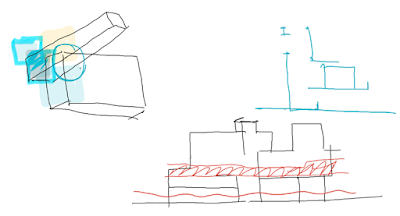
We were strolling across the older neighbourhoods of Pune in around 2017 when we came across this wonderful contemporary extension of an old house. The owner was kind enough to allow us to visit the space and take photographs.








Seeds of
phenomenology were laid in the 18th century
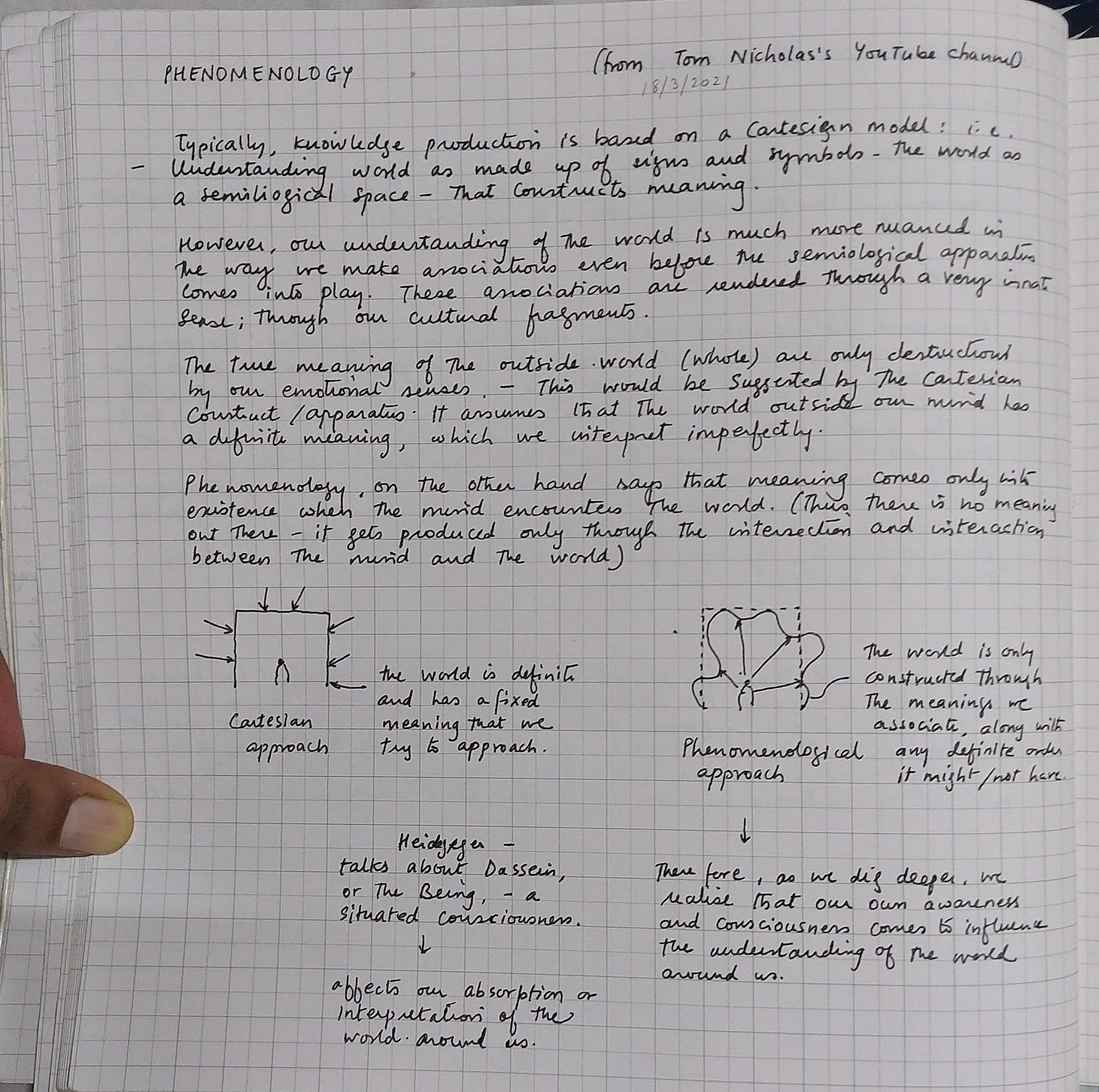
Typically
knowledge production is based on a Cartesian model, i.e. understanding world is
made up of signs and symbols – the world in a semiological space – that which
constructs meaning. (that the world is only constructed through the meanings we
associate along with any definite order it might have/not have)
However, our
understanding of the world is much more nuanced in the way we make associations
even before the semiological apparatus comes into play. These associations are
rendered through a very innate sense, through our cultural fragments.
The true meaning
of the outside world (whole) are only descriptions by our emotional senses.
This would be suggested by the Cartesian construct/apparatus. It assumes that
the world outside our mind as a definite meaning, which we interpret
imperfectly!
Phenomenology
on the other hand says that meaning comes only with existence when the mind
encounters the world. Thus, there is no meaning out there – it gets produced
only through the intersection and interaction between the mind and the world.
Immanuel Kant made a distinction between the noumenal
world of things in themselves and the phenomenal world of reality as experienced
through our senses. (in philosophy, noumenon is a posited object or event that exists
independently of human sense and/or perception.)
This was
picked up by Hegel
Then developed
by German philosopher Edmund Husserl – he was trying to develop
an objective study of the subjective study and use systematic reflection to
determine the essence of consciousness.
Understood as
the careful description of experiences in which they are experienced by the
subject to study, in Husserl’s words the whole of our ‘life of consciousness;
Although, Phenomenology
was really shaped by Martin Heidegger in his Being and Time
And
eventually that became the foundation of Sartre’s existential philosophy
and that of
School of
Phenomenology is dedicated to understanding consciousness in its raw form. It
is an experientialist philosophy rather than a rationalist philosophy (rationalist
meaning related to scientific understanding of things).
Analysis of structure
of self-experience
Husserl
talks about ‘natural attitude’ – that the word is out there, relative to
our experience, that it is just a belief
He asks what
is the structure of consciousness? Proposes a theory called INTENTIONALITY – ‘aboutness’
Articulates that consciousness cannot be an isolated thing. It is always ‘about’ something. Intentionality is the interaction between the CONTENT of consciousness and the STRUCTURES of consciousness. (Structures of consciousness include perception, memory, protention, retention, signification, amongst many others.)
How is
phenomenology mobilized> What is the methodology?
·
Bracketing: Remove all judgements, reduce all phenomena
to its rawest experience
·
Eidetic
reduction: Goal
being to find the essence of the phenomenon. Separation of the necessary part
of the phenomenon from its contingent part in order to truly understand the
essence. For Husserl, the essence is the universal scientific truth.
This is what shaped the idea of Transcendental Phenomenology.
Heidegger
was more interested in ontology, rather than universal essential structure.
He talks
about Dassein – or the Being – a situated consciousness. This affects our absorption
or interpretation of the world around us.
He believed
that experiences cannot be separated from the context in which they arise. He
proposed that phenomenology is not a science, but it is about understanding the
being itself.
This is what
is the foundation of Existential Phenomenology.


notes
According the the Brahmin systems, when we manage to stay permanently in this state of attention, with our entire mind stilled and absorbed in the Ultimate, we may achieve Release. Our nature may cease to be human, so that we are converted into an all embracing Consciousness which is at once Being and Bliss.
pg 7-8