by Aazhi Archives
at Fort Kochi
This collection of works presents the mythical realisms that emerge in the printmaking practice of artist Jagadeesh Tammineni. Tammineni juxtaposes familiar subjects that create a surreal estrangement within which several personal and political pasts and presents may be situated. His works try to offer a political commentary on the subjects of labour and longing, power and peace – held in a mood of glimmer and gloom.
Strands of Tammineni’s mythicality may be traced back to his assimilation of his father’s allied engagement with the make-up for mythological characters for traditional plays in his village, beyond the drudgery of tilling the rice field on the one hand; and the dreamlike poster-visuals of Telugu cinema seen and rehearsed in drawing during his childhood on the other. These imageries, through the filter of Francis Goya, offer him the syntax to put together his soft satires of everyday politics.
Tammineni uses animals in his works as symbolic motifs that unknowingly also create a space of empathy. As Gandhi fondles the peacock, tiger, or the cow, one is reminded of an innocence that is now entangled in the political play of identity. These animals with symbolic nationalistic status are further woven into the working apparatus of the contemporary state. The animals in these works struggle to save their appropriation within the narrative of power. In another instance, such as the head of the sewing machine doubly morphed into a bull/donkey - the cultural motifs of labour - the artist laments upon the lack of dignity workers are able to gather for themselves despite their endless toil. Such visuals comment back to the farmer and the field as much as the precarious labour on urban construction sites today.
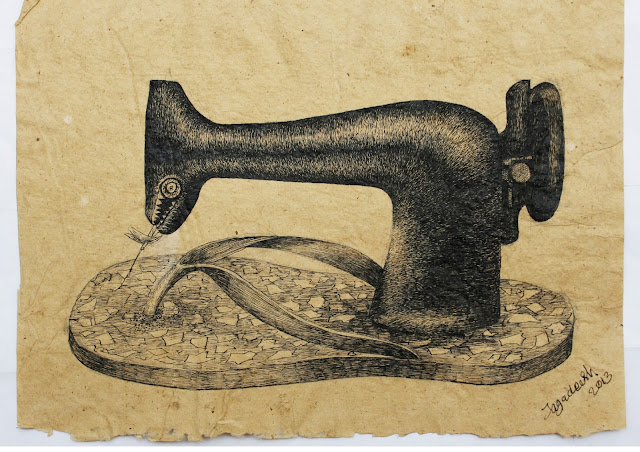
The staircase of shards, the sewing machine on a slipper, the labour and lightning, Gandhi playing with the animals – are all hope horizons that the artist impresses upon the contemporary viewer - something that is in view, but never reachable. The gentle glimmer in the chandelier not only demonstrates the masterful print-work of the artist, but also leaves us in the promise of the light that surrounds the darkness of gloom in his works.




This collection of works presents the mythical realisms that emerge in the printmaking practice of artist Jagadeesh Tammineni. Tammineni juxtaposes familiar subjects that create a surreal estrangement within which several personal and political pasts and presents may be situated. His works try to offer a political commentary on the subjects of labour and longing, power and peace – held in a mood of glimmer and gloom.
Strands of Tammineni’s mythicality may be traced back to his assimilation of his father’s allied engagement with the make-up for mythological characters for traditional plays in his village, beyond the drudgery of tilling the rice field on the one hand; and the dreamlike poster-visuals of Telugu cinema seen and rehearsed in drawing during his childhood on the other. These imageries, through the filter of Francis Goya, offer him the syntax to put together his soft satires of everyday politics.
Tammineni uses animals in his works as symbolic motifs that unknowingly also create a space of empathy. As Gandhi fondles the peacock, tiger, or the cow, one is reminded of an innocence that is now entangled in the political play of identity. These animals with symbolic nationalistic status are further woven into the working apparatus of the contemporary state. The animals in these works struggle to save their appropriation within the narrative of power. In another instance, such as the head of the sewing machine doubly morphed into a bull/donkey - the cultural motifs of labour - the artist laments upon the lack of dignity workers are able to gather for themselves despite their endless toil. Such visuals comment back to the farmer and the field as much as the precarious labour on urban construction sites today.
The staircase of shards, the sewing machine on a slipper, the labour and lightning, Gandhi playing with the animals – are all hope horizons that the artist impresses upon the contemporary viewer - something that is in view, but never reachable. The gentle glimmer in the chandelier not only demonstrates the masterful print-work of the artist, but also leaves us in the promise of the light that surrounds the darkness of gloom in his works.


