Monday, September 23, 2024

Sum up note / Shanghai Other Other Conference May 2024

on ethnographic practice


It has been a wonderful two days. And I must put a disclaimer - I dont know what to think about it but I'm probably the only person who is not a PhD person. But still and also I'm an architect, I've not done much ethnographic work, really, but still I mean, I want to say that from what I could learn from all the presentations, that it's a lot about negotiation of meaning. And what I was thinking throughout is: ‘is or isn't meaning provisional? and you know, and does meaning operate temporally in experience? Because how do we understand ethnography which is inscribed in the meaning that is the changing locus of both the subject and the object? Like what I understand today is not what I understand of this object tomorrow, and what this object is today will not be the same object tomorrow? So, you know, if the meaning of an event is continually changing with the evolving lives of the subject and object, then what do we make of a given ethnographic process or product? and this was the thought that, you know, was running in my mind.

And the second is my engagement in this, in, like, my closest association with ethnographic kind of practice, is to kind of coordinate with many kinds of people. In the sense that you know, my or even my context of other other coordinating with many others in curating. Or when i'm kind of bringing many people together to kind of understand what are the vulnerabilities they are experiencing or assuming or foreseeing in getting somewhere, doing something, and as a curator, I'm always kind of trying to help them mediate that - sometimes effectively, sometimes not, sometimes Getting into many fights, and because of lack of, you know, conversation, and I wonder if this can itself be an ethographic reflection. 

[...] and as an architect, I am trained to read spaces. And so I kind of do ethnography of spaces and objects, and I kind of like to think through Appadurai's Social life of Things or Kopytoff’s Cultural Biography of Objects, because we feel that people because we think of people as embodiment of spaces; or embodiment of spatialities and therefore I'm interested, or I also think of it as archaeology of space, or in some sense, reading space to excavate behaviors of people. So in that it is in that sense that I kind of think of ethnography and ethnographic practice. And so, you know, in that sense, i've been thinking that what other qualities than an ethnographer must possess. And what, after all, is the ambition of ethnography, you know, because we all were kind of discussing some time ago that, you know what jobs we'll do, or whether we should do academic practice, or whether or not we should join corporate spaces and stuff like that. But what do we really want to do as ethnographers? And I think in the least it can be, of whatever we want to do, it could be about culling out of concepts of space and living. You know, rather than creating regimes of control because you've seen that colonial ethnography has mostly been about controlling, and I've also been very skeptical about these Area Studies Departments that come in many Western universities, because they have, primarily, it's the historic force behind. Kind of a new colonization. So i'm always skeptical of these Area Department or area department studies, so I don't know how to think about it. But also I mean, therefore, how do we produce frameworks of alternative practice through our new ethnographic context?

So with that, I kind of invite you all to think and linger through these thoughts and bring this Bring this two day intensive workshop to conclusion and invite you for dinner.

Thursday, September 12, 2024

Bumbling Conversations / On Loudspeakers

I write this as I feel gently irritated through my quiet and unproductive day, forced to overhear the loudspeakers shouting off crass bhajans on the corner of my street junction. This street junction is always made and remade with sets for political campaigning and speeches, festival celebration, public events, street theatre - all this while it doubles up for the everyday as a katta for old people, a reading station, eatery, bus stop, hawking, and so on. But that for another day. 

Speaking back to the loudspeakers, I had quite an insight towards the insanely loud music that our festival farewells are accompanied with. Yesterday was the immersion day for those who bring Ganpati for five days during the Ganesh Chathurthi festival in Mumbai. This ritualistic procession towards the immersion is often jubiliant while people ironically chant "Ganpati gela gaavaala, chein pade na aamhaala" literally translated as "The Ganpati goes back to his place, making its people restless." To this thought one questions what precisely holds the sentiment as people organize for orchestras that can play the most upbeat songs from films when seemingly they chant of sorrow. A unique mixture of celebration and catharsis, these processions are full of people dancing, drinking in the blindness of disco lights in the no-place of the street. To a large extent, Ganesha and the festival thereof is a proxy. Much like during its inception by Lokmanya Tilak to bypass authoritarian control over public conversation, the bringing of Ganesha and the festival is an opportunity to do many other things: businessmen network in bringing partners home under the pretext of darshan of the deity, political parties campaign through posters put up around respectively funded street corners, local mandals organise youth to collect money and put together a structure, women socialise and organise their own programmes - all in all, the event is the onset for the festive season in India.  

Still drowned into the numerous discordant sounds coming from the diverse directions from the window into my years - which I certainly cannot avoid - all sounds of some form of celebration, I present this short conversation with a stranger that helped me put all of the above in perspective. 


"Its bursting loudspeakers here. Midway time visarjan. Ugh. Can't tolerate!"

"I dont like but I can tolerate."

":)  You can like it too. [just that] Its decibels should not exceed the max human beings can hear"

"Yes. Wonder what people like about it and they pay for it"

"What have these songs got to do with visarjan? All disco."

"It's become a fest / disco / all nighter for those who cannot afford / or are allowed such things.  Such things that are everyday and accessible for many of us bout for some it is luxury or rarity both. Hence I tolerate. But noise pollution yes! That's a downer."

"Ok. That's a very good perspective. You mean to say it's cathartic release for the lower classes?"

"Celebration... also and it is quite an ultimate equaliser for this city. Brings all classes together"

"I am not sure it equalizes class"

"Sab ganpati laate hain...sab visarjan karte hain. A businessman and rikshawala both at Juhu Beach with their families...feeling the same thing"

"Very interesting. Sure. I buy that!"

Wednesday, August 07, 2024

The Waiting Room

The Waiting Room is an exhibition-proposal to invite participants of the ICAS13 conference to linger through the inquiries of the research programme ‘Youth on the Move: Performing Urban Space in Global South’. Sponsored through the grant programmes of the Urban Studies Foundation since 2023, the project has grown substantially through collaborative networks and intellectual exchanges sustained through the support of French Institute Pondicherry, Humanities Across Borders and International institution for Asian Studies, Leiden and the Lagos Studies Association. ‘Youth on the Move’ investigates diverse and non linear space-time relationships that the youth inhabit and co-produce while navigating urban space across Asia-Africa. ‘The Waiting Room’ is a knowledge-sharing exhibition narrating about 50 stories of youth across Africa-Asia documented in collaboration with the growing network of actors and institutions that have germinated through the ongoing field work and across the region.

Literally, ‘The Waiting Room’ is a place within the conference through which people not only pass by, sit, idle, catch up on breath, take rest, chit chat but also note information, read stories, make connections, wander, contemplate; activating the work of imagination. Metaphorically, it indexes a host of allied practices and subjectivities through which the urban youth perform the politics of living within the global south, navigating the never fully implemented infrastructures, lack of sufficient state support or traverse desires and destinations to escape everyday anxieties. The practices invented to reconcile or circumvent these situations demonstrate modes of enterprise and meaning making, and showcase a liminal situation of becoming, thus bringing the notion of a static space, i.e. the waiting room, in dialogue with that of being on the move.

Imagined as a transitory and fragmentary portal / pavilion within the conference site, the waiting room is a receptacle of multiple temporalities in material and space that hint at the politics of (in)visibility of youth in the region of Africa-Asia. It brings viewers to consider the dialectics of youth-actions and corresponding (un)folding urbanities through stories that may offer new insights into their own practice of maneuvering their respective contexts. In the form and material held within the waiting room, visitors may engage and play, make friendships, maneuver around rules, share information - thus building agency and networks for the(ir) future.


***

In addition to the above cited institutions, the curators would like to acknowledge the academic support offered by Peking University (Beijing), Tongji University (Shanghai), School of Environment & Architecture (Mumbai), Ambedkar University (Delhi), Geoffrey Bawa Trust (Sri Lanka), DBSA Art Programme (Nairobi) as well as the local partners from Surabaya. Scholars from the above institutions shall contribute to the story-telling and participate in the round table discussion entitled “Linger Longer: Collaborative Engagement in Collecting and Narrating Young Peoples’ Stories”.


Youth on the Move Team
Anuj Daga (School of Environment and Architecture, University of Mumbai)
Min Tang (Tongji University)
Ying Cheng (Peking University)


Contributors
Advit Kalgutkar
Andrew Adigwe
Anu Sabhlok
Brian Otieno
Collective Research Initiatives Trust (CRIT)
Dream Building Service Association (DBSA)
Dimas Ijat
Dwiputra Rizkyandhani
Ennovate Dance House
Illuminate Theatre Productions
Ka Kin Cheuk
Li Dong
Min Tang
Nadya Perera
Nancy Chelwek
Nisha Nair
Nitesh Patel
Patrick Shomba
Prakriti Shukla
Pranjal Sancheti
Prasad Shetty
Rezza Lellyana
Rupali Gupte
Ryan Herdiansyah
Qidi Feng
Segun Adefila
Shambhavi Bhushan
Studio Immaterial
Tatiana Thieme
Wong Liensheng
Ying Cheng
Yusuf Avci
Zenzo Siamenda

Production
Tasyha Febrycha
Taufiq Ezha Prianto


Site Assistance
Ayos Purwoaji
Gata Mahardik

Execution
Anggie Arizal Geovanni
Gilvan Rachmadhany
Lutfiah Setyo Cahyani
Aliyya Azra Amanina
Annisa Rahmatillah
Muhammad Afif muqsith
Sarah Nur Rizqi
Nayla Dewi Putri Wardana
Happy Firnie Nur Khaila
Bryan Setya Darma

Acknowledgements
A4 Museum
Charlot Ngwenya
Deep Desai
Dimas Kuswantoro
Sunil Jambhulkar


Read more here
--


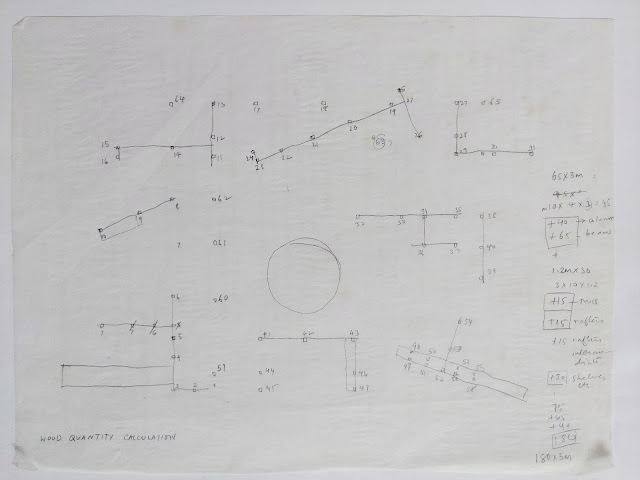
The design below was never realized as is, but was adapted to the forces of the site. the drawings below are thus, work in/from the waiting room for The Waiting Room.