Sunday, April 17, 2011
Saturday, April 16, 2011
Untitled

They make their houses quite interestingly. Using rejected collapsable shutters, jaalis, grills, etc. they make the inner reinforcement of their house, which not only becomes the railings for their windows, but also take on GI sheet claddings as wall surfaces. Red and green. The colours, which make quite an interesting collage. They fade in sun and get painted and repainted. Quite simply.
A completely utilitarian logic proportions the massing and visual aesthetic. The openings do not seem unpleasant. The slopes of each of the house give a flow - not only to the architectural fabric but also to the water that has to be drained in the monsoon.
Across the train, I always try to see beyond what my eyes can look. The scrap that makes up their domestic space may be our own...
Friday, April 15, 2011
From sky to earth
Anuj: There is something wrong about these yellow copper pods.
anuj: But they are beautiful.
Anuj: I know they are beautiful, but what goes wrong?
anuj: They look bright and spread randomly on the floor.
Anuj: Yes they do
anuj: then?
Anuj: They made a nice combination at Bharat Bhavan on the red sandstone.
anuj: Do you mean to talk about their background?
Anuj: I guess so. Yes, i think they do not deserve this silly faded pink paver blocks.
anuj: C'mon, they don't design paver blocks for flowers now.
Anuj: But why cant they? And why should the paver blocks be only diseased pink and yellow? Or the concrete grey? Do they think about what colour the paver block should be?
anuj: you've gone nuts
Anuj: Imagine how beautiful it would be to have nice backgrounds for different flowering trees. The gulmohars look lovely on black tar roads. But when they fall on pink blocks, they lose all their character. The bogen-villas - pink, white, orange, blue: they keep flying off like paper on the streets. Aren't they almost theatrical?
anuj: hmm, actually i never thought so.
Anuj: If they planted pavers according to the trees, or if they planted trees according to the pavers...they would build up a beautiful urban landscape.
anuj: then why only pavers, i would say walls too.
Anuj: yes, absolutely.
anuj: hmm...
Anuj: but we haven't finished sussing out on the paver block issue. I hate when the sweeper sweeps the yellow flowers from the college entrance floors every morning. Those lovely yellow dots, although random, call for finding a pattern. I love looking at them from the first floor large window. Why does he sweep them? His sharp toothed broom must be hurting the peltaforums.
anuj: but they dry out anyways
Anuj: Yes, and the wind would wash them away anyways. Dont you like walking on a yellow carpet of flowers, gradually turning golden?
anuj: I do, but...
Anuj: Exactly, I am talking about these dead paver blocks - they suck. They don't suit our environment. They need to be sensitively designed.
anuj: dont you think that's too small an issue.
Anuj: Unfortunately, that is what most of us end up thinking and giving up for.
anuj: okay, you can keep this thought for your future practice.
Anuj: May be. But i surely think paver blocks can respond to the trees they jacket.
anuj: sure. For now, may be you can take pleasure in watching them fall on you as you walk under the trees. The weightless flakes - you can keep in your books, if you like it so much.
Monday, April 11, 2011
Things yet to be Introduced
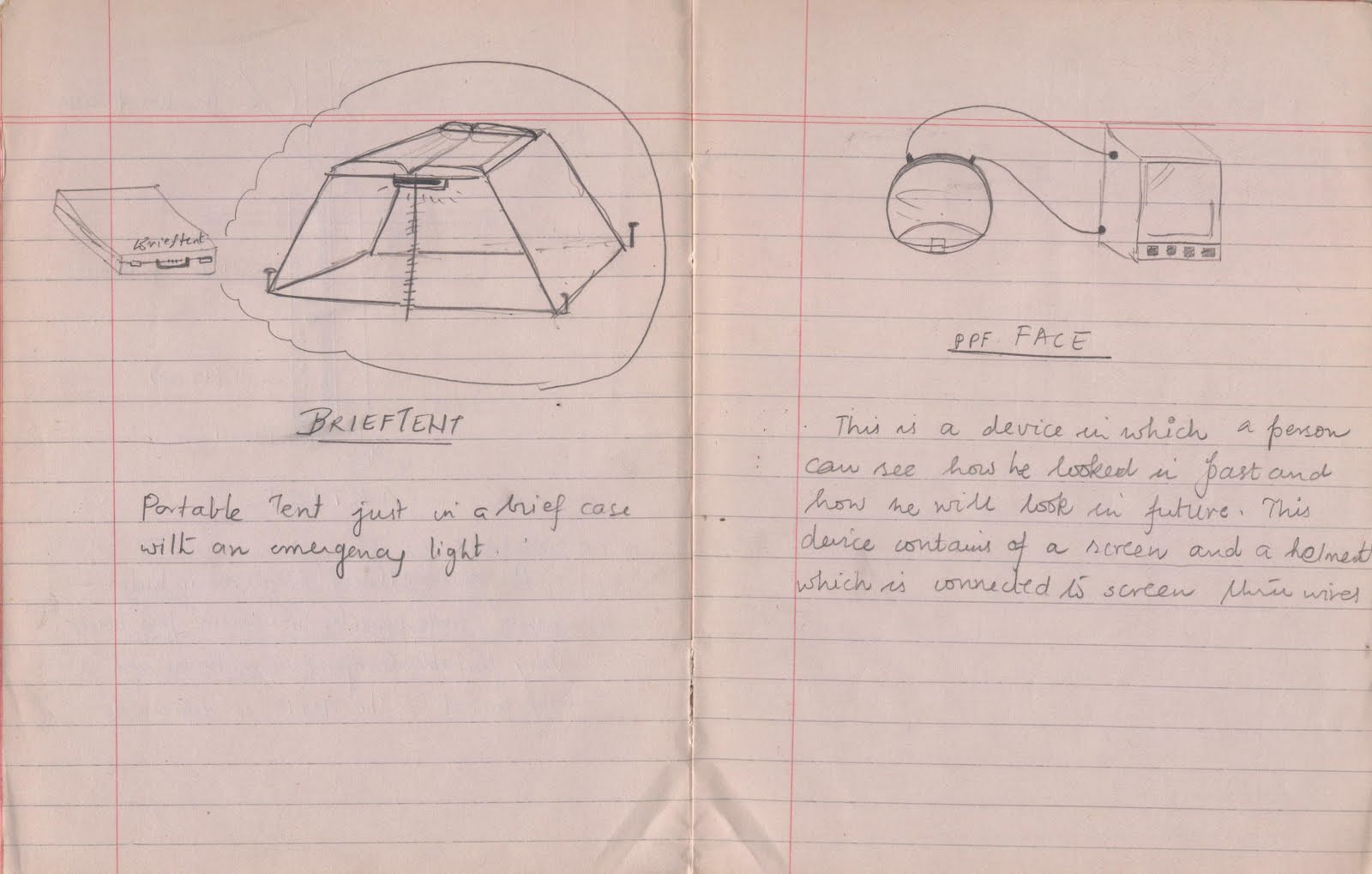
When I was about 12 years old, I used to maintain this book called "Things yet to be introduced". In this book, I used to sketch out things that might be useful, but not yet been made. I don't remember what was the inspiration for all of them? The cartoons perhaps. Also sometimes they came out of strong concerns of energy crisis. My maternal native place being Bihar (now Jharkhand), there were massive power cuts, sometimes for 5 days in a row or telephone lines would not be there for months. We used to visit our native place in summers when it would be terribly hot and without electricity, the place would be as good as hell. Some of these techniques were therefore a resolution towards these issues. Others came out of pure fascination for mechanics, or techniques or some science fundas. I used to draw them out, in plans, sections, elevations or even views. Today when I look back at them, I wonder how did I ever understand, at that age, "top view", "Section". At any stage in my drawing, I do not call them so...
Notice also the dotted lines that show displaced positions of moving parts...the nature of hard lines versus the soft (wires, cables, etc.). All of these contraptions were accompanied by a short writeup about what all they perform. Some things here might have even been introduced or been there in some other part of the world! They were only not exposed to me then!
And why would I so neatly keep them, archive them? It was the Diary of Anne Frank I guess. In 11th standard, we studied about Anne Frank and how she maintained her Diary during the Nazi war. And later all her writings were published by her father's efforts. I kept maintaining my things after that, thinking that one day all of my work will be published!!
However, what I do not understand is that why did I decide to draw (and not write)? And so accurately? And I wonder if all this was building up towards my choice to be an architect?
Notice also the dotted lines that show displaced positions of moving parts...the nature of hard lines versus the soft (wires, cables, etc.). All of these contraptions were accompanied by a short writeup about what all they perform. Some things here might have even been introduced or been there in some other part of the world! They were only not exposed to me then!
And why would I so neatly keep them, archive them? It was the Diary of Anne Frank I guess. In 11th standard, we studied about Anne Frank and how she maintained her Diary during the Nazi war. And later all her writings were published by her father's efforts. I kept maintaining my things after that, thinking that one day all of my work will be published!!
However, what I do not understand is that why did I decide to draw (and not write)? And so accurately? And I wonder if all this was building up towards my choice to be an architect?
Saturday, April 09, 2011
Surrealism & Privacy
Along with visibility, the internet also makes possible a lot of privacy. Privacy by hiding / faking. But the interesting part is that it allows privacy visibly. That's quite an interesting aspect of it. The dimensions that internet allows for the manifestation of privacy are multifarious and interesting. Taking forms of second life, alter egos. The internet thus allows a lot of reality to exist in its original form. It it was not to exist, people would definitely take on those changes onto themselves, to hide their real selves. (something like make-ups). But at the same time, we may confront ourselves in being someone else. In that confrontation lie questions of identity and self-hood.
In our architecture theory class, George Jose spoke about Bataille and the Surrealist movement in much detail. At some level, the surreal movement was quite brutal / cruel in confronting the self. I think the surrealists enjoyed the discomfort they created within people's mind (and themselves?). To discomfort is to push the boundaries of knowledge, they felt. The matrix of people that influenced each other across disciplines is also very crucial to understand how one form of knowledge / understanding transgresses into another. For the surrealist movement, it was the three disciplines of literature, art and film making. How they brooded over each other could be a real interesting study.
However, studying the works of these people will allow artistic expression of privacy that exists in the soft world. Quite paradoxical. A person who is able to confront his/her private world should be ideally very strong. I don't know if the society allows this strength. Rather, what form of strength it gets moulded in the space of the society remains an aspect to observe.
Subscribe to:
Posts (Atom)