Thursday, September 15, 2011

Implosions

I have not been writing. I have no drive to write meanwhile. Perhaps I am just in a void.
There are times when I want to draw badly - and when i take a paper, the pencil refuses to draw.
There are times when I wish to paint - but as I arrange all my materials, the paints become colourless.
There are times when I feel like writing poetry - and as I write, sentences reduce to words and letters.

Why does this happen? And why is it happening now all of a sudden - when just some days ago, I was almost regularly reflecting on everything, everyday. Am I tired or bored of it? Do I need a change? Do I need to quit what I am doing? Do I need to find a new place for myself to be in? Do I enjoy teaching? Am I doing enough  or far too much than required? Or am I too ambitious and focused? Should I just let things easy? I keep floating in this pool of questions - wading one question by another! There was a point in time when I was negotiating questions by doing things. Now, I am just meandering through them! I feel it's dangerous, scary. For some time, I feel like a weed - existing for nothing worthwhile!

Although, I enjoy completing half done things initiated by others, - when students produce sparks of ideas, and are not able to take them through, I feel like pulling their pencil, sitting on their stool and finishing off the ideas. "But those are not my ideas", I say to myself. Why am I not producing ideas? Am I really not producing ideas or have I just fed myself with too much of theory? Do I need to sit and just ruminate over all what I have read by far? I have read a bit too much i feel- it has made me very quiet, perhaps? Am I quiet? I don't know...

I keep going to the library occasionally - only to remind myself that there are so many books I haven't read yet. Today I re-familiarized with the library, and found there were so many new books...Whenever I see a new book, the only thing I think is that someone is thinking far more than myself. I am badly stuck in the sea of information. The other day, Chaitanya spoke to students in class: "This is your time to gather information, after a few years, all will make sense." I am in a phase where all information makes perfect sense to me and I don't know what to do with it! I am tired of being patient. I am tired of waiting. Wait is painful. I have to move on, and I am losing all interest to take the next step...

Its terrible - there was a time when I was upset because of my unclarity. Now I am so clear that I don't find the means to bridge huge gaps that lie towards my goal...

Saturday, September 10, 2011

Janmashtami


This time I made a tree out of newspapers. I rolled up lots of newspapers and then kept tying them up using the knot system. Basically like a cue. I kept pairing lots of papers to make a thick trunk and left the branches loose to hang down. Then I painted most parts of the tree in brown to cover up the 'news' on the tree :P.
However, lastly I got some natural fibre of the tree from the building campus and covered it up with it and some green leaves. In the process stage, it looked a really gorgeous abstract tree form - like an octopus. I had to subtle it down to appeal to my family!

Some propping of branches was required due to the weight of the leaves, but the dim lights and correct focus successfully hid all the jugaad!

Natural trees and lots of clay toys made up the forever acceptable raas-leela scene for Jansmashtami. I had a good day of experiment.  

Plaza, Dadar

Kafkaesque models


TEXT - WORDS - IMAGE - BUILDING

Over the past 3 years we have been trying to formulate programmes which translate text into a physical landscape. Our endavours to engage with text have primarily been to inculcate may aspects into the studio. A study of Adrian Forty's "Words & Buildings" will give a worthwhile explanation of how we negotiate through language to communicate intangible ideas and how they finally get understood and manifested. In such transfer of ideas from faculty to student, and student to physical form, wide gaps are created. These gaps are because of the varying levels of understanding at which thoughts are exchanged. Much of the times, these thoughts are physically manifested as literal.

I have been trying to exactly define what does one mean by 'being literal' in architecture over the past 2 years. There is one mode of explanation that I generally use.
If you say,
A = B
A = C
then make B = C,
(where A is a word, B, C is a meaning)
you will be making something literal.
Mathematical logic in equating words & meanings perhaps makes architecture literal. The words we use for communicating our thoughts in architecture can be translated literally. Much of the goof up happens in verbalizing. While faculties talk of ideas, students understand it as words and dictionary meanings.

However, in this process, we were able to generate some interesting forms - sloping, crooked, twirling, swirling, spherical, conical, biological, etc. Only that none of the forms were placed in an appropriate site context. We have to still investigate how the interaction of form and site should be instructed. An architectural form is a result of not only the externalities of context, but also responds to the interior functions. This complex process, when well balanced along with all other default parameters like light, ventilation, circulation, etc allows for a debate at the next step. In juries, we ignore much of it and still are not able to talk of architecture.

However, if I was to evaluate text-based-entries to generate design solutions, we have to care to make students aware of the following:
1. When do you choose a text to intervene in a site.
2. On what basis shall you choose the text - how do you make a text relevant for a project
3. Do you use text as meaning or as concrete poerty? In other words, how do you use the text?
4. How should you rephrase architecture as words?
5. How should your building 'read' as text?

And there are many more, but the above questions are highly complex. What we wish to do is to expose the students to reading, thereby imagination and visualization. At that level, the project does open up points of debate. A lot of effort needs to then educate oneself on exposing to a lot of text-to-visual translations.

I don't really blame students, it's too early to manage all of it together. Perhaps if we could control our ambitions and design more feasible projects, it would be better for students. Although studios would be dry then, we should be able to bring out much more interesting and promising work.

Sunday, September 04, 2011

Teachers's Day 2000

Ten years ago on this day, I was preparing for a lecture on "Biosphere" for class 9. The next day was going to be Teachers' day and students were going to pose as teachers and take a class. I was excited. Most of my classmates taught lower classes and were surprised of my choice to teach a class immediate to mine (I was in class 10 then - my matriculation year). Moreover, it was a subject handled by one of our strictest teachers in the school. However, I wasn't intimidated.

The next day was fun. We dressed up as teachers and went to classes to see how our peers performed and what responses they got from students. Later during the day, it was my class. Although many would pass of this day as waste, I conducted a serious lecture. I explained each part of the lesson using my own version of notes. Students asked questions later and I clarified each and every doubt. The jury went around classes and looked at how we conducted classes.

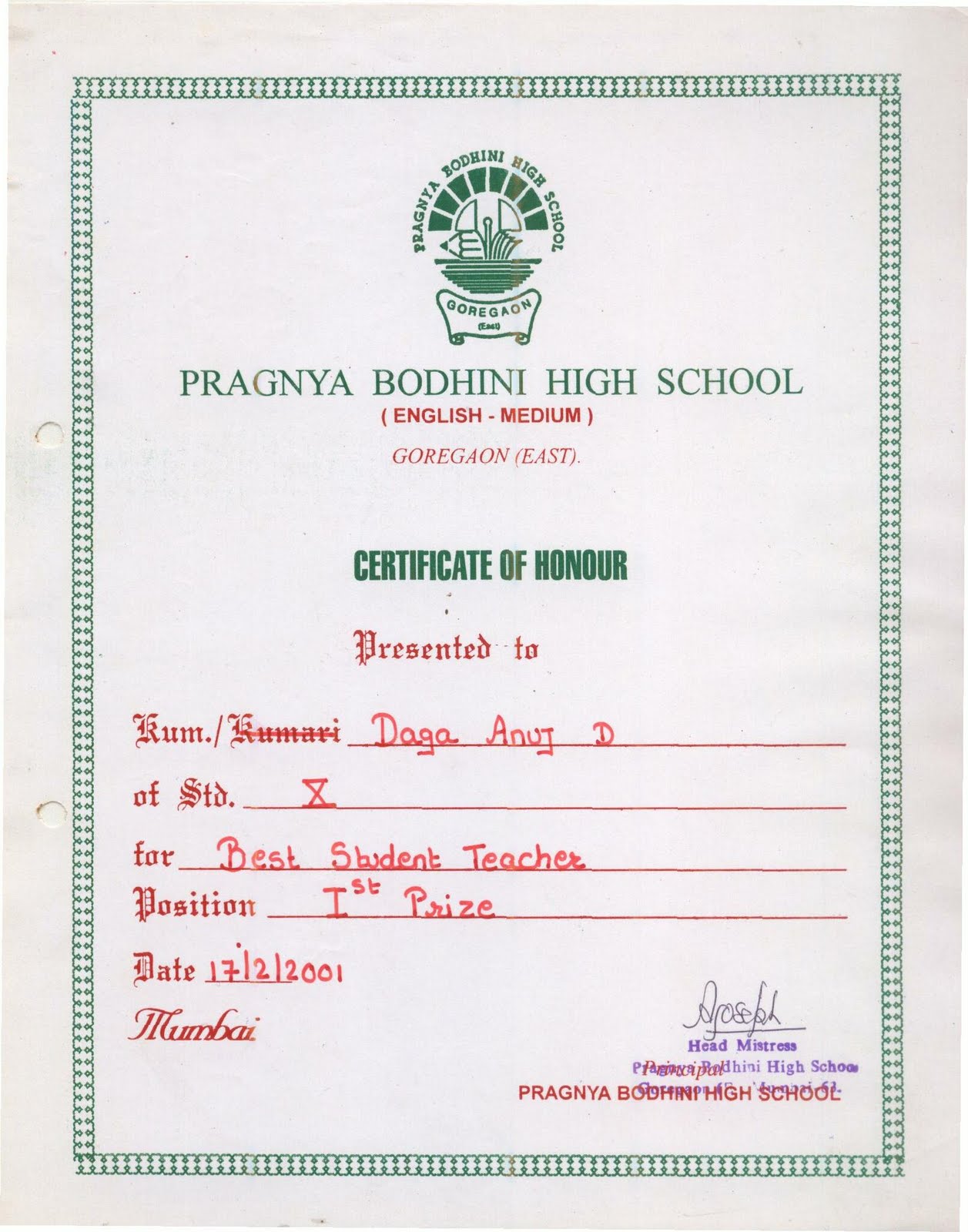
At the end of the day, results were announced. To my surprise, I was declared to be the Best Student Teacher. I was thrilled and excited. My friends were surprised of me handling class 9 being just one year senior.

The story wasn't over. I was only thinking that this was just a one sided affair. The jury felt that I conducted a good class. The next day, as I attended my regular lectures, the Geography teacher of class 9 (the strictest one, as I said before and our class teacher then), came to my class in person and shouted:

"Anuj, what have you done?"
I was scared! I asked, "Why, what did I do ma'am?"
"They are not letting me inside the class, they say they want you!" she was referring to the students of class 9.

This had  never happened in the history of our school before. Most student teachers pass off the day for fun, but I was quite passionate about it! She never taught the lesson to that class later - they only discussed questions on it. I felt truly appreciated and hence, the certificate below is very precious to me.


Perhaps there would be no better time than this to relive this part of my history. What importance do such certificates that we win during school times hold ? - probably they only gave us confidence then. But they have certainly helped / shaped our current trajectories...

Thursday, September 01, 2011

Baghban IV

In the past few weeks, I have been questioning, rather understanding the construct of the institution of Indian family. How does the Indian family work. What are its codes? What are the roles of each person in the family? How is one made/supposed to behave? What if one does not follow the codes? How does it rupture one's way of living or operating then?

If family is our first school, then a lot of rules are set up within this institution. The Indian family is very hierarchical. The hierarchy dictates the code of conduct. Essential values like respect, truth (honesty), economy are controlled by this hierarchical setup. What one must speak and how one must talk to any one is also a political construct of this hierarchy. Unfortuantely, this hierarchy continues till you die, so there is not way to peek into your parents' lives by pointing at them any questions. Questions can easily be screened through the wall of hierarchy: "How dare you ask this question?"

However, a bigger problem is that all these values conceptually conflict and contradict each other. We are taught to be truthful and honest in our childhood. We are asked to talk politely to elders. We should respect others, and all that! In the real life, these actions are guided by factors completely unknown to us. There are times when our parents themselves refute their taught value systems. Money is a funny issue! All this while, my father maintained that life was larger than money, and these days he says that money is very important in life.

A major portion of the education from family or school is imparting certain idealist values in a person. These ideals were created and suited to a certain historic time and space. Do these values work in today's world? Does the conceptual framework of the formation of ideal ideas change? Are ideal thoughts sacred? Ideals create a lot of friction in the real world. The family never addresses this issue. Why does the ideal get so much importance in our lives when it never holds true? Why are we made to believe in this apparent truth, which ceases to exist? What consolation do we seek for in honesty? I don't understand. The family has to teach a small slice of corruption or to be flexible to corruption. We don't live in an ideal space and we have to be groomed for such a space right from the beginning.

Schools have to teach us to be tactical, opportunistic! Unfortunately, we only learn this when we grow 60 years old - that knowledge conveniently classifies as wisdom! By then we already lose on all luxuries of life - then they say, be happy of the fact that you never committed a crime! I say - well, those who committed are living far comfortably! Truth is over-rated, honesty too. Yes, we do need it, but in a world like this, family values itself have to change.

History:

Baghban
Baghban II
Baghban III

This post needs more clarification and elaboration. It shall be done in subsequent time.