Sunday, April 03, 2011

Out of 'Practice'

While working on a project that I am handling after a long time today, I realised that I have become tremendously slow at AutoCAD, and that I am slowly starting to just not like doing all this. I can think designs, sketch, but drafting on CAD is like hell. I just wondered only if I had an assistant, I could just sketch and tell someone to make the changes on the computer. Gone are the days when I would be on toes and do the finer changes jhatpat! I also have forgotten so much on Sketchup!! And I am feeling terrible about it!
Atleast practice keeps you up with your skill-speed, especially when you are skilled! But on the other hand, my typing speed has increased tremendously. I learnt typing from a typing institute after my 10th standard.

Typewriter fascinated me, more so, the sound and the tension on the keys. That's what I joined the class for. To feel the typewriter. I never learnt typing the right way. The right way is to look at the paper (where you read from to type in) and the fingers on the keys. I always kept looking at the keys while typing. After all, i wanted to see the mechanism of each printed word. Something going up when i pressed the key down - hitting the black ribbon and printing the letter - it had so much of character! The black south indian lady who was the supervisor would keep telling me: "idhar nahi dekhneka" - after she went, i again gazed at the lovely machine. Due to this, I never learnt the right way to type. As years passed by, I have learnt to correctly look in the paper and type - perhaps computer as a machine is not as fascinating as the typewriter. The keyboard is a softer interface though; as compared to the typewriter. It's too passive. I liked the older keyboards which made noise (tik tik tik), the sound made you realize how well you typed. Now they have all added these silencing devices to them, so you dont hear anything.

But well, AutoCAD has gone 6 years forward from where I started and it has become as complicated or organized as MS Office 2007. Sometimes I feel scared if I will be left behind. But may be this is a question of what I consciously want to prioritize...

Saturday, April 02, 2011

Design Methods

They crave for a method. And there are very few who can teach methodologies for design.  What methods do is that they allow form-al, spatial, structural, etc. progress of design logically. Design methods can be debated (unlike designs, where personal opinions come into picture). But that's the catch - methods are a very "modern" way of working. But it might be interesting to get different structures of thought from the modern thought itself.

Design methods doesnot figure anywhere in the curriculum of architecture.  "Criticism" has been a popular way of learning design at Academy of Architecture. Somehow, the reality of practice and the ability to handle it gives the alumni of the college a lot of confidence. But we need only some one to tell them how badly most of them do it!

Academic practice can be far more rigorous if we discuss academic issues instead of the practical. The practice is all for materializing the ideas. But the academic space needs to inculcate into students how to handle ideas and let them be produced. Meanwhile, we only have black squares towering up the sky. Design methods can help breaking the monotony.


(above: placing planes that indicate movement in the site owing to interests of view, climate, function and regulating their spacing and height through logic of circulation and context. The design ended up quite differently, but at the end, there was a reasoning for everything that was placed on the site)

Thursday, March 31, 2011

Grids of the Grocer


It's not only architects or artists who deal with geometries. Geometry I think is a part of every person. When I mention geometry, I am referring to complex patterns that are made out of basic shapes. While walking across the streets everyday, I look at how vegetable vendors arrange their pyramids of tomatoes, gingers, apples or other fruits. How neatly they make bundles of chillies, gingers, spinach in a grid. How nicely, the flower vendors make groups of a handful (palm-ful) of orange flowers and cap them with a red one. How they arrange the stack of leaves overlapping each other...

I wonder how the people who make the cane baskets make a multitude of shapes out of a single thread of cane...its like a complex structure of geometry used very simply. Looking at hats, baskets, containers all made out of basic long cane, I was surprised with the intensity with which they engage with an object (which is an everyday object for them). Bamboos, and the ways they cut it to make classes, cups, boxes and a range of other products...Wires - the way they shape it up into cycles, cars, trains, etc - or plastics, take anything. There is so much of it.

On one hand, where geometry is organizational (in the way of the grid) its also something that they structure their lives around.  It is also that they make into a structure (an object). Craft is thus important. It makes you realize of what you can do with objects, and how you can build on to them.

however, what i really like is that inspite of a rigid grid, the gingers are irregular. Inspite of the unstable rolling round tomato, it makes one of the most stable structure of the pyramid!! how interesing. They do it with a lot of love, in the heat of the sun, only waiting for all those pyramids to disappear at the end of the day! A basket of things to play - keep arranging, refilling their mats -the chickoos, the bananas...how they make the most interesting patterns.

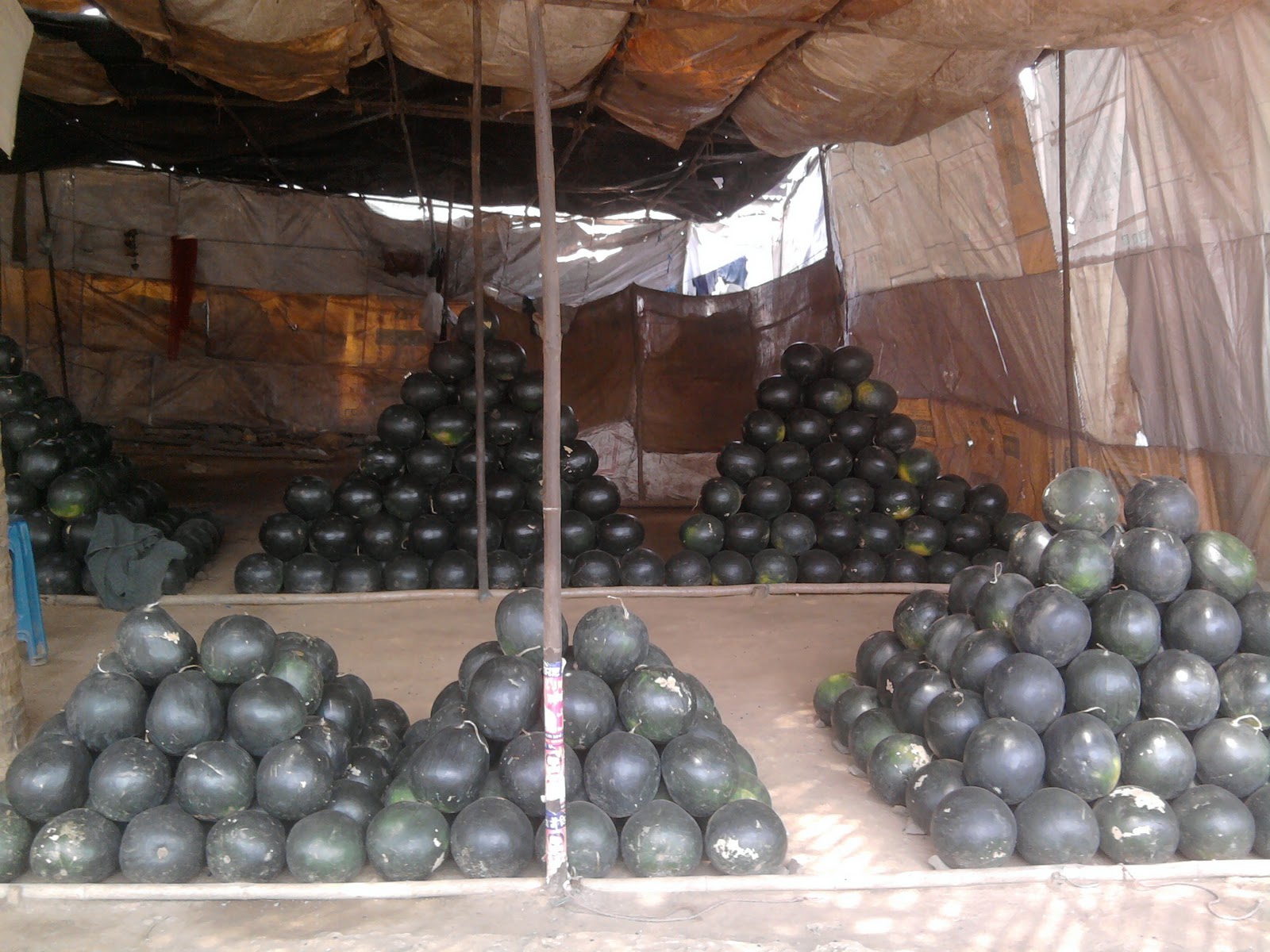
Do they do it as a pass time? Or do they create an aesthetic of display? Does it appeal to people to see shining jaamuns as a regularised mountain of equal units? Making a mountain out of watermelons - and cutting a pyramidal cone out of it only to tuck it back in its profiled section? all of it suggests so much of articulation. I think we could learn from how these people deal with geometries...For articulation, for resolution, for finding ways of economising space, for finding out how spaces in-between are created, how colours interact... all of that.
And this only came up more strongly when I sat over a student's drawings resolving his circular space structure...if only he could inform him more with things around....

err...

But i would have almost missed the point...How does the grid so naturally come to the vegetable vendor? Sometimes I wonder how would Descartes react to this!? How would Euclid react to such natural instinct of making pyramids of papayas? And was the grid practised before it was discovered? Is the cartesian grid primordial? Perhaps questions which have been answered...i could just re-thread it...

Sunday, March 27, 2011

The Interesting City

Yes,
This is what I kept forgetting.

Why is this city interesting? Why everyone is plunging into it? Why everyone wants to study it? Why is it so fascinating? Why are people migrating into it?
Any object/ thing in making is always beautiful! Look at a building being constructed and it looks more beautiful than once it would be completed. (at least that's an architect's point of view). Mumbai, I feel, is still a city in making. Unlike other cities, Mumbai still struggles for a coherent image (out of its cosmopolitan). You see buildings amidst the shanties. You see the shanties just getting transformed into slightly taller buildings, and the slightly taller being converted into larger ones. There is debris all over, there is cement, reinforcement, bulldozers everywhere. Flyovers, skywalks, trains, buses, metros, buildings - all in the process. We see it happening all around us. I think although we hate engaging in all of this, this is that we love about it.
We still have wadis, villages, beaches, padas - how could it then be a city? Just go to the outskirts - say Bhayander and you will see a gamut of adopted culture from the main city. Someone once said: "Mumbai is a village" intending to say - there is no amount of city-like civilian built form here.
Can you imagine what it means to be in a city which is still in its making? 100 years later, when its full, we will be historical. They will write on us as "these people used to take a train from Goregaon to Dadar for their work" - quite possible. No, actually what I want to bring out is that while cities like say New york or London are all almost done, Mumbai is just midway. Now that Other cities are being reacted to, Mumbai is doing it all at the same time. It is building itself, critiquing itself, reacting to itself and growing simultaneously. I think that is what makes it interesting. And in between all of this lie a group of people called "architects", "urban researchers" and the whole group of "activists" and others. Some of them one day will be known as we know of the "surrealists/dadaists/situationist" today!
The only unfortunate thing is that while the other landmark cities that we study today were widely documented, Mumbai has already become far to complex to be documented. Documentation should be available for future study. And we need to still archive a lot of it. How do we begin to even look at this city in process. Is it correct to be evaluating it while it is still in process? To be able to talk about it more confidently, there should be some intensive effort in its documentation. There should be something like a City Document Society - something like a gazzetier. The gazzatier is far too limited in terms of its methods. May be new age tools could be used to start looking and recording the place we live in.

(this post needs to be formalized)

Passing thoughts

One of the reasons why I keep earphones plugged onto my ears all the time is that there are so many thoughts that come into my head all the time that one day they would drive me crazy. As i look around myself, I feel like I could document the whole world in my own way, in the way I observe. But it's impossible. Because thoughts come and go at electrifying speed. When I listen to the music through my earphones, I am only thinking of the song, and these days, I keep analysing all songs as I listen the tunes I've loaded into my phone - for the n-th time. I keep noticing the fine tunings, the overlaps of instruments, the nuances of singers, the beats, the composers...and its interesting how I have been able to comprehend my sensibility of understanding music.

The other thing that I feel wierd about is that my friends keep reminding me about my other friends' birthdays! That's really sweet of them! I mean how considerate can friends be? I think I am quite lucky to be between such people who understand that I just can not remember dates. I was terrible at historical dates! I still am, although I love the subject now!

Shadows in summers are beautiful. I think it's very recently that many of the people around have painted their walls in bright colours. So you can see crisp metals giving amazing sciography that one would like to draw on graphics plates! Sometimes, when they overlap over each other, or sometimes when flat lines make 3-dimensional shadows on folding planes, one wonders what wonderful spaces can be created using only light and shade...

On the other hand, summers are also for mounds of watermelons, parrots on cables, copper pods on black taxis, bottles of sherbets....all of which is also colourful!

These are also the times when I am preparing to separate myself from my first closest association with students - my second year batch. And I am feeling terribly uneasy to be able to dis-associate with them! I never thought that it would be such a hard feeling of loss. But one day, even I would go...and I don't know how important I am in their course of lives anyway - I was just a coordinator at the end of the day.

Hmm, just moving on now. Far too many things that hold back, and far too many things to look forward to...