Saturday, November 19, 2011

Dead Plants and Architecture

Today morning as I was leaving home for a visit to the CST building, I saw this plant in my house which was almost dead. Perhaps this happened while we were away for a week from home for my brother's wedding. I picked up the pot from our grill and was amazed to see the beauty of the dead plant. Taking a closer look, its leaves had taken permanent shape, they were crisp brown and refused to oblige. They had become hard and adamant. The leaves curled into itself and did not open up. It felt as if the plant was very upset, angry and  looked away into itself. 

Like we say, when angry, some people look even more beautiful. I captured this beauty in my camera.


Incidentally, at CST (Chhatrapati Shivaji Terminus, Mumbai), we saw similar ornamentation on the building. The visit was quite mundane, but refreshing after a long time. For the first time, I noticed the intricate detailing of flora and fauna on the different parts of the building. Animals, birds, reptiles...all in action adorned the building. Flowers too seemingly looked at us and felt like animal figures. Water and lamp holders spurt out of animal mouths. If we only put glass cases around all of these, the station would become a zoo-ish museum...


Sunday, November 13, 2011

Architectural Design Final Jury

S Y B Arch / AOA UA

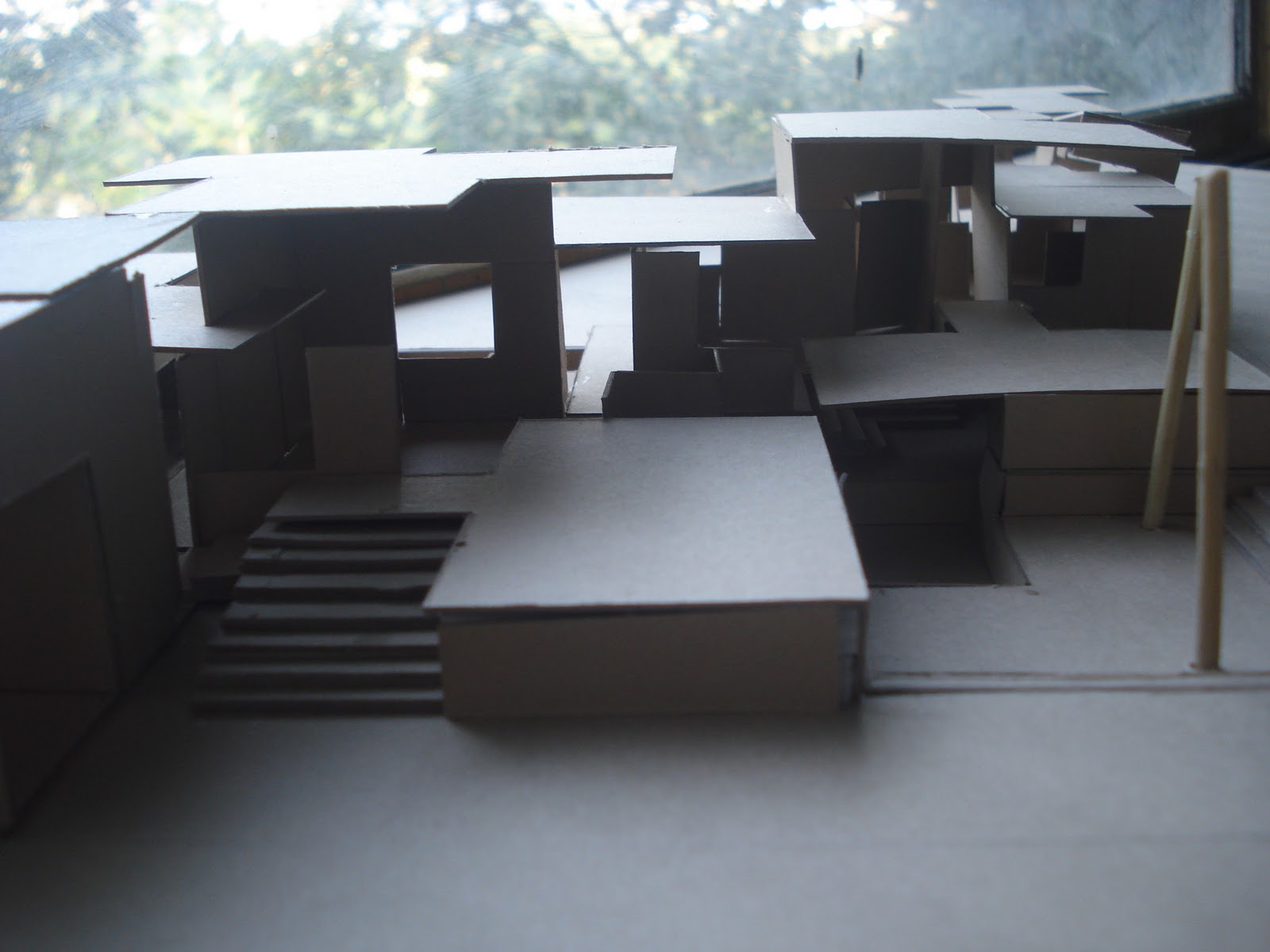
This post was due since some time now. I have managed to put together some thoughts on the final jury for the last project that happened just before the Diwali vacations for the second year students. The design problem given to them was that of a play school - students were given a site along with requirements (brief). The method chosen to execute the project was the channel of mathematics. Students were to choose / develop / explore a mathematical system / ordering principle to evolve their design. Here are my observations after the closed jury:

Overall, the quality of communication through the drawings that we were seeing throughout the process had improved. The closed jury seemed to be helpful because students understand the importance of non verbal communication and try to update their sheets with as much information as possible. Sometimes, they over do it also. We decided to have a closed door review to avoid unnecessary theorization and misplaced jargon of words. Especially with a class good at getting away with talking, we thought it would be best to avoid discussions which become cyclic and subjective arguments.

Juries get caught up in pointing out drawing errors when open. Most of us are quite distracted due to the non conformity of thought in drawing that students generally produce. The drawings do not show distinct plinths, doors, windows (openings), roofs, etc. Structures or structural systems are difficult for students to comprehend.  Most projects wanted to take an intellectual leap in terms of formulation of a completely new, original module. Students invested much of their effort and time in this process. This could be concluded on the basis of the fact that most students were reluctant to work on simple grids to begin with.

The various ways in which the brief was understood generated a range of attitudes of working across the class  Most of these design attitudes were towards generating a formal architectural language. The form, to the students, unarguably becomes the most important aspect of the design process. It is the form that the students draw. Thus, it is the drawing that makes their sheets look dynamic and interesting. It is through the drawing that they are able to show their skills in design as well as its documentation. For the student, a lot of effort goes in deciding about the presentation - the format of the sheet, colour, texture, sheet size, way of rendering etc. The drawing is an intellectual product of the studio project, equitable to the actual building in its absence. The drawing is thus the building. Designing the experience of the presentation is the real project at hand.

Thinking in space, thinking of space and drawing of space (and not form) somehow remained the lacuna of the project. It is very difficult to communicate to students, architecture's engagement with space v/s parallel cultural engagement with form. We selected 6 projects out of the 42 or so for a final pinup. (of which i remember only 5 meanwhile). The projects at hand could be seen as different ways of working / different understandings:

  1. Concept driven
  2. Process driven
  3. Geometry driven
  4. Space driven
  5. Drawing driven
1. Sujeet Pehekar / concept driven: Sujeet's work was an abstraction of the figure of a baby drawn within the shape of the site. The concept of such form was successfully broken down into smaller scaleable modules which were neatly organized in structured cross sections of open-semiopen-closed spaces. The open areas were subtly detailed and the delicacy of structure was well understood.


2. Rishad Netarwala / process driven: Rishad's work reflected the indefatigable innocent play of cut-fold module that he came up with during the initial stage of his project. This flat module which encapsulated a variety of spaces when rhythmically cut and folded became the prime generator and regulator of space. By virtue of the module, Rishad's design did not need, nor had any special openings in his building. The module folded in to building elements of the roof, wall and the plinth leaving gaps between them (as they joined) to form sky lights, semi open spaces or inner courts.


3. Shantanu Bhalla / geometry driven: Shantanu's meticulous efforts in understanding and breaking down a 5-pointed star form and thereby using it as a planning, structural and articulating principle was the merit of the project. Shantanu's struggle in deriving all possible expressions in his design using his diamond shape module without being literal resulted in a play form that played with well thought out levels and well integrated inner spaces.


4. Pranit Rawat / space driven: Pranit decided in the initial stages of his project to work with a circular geometry coupled with a square grid. Initially he produced interesting gear like interlocking spaces by virtue of his square grid off centred to the circular. However, in the process, he decided to chaff out the circular forms from the square forming an interesting spatial composition on the site. The narrative he produced by the composition of well articulated levels, planes and openings in his space was the strength of his design.

5. Sanhita Vartak / drawing driven: Sanhita enjoyed the project through the drawings she made. The project displayed exemplary commitment from the student to think about how the triangular grid would work in layout of plan, skin as well as roof forms. The completeness of the project in terms of its drawings (deliverables) and thought in design made it commendable.


There were a few more interesting projects which were not discussed due to lack of time. However, I am sure the class's standard is to go higher in drawings and non verbal communication. This is something that they have consciously realized for themselves. 

Monday, October 31, 2011

Song - Translation


Song: Suniyo ji Araj mhaari
Film: Lekin
Singer: Lata Mangeshkar
Composer: Pt. Hridaynath Mangeshkar
--

Listen, o father
a request of mine
The rains have arrived
Now, take me home

Memories of the wet court strikes
and the dry sand fills in the eyes
in my lonesome, solitary, empty eyes
spray some shower of hope

Have you forgotten having sent me to a foreign land?
call me back sending a carriage
Summon, send, call
people who can take me away

Listen, o father,
just a single request
the rains have arrived
take me back home.

Sunday, October 30, 2011

Baghban V


Parents, even if they try to, cannot live without expectations from their progeny. This is perhaps a natural instinct – a give and take relationship. There were already films in ’70s which raised the issue of children ignoring their parents while they grew old. Others sensitized the tension of difference in thought between the generations. Recent films like Baghban, Dil chahta hai, etc bring out several issues of this gap very sharply. Where does the problem actually lie? Every age is a generation, so there ought to be a generation gap in a parent and child span. 30 years.  Very few of the older generations actually are able to connect to their children. There is a change in the value systems, in the way things are understood around them and even the priorities of children change. Then how are relationships understood and expected to remain ideal? Parents always expect their children to take care of them, to support them, to help them financially. Yes, they did that for us too when we were small. But didn’t they know they had to do it anyway before having a child? Are children investments - Social, moral, financial, emotional? And when they do not give expected returns, issues spring up.

I don’t think there has been any film constructed from the point of view of the children. There is a tremendous pressure on the children itself – balancing their own ambitions, managing the family (starting a new one, and keeping the old one), etc. The argument will be: “We did that too” – to which the counter argument is “then why don’t you understand the situation? The circumstances and the complexities of life today have increased, only because the number of options available have increased.” It’s infinitely difficult to communicate this to the parents. Communication has always been a tricky issue in conventional Indian families. Most of the children fear the head of the family. Hence, all talk is routed through someone.

When children grow older, able, and self dependent, they do not understand what kind of a relationship to maintain with the otherwise head of the family. Ours is a patriarchal family system. This head of the family is generally a head primarily because he supports the family financially, according to me. Another is of course the political power that he has in the family. When this head retires, the power automatically transfers to the succeeding financial figure. But how does this new financial position get constructed? I mean, when does a son or daughter decide that he/she would start contributing money for household affairs? How are such decisions taken – these are extremely political, and what when the number of earning heads are more than one?

Education, although on one hand enables children to become more sensitive to parents, it also makes themselves more ambitious and rational. In the pursuit of rationality, children question most things – what they wear, eat, drink, live, use and even relationships. How must parents handle this? Or what should the parents expect out of such relationships? Parents try and educate their children as much as possible, but isn’t it hitting their own heads? Because children are going to be more self contained, self exploratory and self sufficient – perhaps a law of nature. Each time in each generation is a new individual constructed. This is bound to be different from the old one. But this new and old creates a lot of friction.

Someone told me that some friction is good. If a child chooses to keep his/her parents happy, is it necessary that his/her happiness too lies in that? These questions bother me all the time. My ethical stance is to keep everyone around me, related to me in any way, happy. How does that help me though? I wonder. But relationships are complex. And expression towards such relationships is very difficult. The generation gap is what perhaps makes the expression difficult. How must the parents deal with children to make them more comfortable to talk to them? May be, here I must get specific about certain kind of conventional families, where children in their formative years face this kind of extreme difficulty to convey their emotions to parents.

In traditional Indian family systems, the childhood is a period is which the child is trained in family values – social, moral, ethical codes of conduct. The aspect of communication within a family is never dealt with. The emphasis is on teaching – in a crude sense, giving. It is never believed that one could learn anything from kids. Kids are to be attuned to the society and in the process of training in social values, a lot is already lost. Moreover, while communication is not the agenda, it itself is institutionalized. Implied codes regarding what must be spoken and what not are inflicted. Sharing of emotions at a later age becomes a gestural act. Emotions are then to be understood through acts and are not really expressed. At a mature age, it is even embarrassing for most to publicly express happiness or sadness since it has either never been done before or it seems a socially misfit act.

It becomes very difficult for my father to acknowledge or appreciate me in public. He stumbles and doesnot know what to say. My mother ends up expressing her happiness by talking about it to as many people as possible – neighbours, friends, relatives, etc. On father’s promotion, a silent sweet is prepared at home. The tastefulness of this sweet is not orally acknowledged, but suggested by eating a bowl extra. During a festival, new clothes suggest happiness. Gifts on the table for success become ways to express happiness. All becomes suggestive. Such over-suggestion is repressive. It is implosive.  Objects, than something that was once emotive, become more important. This lack of communication suppresses a lot of expression.

On the other hand, during tough times, a maudlin silence pervades the atmosphere of the home. Behaviour becomes stricter. Television programmes are moderated, volume of talk is regulated. Eye contacts are stolen; everyone looks at the walls or dead vantage points. Low moods are never discussed – the feeling of vulnerability is seldom a part of the institution of the family.  The family always presumes an ideal role for itself. Perhaps it is due to its hegemonic social function of keeping all the state of affairs at home in a happy condition.
But I am very concerned about the how members of a family talk to each other. I believe that the hermetic way in which traditional Indian families behave is detrimental to furthering of social values and the problem lies in the training period of the child during early days.

This is a highly “under construction” post. Feedback is most welcome.
Earlier threads of 'baghban' can be searched at "Search This Blog" Section (Type Baghban)

Tuesday, October 25, 2011

Folds / First Year Final Jury 2011


Envelops for (from top to bottom):

1. Florist
2. Bhel Wala
3. Rat Poison Killer
4. Corn Remover

Project Brief

Body - Envelop

Students are supposed to select a hawker from their respectively studied areas and study how they negotiate their activity in space. Hawkers carry their shop with them and thus, the shop becomes the spatial envelop of the body. These shops are objects that transform into spaces while they still respond to the body. This understanding has to be developed into a portable envelope that supports the profession of the hawker and solutions that can offer more than what the hawkers currently do with their envelops.