Sunday, October 16, 2011

Folds / Readings

I was reading Deleuze's "The Fold" a week ago and tremendous ideas rolled my head. I have these phases when I heavily start interpreting students' work through the latest reading that I am doing. Sometimes, I feel it's unfair and silly. Many of my ideas and opinions are influenced by my immediate readings...

The fold opened up to me something like Einstein's theory of matter - that every particle's density can be exploded and expanded into large amount of energy. Meanwhile, I keep thinking of shrinkable spaces - spaces which fold (literally) into packets and when unfolded, become large envelops that surround bodies.Yes, although it's a very apt reference for an exercise where we are looking at hawkers, bodies and enveloping spaces, I feel I am too influenced by Deleuze's "the Fold"!

Some time ago, I was reading theories on "Diagrams" or "Diagramming" and I felt that I got carried away in understanding everything around me as diagrams. Reading Stan Allen, Tschumi and Reiser on Diagrams has been enriching and these also feed into my graphics classes. Some time ago, I was reading Koolhaas and I became very cynical of things around me. I guess readings really really engage me and change me...When as a student, I read fountainhead, I almost became a Roark! It was only until someone gave me a reality check that I realized that I had gotten unnecessarily into the character...

Reading Rosalind Krauss's papers on grids influenced me to working with grids in innovative ways, breaking earlier conventions - I designed a whole Graphics exercise on grids last year. Archigram's work influenced my drawings, sketches. Readings of David Harvey again changed my outlook to society and things around me...But readings have made me too academic and I must change the nature of my reading to lighten up a bit...

It would be, I suppose, so futile to discuss "The Fold" with the first year-ites - they don't even understand "anthropometrics" yet! I don't really have any one to discuss ideas here! So I keep listing them! What will happen to these lists I do not know! I feel, theory is an area where one grows through only discussions. I am in a world of my own references!


Globalization & Insecurity

Globalization not only creates cultural homogenization, but also induces a tremendous feeling of insecurity. This insecurity is caused due to the slow rupture of roots from one's own culture, one's own way of living and working. It is a process in which one tries to adapt some new kind of order that is imposed or set by another faculty. Globalization automatically creates minor hierarchies though destroying many others. For example, culturally, most of the developing nations accept the western ways over their natives. The idea of 'imported', or the favour to white skin, the adoption of English - all are indicators of accepting the west as superior, thereby setting an order of aspiration. The sense of not possessing many such (foreign) values creates a lot of insecurity. It challenges one's confidence in one's own culture. 

Image production capitalizes upon and nurtures itself through this insecurity. Today, the entire world is presented to us as an image - through television, internet, mobiles, photographs, etc. What we once lived as memories of distant lands are now virtually available to as as visuals. The fact that we can see and virtually experience a simulated distant reality hybridizes existing cultures thereby creating doubts in everyday living. Doubts begin through comparison and end in homogenization or flattening of cultural practices.

In universalizing English as the communication language, hasn't globalization quietened a lot of people who haven't able to cope up with change? Hasn't it paralysed people who can not use the internet? Hasn't it generated a lot of gap between the immediate generations of fathers and sons? Although people are putting in a lot of efforts to make a tool like the internet as accessible to all people, the language base it uses is still English. I am thinking of the most interesting and subtle folk traditions, cultural practices, of songs, theatre, craft - what would happen to them? We can record and keep everything, but could a Jaipur Music festival at Mehrangarh fort be experienced by images - where the fort walls are equal participants as the performers? Or can the Siddhivinayak be really worshipped on a website - where the smell of the incense or the place makes one feel transported to a new place? I am not being romantic here, what I am trying to say is images flatten our real experience, and they win over us through our insecurity. 

But why am I writing all this? Because I actually wondered why I felt so vulnerable as a college kid and almost felt lost in a whole new world that opened up after my school...It was a time which forced me to rethink my value systems, upbringing, culture - everything - it was a very difficult period. An in this insecurity, I took time to be quiet and rejected most images. I could never rationalize for myself the reasons for homogenizing....And I still haven't been able to rationalize...


Saturday, October 08, 2011

Open Jury at AOA - II

"Open Jury" event at AOA is an initiative to exchange ideas and reflections on student works across classes, departments and faculties. We had the second open jury yesterday. It was more of a review in the process stage.

The invited reviewers were to comment on students' process work. I feel it's pointless to call reviewers in process. It's like asking a pottery specialist to comment on the strength of a pot when it's still drying. Or like asking a chef when he's cutting the vegetables of how tasty the dish will eventually be...In such cases, you know what the feedback would be like.

Some classes decided to show their earlier projects. We (UA) felt that showing an earlier project right in the middle of another project is adverse on two grounds - one that you re-prepare to present your earlier project (a day spent in touching up earlier sheets) and second that you spend another day in something thats done long before and closed! So we decided not to have any special people and instead let our students see what others are doing...

Our principals like to keep the mood of the college upbeat. They keep on thinking of doing various things in college - like tamasha. I was reminded briefly of Sarita Vijayan at IAB - many said that she never bothered about the content of her magazine but kept on doing all sorts of nautanki - organizing events, seminars, launches, etc... 

The other day I met an absolutely beautiful human being - Vandana Sinh. She spoke to me of her recent participation at the NIASA awards. She was invited to a small place in the interiors of Maharashtra to choose the best architecture thesis projects amongst some 20 colleges which participated. These included city colleges along with the smaller towns. Without a doubt, the city colleges were far ahead in their thought, work and representation. The others were not even talking of issues around them...(The identity of such colleges appeared to her only later, since in the jury, the college names are not revealed). She said that she had, on perusal, absolutely rejected the entries of the smaller towns.

A girl from one of such places comes and asks her politely: "Ma'am, I wanted to know why my thesis wasn't selected amongst the final 10". Vandana looked up her file to read her comments on the girl's entry. She had written - "NO - X ". She felt absolutely guilty and without disclosing her sharp judgement, she asked the girl probably to recall her project. She then patiently spoke to her.

She then shared with me how bad she felt of her decision and judgement. She spoke of how under-exposed the kids in the smaller towns are. How un-motivating their faculties are...We spoke of our experiences of students from smaller towns (I spoke to her of my NIASA experience when I met students at Bhopal trying to take our autographs on winning the national award). We spoke of how sensitive students are, and "students are same every where", she said. She said how she would never do the mistake of rejecting a kid's work in future. But we were all very concerned of the under exposure of students in the interiors to issues and works around. Rohan (Shivkumar) once said to me (when I asked him - what's the point of organizing these seminars so frequently?) that "Anuj - students get to talk, they get to meet people, they want to meet new people"

Within these thoughts, I wanted to contextualize yesterday's jury. Our principal called fancy architects: Sanjay Puri, Ratan Batliboi, Chirag Jain etc. I wondered if there was any coherent agenda - all these reviewers are different schools of thought. What does the Academy want to think like? On questioning the team, it would be conveniently passed of as: "We wanted different points of view" - but I believe, that's an escape. We have to accept that we dont have a stand - it's always a pao bhaji - like our built environment. The physical condition of our environment is nurtured / begins at the school of architecture.

We refrained from calling any jury. Although, taking from Rohan's point, I felt, the students should absorb from others. That they might find some resonance and ideas from other panels. But I wonder how much are students from the urban areas interested in all this!? Only a few. The review would have been much successful if we called a college of Bhopal or Nashik or Lucknow to interact with ours. They would all sit together and talk to us - as a team. They would realize the value of discussions we have. Many of our kids take this time off to chew some more bubble gums and spend time at the canteen, giggle off jokes and not even note down a new comment in their books or sketch out a detail from a panel the liked, or connect to a senior on an idea, or get back to faculty on a comment he/she made...! Who is interested?

That's why I reject such grand gestures as 'tamashas'. They only feed into grandiloquent egos of our decision makers. Although they ask us for suggestions, they change or amend their decisions only peripherally to accommodate even our significant ideas - to make us feel happy! That's the kind of diplomacy I despise. So I keep myself away from meetings and suggestions. 

If this post seems to be too judgemental, I cant help it. This open jury at AOA (the second one in series) seemed least interactive to me. None of the internal faculties across departments really got time to see other work, the management is always a fuss, space was terrible (they covered up all open spaces to make them green houses, which were supported on bamboo framework that visually interjected all possible panels) - our comments muddled up in a lot of street noise - but i guess that was all desired - a part of the designed chaos. I hope the students made some meaning out of it. 

Monday, October 03, 2011

Untitled

When
I take my tongue out in the air
I can't taste it
I feel, 
Have I
lost my sense of taste
Or is the air tasteless?

When 
I plug onto my ear
the music from my earphones
I feel
Have I
merged my song with the tune
or is the city full of noise?

When 
I try to see new things around
trying to frame through various means
I feel
Have I
just turned blind
or is the space around me unchanging?

When
The sweat rolls by my forehead
to wet my temples
I feel
Have I 
worked enough for the day
or it's some hidden tension oozing out of my mind?

When 
I think of my senses
and sense my thought
I feel
Have I 
started to think too much 
or I think too much to start?


Boredom

If there is any thing that I could write here, it should be about my absolute boredom with the current state of my life. I think I am done with this city and there is nothing more Mumbai has to offer to me! Although I haven't seen the entire city, every new place I go could be categorised into some kind of generalized experience. I went to Dharavi yesterday and I didnot feel any thing different, just before that, I had been to Ghatkopar and I felt like I would feel in all typical neighbourhoods. A few days ago, I had gone to Brinda Somaya's office - yeah , that was something that made me feel as if I entered a different area, the huge walls screening of the docks and the sea. That was interesting. But over all, the fort and the suburb has nothing new to offer.

The events in the city are mundane. The fast paced life is machinic. Not that I didnot try to unwind myself: I enjoyed at Namrata (Shah's) engagement over the weekend - we danced, jumped, ate...But why would I feel bored? I wonder!

I have written off to Sen Kapadia and Vandana: Both have been extremely helpful and cooperative. I have no interest to undertake those projects now. I could have ended up in great papers on their practices. There is a sudden lack of motivation to work on it now. Project offers come and go. Design ideas don't occur to me. Studios are dull. Teaching is exhausting...

?

But I am not even working enough, producing enough...sometimes I feel I should take a sabbatic - just go to some asylum. I am wondering if I can carry it on for the next year...!?

Monday, September 26, 2011

Academics - A Fractal of Reality

I think as academicians in the field of architecture, we take more pleasure in the production of representations of the real world. We love to get beautiful work done from students on paper. We like good drawings, good models: all good looking things which are a miniature version of the real world. Do we feel happy about it being more pristine, clear and pleasing to the eye as compared to the reality around us? Are we too disturbed by the adulteration of imagination as it becomes real? What kind of a world do we live in - that of the comfortable 'experiment' space where we can change colours or materials to suit the eye. It's only about the eye. That which looks pleasing to the eye. On the other hand is writing, which can slip from within our hands...

Yes, academia produces questions, criticisms, debates. But the nature of frustration that professional practice brings is absolutely different and could completely validate the physicality of the built environment. I guess the biggest factor in profession is time - the time in which you deliver. Imaginations get crunched in this time machine. Other is the reality of economy, unfortunately. And lastly, all material things that manifest ideas. I am recalling Plato and his idea of the ideal being something that you could hold...

But I have to find stronger role of the academia in the built environment - not just that of the training. How much of training does the built environment reflect anyway? The professional any way has an different institution through which he/she operates. Its almost like brain washing - what you retain from school is only the factual knowledge. It's a pity that those who want to engage with critical questions only can teach...I am wondering if profession can allow / look beyond time, money and material...I am sure it can, and it has, but the extent is very less.

Anyway, why I thought of this was thinking of all abstractions that we make in school to make things look good. I had this habit of making models as they would look in real  - so I had really jazzy colourful models. Later I started making monochrome models - but buildings are not monochrome! And in addition, people like multiple colours on their walls...But in school, its probably all about the aesthetic, or rather am I getting too driven into it? Hmm, point to note.

Sunday, September 25, 2011

Pedagogical Deviations

Over the last year, we were experimenting with a very bottom up approach. We would give the students problems which completely throw them off and force them to question if that is what architecture was. Our projects revolved around strong theoretical ideas and issues and we were able to raise important issues through conceptual solutions that students unknowingly brought to the table. The faculty was interested in thinking with the students and I felt, it was an interesting way of working.

However, by the beginning of second year, we realized that students had no idea of scale and proportion and still drew their drawings as if nothing mattered. They had no idea of logistics of space or proportion. Staircases were randomly placed or unresolved, rooms were obnoxiously proportioned, there was no relationship between sequencing of spaces, no response to anthropometrics - something that we thought was a matter of observation. However, students failed to even think about all of it. This year, it was scary to have designs which had no idea of proportion and scale - even when questioned about it, students were in oblivion. This is when we realized that we need to address this aspect critically in our upcoming projects.

As a result, we started thinking of very pragmatic projects, limiting the scope of thinking and response. The project like the play school, which the second yearites are currently working on - is a fairly simple, infact simplistic project. Inspite of this, I do not see conceptual ideas coming through. There is a big gap in the students' mind in relating the programme with the space and user. There is no inquiry into how the user behaves. No one thought of their own childhood - all are working like scientists, trying to manifest it into a formal idea, which itself is based on very weak grounds.

If I was to say that our initial projects in first year were about form (Marrying Machines), constructability (Building out of waste), expression (Expression space) and function (Building New Grounds), in respective order, the students have completely ignored the learning out of it and infact brushed it off. It was disheartening to hear from them that they felt that those projects never addressed 'practical' design issues. I felt that was too myopic a judgement made. However, accepting their feedback, we thought we must try working with them on a practical project and see how well they receive it. It is always difficult to channelize a project without a theoretical stand point for me. The project "Playschool" does not appeal to me, because one does not know how to channelize thought. They have been asked to work out the design through mathematical principles (eg. Fibonacci, fractals, modular, etc.).

Before the mathematical principle, one has to arrive at an idea. This idea across the class is a landscape of randomness - none of the students have come up with a relevant idea, that even relates to a child, or a play school or the organization of a building. Probably what I mean is in such a project, any idea is workable - and then, how do you contextualize? None of them have yet, gone into their childhood to dig out any aspect that they could manifest into a project. But then, there are these vague ideas of working with rhymes, music, dance, sound - all of which can we dealt with in so many ways. The lack of theoretical stand point does not allow to channelize a direction specifically for this particular project.

But eventually, we are moving towards the same random design method of the old school: give a project - student brings an obscure idea - nudge it to make a project. Eventually it will become something. My problem with this is a large amount of literal translation that becomes foolish buildings in our built environment. For example: a child is like a blooming flower, so the building becomes a flower; or children like basic shapes, so the building is a concoction of triangles-circles in plan, which eventually extrudes into a cake form. That the school is a place where knowledge grows - so the graph of growth of knowledge becomes a building; that it should be a happy place, hence curved forms. Such cliches shape our physical environment and a brief like this does not address it at all, in fact, it allows them to take it forward and make it build-able. It is the academia which has to address such issues. However, that's not happening right now.

We always chalk out objectives of the project but we never evaluate at the end of the project if students have achieved them. Most of them don't. And with the current 2nd year class, they ignore much of it, rather, they question the objectives itself! That's silly. But this pedagogical shift which embraces the old school programme driven projects are disappointing and unfortunately become monotonous engagements with a singular site.

I know this post has become fussy - I am not clear on any thing mentioned here. I have not stated what is the deviation, because I am not finding the right words to articulate...but eventually I would elaborate.

Tuesday, September 20, 2011

The Architecture of Non-Reason

"Why can't architecture be illogical?" asked a student.

I answered in the classic modernist way - that architecture is not absolute sculpture - and that thus it differentiates itself from art, that it is for a function and that it has to serve a larger community. That no architect can generate buildings (event if it was for the self) without considering logistical factors. That sculpture does not have to follow rules..." and so an and so forth...
To which, another classic, but un-informed response - "But all forms work..."
I said: "Yes, you put a toilet block in the middle of the road and it shall work - but what as an architect are you offering?"

Ah! Classic statements (I have educated myself on this while I was studying in my SYB Arch fuelled by my angst regarding role of an architect and what we are supposed to do? these were explanations I was satiated with...)! However, to me this debate was outdated and it did not take us anywhere. Sometimes, students ask questions which they themselves do not believe in. (I felt so with this one)


(my problem was the misplaced question on illogic: a brief that demanded an inherent mathematical logic to arrive at a design solution must not have harboured such a question which absolutely seems a-contextual to the project method)

I have been thinking of writing on "The Architecture of Non-reason", which shall ironically be logically reasoned out. I haven't decided on how and what would I write on it. But the trigger is my recent engagement with documentation of Sen Kapadia's projects - absolutely unreasonable. One can't even call it absurd: It does not even fall into a logic of method - he makes purely a-typical objects / spaces (as he would prefer to call them). He calls them intuitive. His buildings are absolutely un-relatable, abstracted to a level where one has to struggle to make an association with the reality of the world. 

Below are some images from Sen's office - and I have purposely chosen images I do not relate to. In all images, I see the manifest of non-reason. He would never justify even if my threw my question in the most direct way. 


The architecture of non reason perhaps works through intuition. Intuitions are one time decisions. They are untamed. They appear and die, one does not make plans for intuitions, they come on their own and go away! They do not have histories and hence are free of associations. Can one justify intuitions? They are not empirical or scientific, yet correct  most times - or at least decisions made intuitively never make you feel dejected. They qualify themselves as acceptable, and certainly one can not demand explanations for intuitions.

That is how the above architect works - with the idea of non-reason. But I am still not sure if non reason is a reaction to reason. Is it the struggle to be unreasonable that one makes such alien forms? Are these objects from another planet? They certainly do not qualify as poetic formally, the look like remains of some dead object, or something that has smelted, melted, eroded, in the state of metamorphosis - non conclusive. 

However, I have to elaborate some pedagogical deviations or revisions in the next post. Meanwhile, the post has allowed me to surface some points to elaborate my argument on the idea of non reason.

Thursday, September 15, 2011

Implosions

I have not been writing. I have no drive to write meanwhile. Perhaps I am just in a void.
There are times when I want to draw badly - and when i take a paper, the pencil refuses to draw.
There are times when I wish to paint - but as I arrange all my materials, the paints become colourless.
There are times when I feel like writing poetry - and as I write, sentences reduce to words and letters.

Why does this happen? And why is it happening now all of a sudden - when just some days ago, I was almost regularly reflecting on everything, everyday. Am I tired or bored of it? Do I need a change? Do I need to quit what I am doing? Do I need to find a new place for myself to be in? Do I enjoy teaching? Am I doing enough  or far too much than required? Or am I too ambitious and focused? Should I just let things easy? I keep floating in this pool of questions - wading one question by another! There was a point in time when I was negotiating questions by doing things. Now, I am just meandering through them! I feel it's dangerous, scary. For some time, I feel like a weed - existing for nothing worthwhile!

Although, I enjoy completing half done things initiated by others, - when students produce sparks of ideas, and are not able to take them through, I feel like pulling their pencil, sitting on their stool and finishing off the ideas. "But those are not my ideas", I say to myself. Why am I not producing ideas? Am I really not producing ideas or have I just fed myself with too much of theory? Do I need to sit and just ruminate over all what I have read by far? I have read a bit too much i feel- it has made me very quiet, perhaps? Am I quiet? I don't know...

I keep going to the library occasionally - only to remind myself that there are so many books I haven't read yet. Today I re-familiarized with the library, and found there were so many new books...Whenever I see a new book, the only thing I think is that someone is thinking far more than myself. I am badly stuck in the sea of information. The other day, Chaitanya spoke to students in class: "This is your time to gather information, after a few years, all will make sense." I am in a phase where all information makes perfect sense to me and I don't know what to do with it! I am tired of being patient. I am tired of waiting. Wait is painful. I have to move on, and I am losing all interest to take the next step...

Its terrible - there was a time when I was upset because of my unclarity. Now I am so clear that I don't find the means to bridge huge gaps that lie towards my goal...

Saturday, September 10, 2011

Janmashtami


This time I made a tree out of newspapers. I rolled up lots of newspapers and then kept tying them up using the knot system. Basically like a cue. I kept pairing lots of papers to make a thick trunk and left the branches loose to hang down. Then I painted most parts of the tree in brown to cover up the 'news' on the tree :P.
However, lastly I got some natural fibre of the tree from the building campus and covered it up with it and some green leaves. In the process stage, it looked a really gorgeous abstract tree form - like an octopus. I had to subtle it down to appeal to my family!

Some propping of branches was required due to the weight of the leaves, but the dim lights and correct focus successfully hid all the jugaad!

Natural trees and lots of clay toys made up the forever acceptable raas-leela scene for Jansmashtami. I had a good day of experiment.  

Plaza, Dadar

Kafkaesque models


TEXT - WORDS - IMAGE - BUILDING

Over the past 3 years we have been trying to formulate programmes which translate text into a physical landscape. Our endavours to engage with text have primarily been to inculcate may aspects into the studio. A study of Adrian Forty's "Words & Buildings" will give a worthwhile explanation of how we negotiate through language to communicate intangible ideas and how they finally get understood and manifested. In such transfer of ideas from faculty to student, and student to physical form, wide gaps are created. These gaps are because of the varying levels of understanding at which thoughts are exchanged. Much of the times, these thoughts are physically manifested as literal.

I have been trying to exactly define what does one mean by 'being literal' in architecture over the past 2 years. There is one mode of explanation that I generally use.
If you say,
A = B
A = C
then make B = C,
(where A is a word, B, C is a meaning)
you will be making something literal.
Mathematical logic in equating words & meanings perhaps makes architecture literal. The words we use for communicating our thoughts in architecture can be translated literally. Much of the goof up happens in verbalizing. While faculties talk of ideas, students understand it as words and dictionary meanings.

However, in this process, we were able to generate some interesting forms - sloping, crooked, twirling, swirling, spherical, conical, biological, etc. Only that none of the forms were placed in an appropriate site context. We have to still investigate how the interaction of form and site should be instructed. An architectural form is a result of not only the externalities of context, but also responds to the interior functions. This complex process, when well balanced along with all other default parameters like light, ventilation, circulation, etc allows for a debate at the next step. In juries, we ignore much of it and still are not able to talk of architecture.

However, if I was to evaluate text-based-entries to generate design solutions, we have to care to make students aware of the following:
1. When do you choose a text to intervene in a site.
2. On what basis shall you choose the text - how do you make a text relevant for a project
3. Do you use text as meaning or as concrete poerty? In other words, how do you use the text?
4. How should you rephrase architecture as words?
5. How should your building 'read' as text?

And there are many more, but the above questions are highly complex. What we wish to do is to expose the students to reading, thereby imagination and visualization. At that level, the project does open up points of debate. A lot of effort needs to then educate oneself on exposing to a lot of text-to-visual translations.

I don't really blame students, it's too early to manage all of it together. Perhaps if we could control our ambitions and design more feasible projects, it would be better for students. Although studios would be dry then, we should be able to bring out much more interesting and promising work.

Sunday, September 04, 2011

Teachers's Day 2000

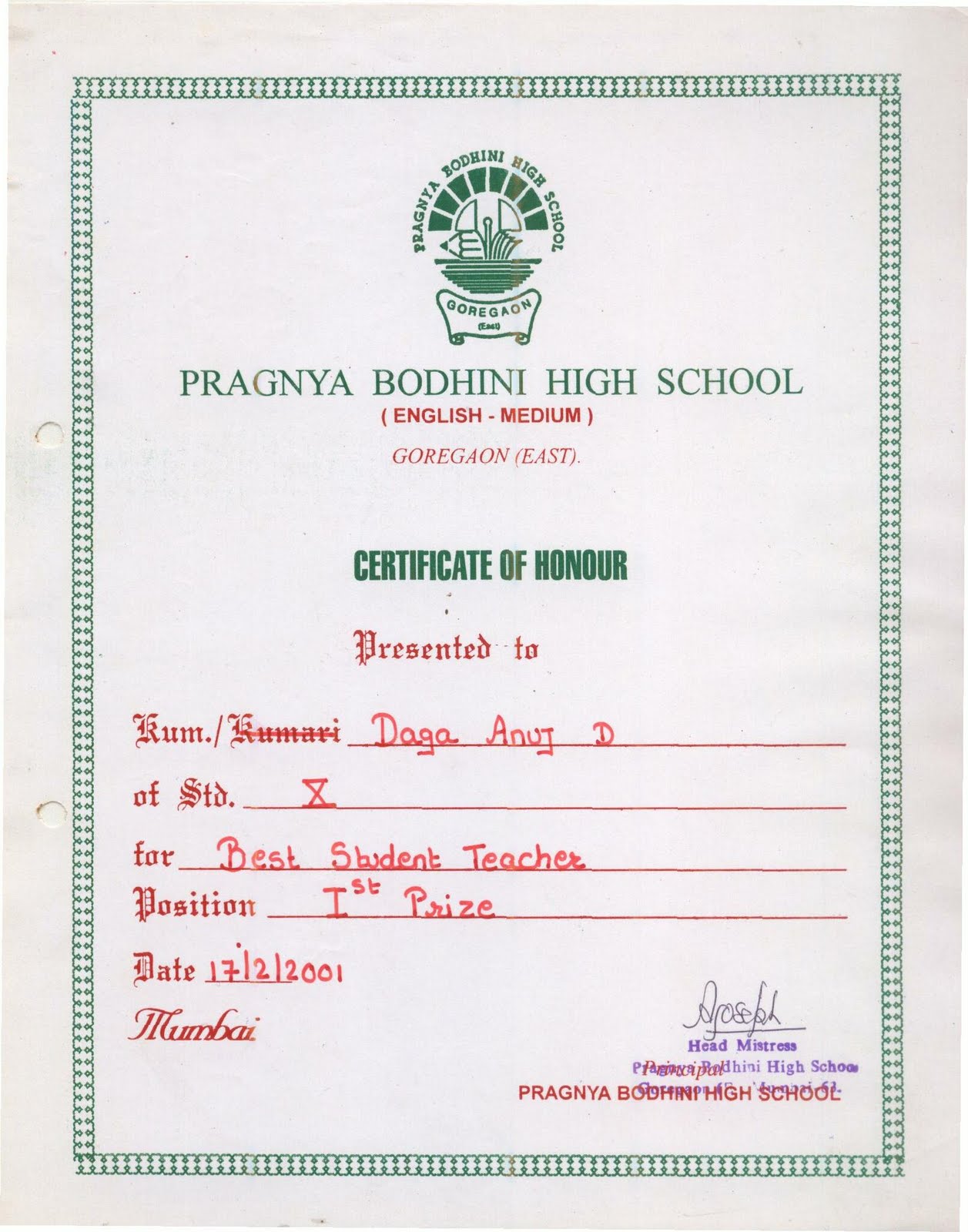
Ten years ago on this day, I was preparing for a lecture on "Biosphere" for class 9. The next day was going to be Teachers' day and students were going to pose as teachers and take a class. I was excited. Most of my classmates taught lower classes and were surprised of my choice to teach a class immediate to mine (I was in class 10 then - my matriculation year). Moreover, it was a subject handled by one of our strictest teachers in the school. However, I wasn't intimidated.

The next day was fun. We dressed up as teachers and went to classes to see how our peers performed and what responses they got from students. Later during the day, it was my class. Although many would pass of this day as waste, I conducted a serious lecture. I explained each part of the lesson using my own version of notes. Students asked questions later and I clarified each and every doubt. The jury went around classes and looked at how we conducted classes.

At the end of the day, results were announced. To my surprise, I was declared to be the Best Student Teacher. I was thrilled and excited. My friends were surprised of me handling class 9 being just one year senior.

The story wasn't over. I was only thinking that this was just a one sided affair. The jury felt that I conducted a good class. The next day, as I attended my regular lectures, the Geography teacher of class 9 (the strictest one, as I said before and our class teacher then), came to my class in person and shouted:

"Anuj, what have you done?"
I was scared! I asked, "Why, what did I do ma'am?"
"They are not letting me inside the class, they say they want you!" she was referring to the students of class 9.

This had  never happened in the history of our school before. Most student teachers pass off the day for fun, but I was quite passionate about it! She never taught the lesson to that class later - they only discussed questions on it. I felt truly appreciated and hence, the certificate below is very precious to me.


Perhaps there would be no better time than this to relive this part of my history. What importance do such certificates that we win during school times hold ? - probably they only gave us confidence then. But they have certainly helped / shaped our current trajectories...

Thursday, September 01, 2011

Baghban IV

In the past few weeks, I have been questioning, rather understanding the construct of the institution of Indian family. How does the Indian family work. What are its codes? What are the roles of each person in the family? How is one made/supposed to behave? What if one does not follow the codes? How does it rupture one's way of living or operating then?

If family is our first school, then a lot of rules are set up within this institution. The Indian family is very hierarchical. The hierarchy dictates the code of conduct. Essential values like respect, truth (honesty), economy are controlled by this hierarchical setup. What one must speak and how one must talk to any one is also a political construct of this hierarchy. Unfortuantely, this hierarchy continues till you die, so there is not way to peek into your parents' lives by pointing at them any questions. Questions can easily be screened through the wall of hierarchy: "How dare you ask this question?"

However, a bigger problem is that all these values conceptually conflict and contradict each other. We are taught to be truthful and honest in our childhood. We are asked to talk politely to elders. We should respect others, and all that! In the real life, these actions are guided by factors completely unknown to us. There are times when our parents themselves refute their taught value systems. Money is a funny issue! All this while, my father maintained that life was larger than money, and these days he says that money is very important in life.

A major portion of the education from family or school is imparting certain idealist values in a person. These ideals were created and suited to a certain historic time and space. Do these values work in today's world? Does the conceptual framework of the formation of ideal ideas change? Are ideal thoughts sacred? Ideals create a lot of friction in the real world. The family never addresses this issue. Why does the ideal get so much importance in our lives when it never holds true? Why are we made to believe in this apparent truth, which ceases to exist? What consolation do we seek for in honesty? I don't understand. The family has to teach a small slice of corruption or to be flexible to corruption. We don't live in an ideal space and we have to be groomed for such a space right from the beginning.

Schools have to teach us to be tactical, opportunistic! Unfortunately, we only learn this when we grow 60 years old - that knowledge conveniently classifies as wisdom! By then we already lose on all luxuries of life - then they say, be happy of the fact that you never committed a crime! I say - well, those who committed are living far comfortably! Truth is over-rated, honesty too. Yes, we do need it, but in a world like this, family values itself have to change.

History:

Baghban
Baghban II
Baghban III

This post needs more clarification and elaboration. It shall be done in subsequent time.

Toys

Since a long time now, I have been wanting to write a post on the kind of toys I played with in my childhood. This thought was triggered primarily by two things: the reading of Roland Barthes'  "Toys" from Mythologies and my discussion on the same some time ago with a students during the Humanities lecture. Rather, I wanted to test if my toys have really shaped me!? I thereby started to write on cartoons too. But that article is not complete yet. I  have to refine it further such that I can make it into a formal paper.

I hardly remember what were my childhood toys like! Perhaps I must have thrown them, chewed them or swallowed some of it - I dont know! The faintest memory of my first toys is a jumping chicken which my mother brought for me after I got my teeth extracted! It was a white furry chicken which lasted for a long time and needed to be keyed. Yes, there were a lot of toys which worked on keys. My uncle used to travel to foreign countries very frequently. He had then got us (my brother and me) a car each. Mine was an old style fiat! I loved it. I would keep rolling it around my axis! During 1990 we had the opportunity to go to Singapore. My parents got a lot of toys for us from there. They were mostly electronic. Electronic toys could be trusted being imported! But it was an eclectic mix - a golden robot, 2 fighting tanks, a set of cars - all of it worked on batteries! I don't remember but there must have been a lot more! We must have misplaced them here and there.

As we grew, our choice of toys became peculiar. I was drawn to more human toys, more subtle; while my brother to the  more destructive and aggressive! I had a distinct liking for teddy bears! They were quite expensive then. So my first and the only teddy bear was stitched by my mother. My aunt gifted me another one on my birthday some time later. I kept them for a long time! I also remember buying a doctor's set - I would see myself as one! It had plastic scissors, cotton, bandage, a fake thermometer - all that! I still remember it cost Rs. 28/-. We got toys only on two occasions: on getting a good result or on a birthday. There were no un-occasional toys. 

Further I invested more in the GI joes - they were really marketed well and I wanted to almost make a collection. Over 4 years, I could collect only 4 of them, through which I would weave stories and plays. Immediately then, the teddy bear became the monster due to its size...Cars were all half broken so they could carry the gi joes...I had enough material to create a setting.

Later, I invested in toys like the safari (cars going through a track), i also had "The Young Architect" and "The Mechanix". I took a game on cricket too, which i seldom played! But these were the toys through which I really experimented a lot! I would not stick only to the manuals, but would go on to make more exciting moving things. 

There is another aspect to the whole story - games: all sorts from board games to the virtual ones (video games and computer games). I had distinct liking for games. I would play games like Business or Ludo with my friend and I guess it informs my notions of 'circulation' that I use in my architectural work today. Computer games like Prince of Persia and Digger presented the world of 'sections' to me. Later as we played newer games, they appeared in perspective. Spaces revealing themselves in perspective were scary...sectional spaces were so much subtler! Games like Tetris on the video games probably taught me articulation - of fitting things together compactly. I had immense liking for racing games. I don't know if they really induced in me the idea of competition. But I developed immense amount of patience and perseverance through these games.

All such games and toys made a definite space around me - a very human like, mechanical environment. Gijoes were a great way to understand anthropometrics and mechanix taught me structure. I think these toys contributed to a lot of my architectural knowledge. I still have all my toys, well preserved - to an extent that my parents are fed up of me. I don't share them with my nephews since they would immediately break them into pieces! Although some of them have been destroyed.

But I am going to try to theorize the above! It's just a descriptive account meanwhile. Somewhere, it does make me different from my brother's aggressive nature coming from his toys like the gun, or the bat, or the WOLF or DOOM he played on computer...Hence the Barthes connect...
Don't our toys shape us!? I have been wanting to pull the idea of toys in studio, especially since Prasad Shetty mentioned it last year to which I refuted. But I guess I am going to think about it seriously to be able to understand and derive newer expressions from the idea of toys and games...lets see...

Saturday, August 27, 2011

Taj - Mumbai


Practice

Any kind of artistic practice involves so much of manipulation. There is so much to and fro in achieving an end. Take water colour for example. The artist uses washes over and over again , sucks or drops more colour and keeps on repeating the process until the desired result is achieved.

The process of repetition is the key to a rich product. Repetition allows overlay and thus gives a lot of depth to work. Depth gives multiple readings of a single work and it creates different moods during different times. Oil painters keep on mixing colours till they achieve the desired result. This process is perhaps meditative.

Architects use tracings, through which they repeat processes. Through repetition and mixing, one may layer ideas. It also involves iteration of mistakes, then correcting them. One keeps going back and forth, revising the earlier thought at each step. Thus these processes are not linear, neither cyclic. They are like eddies, which keep micromanaging themselves. Such processes give rise to techniques, which can be used in varying scales of work. 

I work on my writing like above. I first write in the crudest possible way. Probably because I think in mixed languages. Then I try giving it coherence, by first putting it grammatically correctly, then polishing sentences, words and phrases. But I purposely delay all these steps since every time I read my text afresh, I am able to refine it further. At one go, all seems fine, but in another instance, it appears terribly wrong. Many a times, I find no relevance of a plenty of texts that I once began writing. Then I realize how convoluted my mind is. I discard a lot of such texts. I also preserve a lot of such texts, only to laugh at my silliness. But when I look back, I can estimate how far have I come. And this is the reason why archives are important. They allow to trace trajectories.

Thursday, August 18, 2011

The Discourse of Form

"The discourse of architectural form has become obsolete...who talks of form today? The debate on form is an old issue now,"

"India has not entered, or even managed to enter the discourse of architectural form" - I discussed with the new team of Architecture Design first year. The debate was about the role of form in architecture.

India-trained architects immediately understand form as "iconic" and label it as pejorative. In Indian context, I think the idea of form itself is borrowed. The emphasis of space in Indian architecture is so strong that we fear to deal with ideas of form. Formal responses in architecture have never satisfied the community in India. They have only served the craving for aesthetic or beauty, or otherwise invited a lot of criticism for a-contextual responses. Indian architectural community has not successfully placed a form that generated a dialectic - an argument in a mature architectural sense. All bold forms here can be so easily classified as copied or adopted.

Vernacular has become a style, instead of a cultural manifest. Why doesn't present cultural condition fuel the design of form in architecture? Why don't cultural processes shape form? They are either expressionistic or reproductions of the past. Do buildings talk to each other in the city? We have not, in the real sense, explored the function of architecture as a formal message... Architecture has so much potential to communicate in space. How does Antilia talk to Kanchunjunga? How do buildings in the IIT campus talk to each other? How do the tall buildings respond to each other? Do our cultural institutions talk to each other? All architects are only writing off buildings. Statements is not the way I want to talk of form. In fact, I am talking of form as response in 3-dimensional space. What meanings do forms hold? Can we tap them? Can we play with the imagery, yet be spatial? Any debates, disconnects...post here...

Post buildings, we shall discuss...

Wednesday, August 17, 2011

Sketches - Ideas


Most of the above sketches are states of the mind. These are done over the last 2 years randomly and I am only putting them here as a memory of the past.
In order: (Sketch / Idea)

  • Glass within a glass / Overflowing desire
  • Branches / Directions
  • Water Level Balance / Manipulation
  • Balloon & Knot / Holding nothing
  • Knot Study / Obstruction
  • Street USB 
  • A chance encounter between an umbrella and a sewing machine.
  • Lemon Cut / Abstraction