Wednesday, April 20, 2011

Mango Madness

I have been enjoying gazing at the growing mangoes on the mango tree in our college campus since the past few weeks. The green raw mangoes solely hanging from the tensioned branches of the trees look extremely tempting. For a long time I wondered whether it looks better on the tree, or if it would be nicer to touch, feel and smell it. A lot of koyals keep on singing these days and none of the crows have disturbed any of the fruits on the tree. Finally, Nandu broke his barriers of temptation and hit the closest hanging fruit from our second floor staff room balcony.


The raw green fruit dropped down on the fabric canopy, rolled onto it and fell in the bushes below. Nandu ran down like gushing water to pick it up. He came back with a big green orb. I wondered how big it was as compared to what I assumed it to be from a distance. We placed it on the table and let it roll. Both Nandu and I kept looking at it  - finally I grabbed it and felt it, its smoothness, its curves, its texture, its skin...


We thought of showing it to all - as if it was a wonder of the world. We discussed its shape and compaed it to the ones we draw in our drawing books - we argued if it resembled the haapus (alphonso) - and both agreed that  it was not that perfect. Still, we were not able to comprehend its beauty and our wonder - taking the king of fruits - and the first one of the season in hand. So I suggested we display it for some time. Nandu was extremely eager and enthusiastic about it. He quickly arranged for a glass and filled it with water. I  felt there was something missing in it: may be more colour. He then got some leaves and flowers from here and there and we almost made it into a momento...


Then we all enjoyed staring at it, praising the fruit and preserving it for some time. But finally, Nandu couldnot resist his gustatory urge and he cut it into slices, soon distributing it to everyone around. It was as if beauty (in all forms) has to be destroyed and finally digested.

We all ate a slice of it.
But memories of mangoes (especially the ones you pluck from the trees on your own) are nostalgic and mango trees inevitably take you to your childhood, if you ever flirted with the trees when you were young.

Monday, April 18, 2011

Building New Grounds

FIRST YEAR ARCHITECTURAL DESIGN
Atul Mhatre | Akhil Kapadia | Anuj Daga | Rohan Haksar                                          
Project 4
----
Architecture’s preoccupation with land as its primary resource for operation has led to sharp rise in the density of built form in cities. Mumbai’s land resource has almost been exhausted due to immense pressure of development. This has resulted into either creation of more land (by ways of reclaiming the sea) or sourcing alternative land on the outskirts of the city. Living away from the city creates difficult movement patterns and people prefer to be closer to the city core. Under such circumstances, can architects not look at new unclaimed “territories” to build?

How do we conceptualize living conditions in new ungrounded context? The project aims at exploring resources other than land for manifestation of architecture. 


Following a short research on non-territorial contexts, the project aims at building a dwelling for a family (1-4 people) which exists an any resource other than land surface. This dwelling, although dependent for its basic existential supplies on land, it could perform independently allowing the dwellers to connect to the ground. The project tries to investigate inter-terrestrial relationships (relationship between land and water/air/underground). In doing so, one would also look into the physics of matter, how it influences form and what new conceptual technologies and opportunities can be sought for architecture in the future. Issues of sustainability and generating basic energy for sustaining the dwelling remain open subjects to engage in during the design process. 
---
My ideas for the project: (to be elaborated over with more diagrams)
copyright anuj daga


Ofcourse the ideas below have some conceptual errors, but as ideas, i think these can be developed into potent architectural strategies. More than that, I have enjoyed rendering these and placing them in urban context, although they are almost devoid of them being in air or water or underground.


The idea below (the bubble) works on the principle of controlling the air pressure to create pockets of space for different activities.


Saturday, April 16, 2011

Untitled


They make their houses quite interestingly. Using rejected collapsable shutters, jaalis, grills, etc. they make the inner reinforcement of their house, which not only becomes the railings for their windows, but also take on GI sheet claddings as wall surfaces. Red and green. The colours, which make quite an interesting collage. They fade in sun and get painted and repainted. Quite simply.
A completely utilitarian logic proportions the massing and visual aesthetic. The openings do not seem unpleasant. The slopes of each of the house give a flow - not only to the architectural fabric but also to the water that has to be drained in the monsoon. 
Across the train, I always try to see beyond what my eyes can look. The scrap that makes up their domestic space may be our own...

Friday, April 15, 2011

Containing oneself

Can a spoon contain itself? Dushyant once asked in the class. I think after thinking a lot, I can offer this answer:


From sky to earth

Anuj: There is something wrong about these yellow copper pods.
anuj: But they are beautiful.
Anuj: I know they are beautiful, but what goes wrong?
anuj: They look bright and spread randomly on the floor.
Anuj: Yes they do
anuj: then?
Anuj: They made a nice combination at Bharat Bhavan on the red sandstone.
anuj: Do you mean to talk about their background?
Anuj: I guess so. Yes, i think they do not deserve this silly faded pink paver blocks.
anuj: C'mon, they don't design paver blocks for flowers now.
Anuj: But why cant they? And why should the paver blocks be only diseased pink and yellow? Or the concrete grey? Do they think about what colour the paver block should be?
anuj: you've gone nuts
Anuj: Imagine how beautiful it would be to have nice backgrounds for different flowering trees. The gulmohars look lovely on black tar roads. But when they fall on pink blocks, they lose all their character. The bogen-villas - pink, white, orange, blue: they keep flying off like paper on the streets. Aren't they almost theatrical?  
anuj: hmm, actually i never thought so.
Anuj: If they planted pavers according to the trees, or if they planted trees according to the pavers...they would build up a beautiful urban landscape.
anuj: then why only pavers, i would say walls too.
Anuj: yes, absolutely.
anuj: hmm...
Anuj: but we haven't finished sussing out on the paver block issue. I hate when the sweeper sweeps the yellow flowers from the college entrance floors every morning. Those lovely yellow dots, although random, call for finding a pattern. I love looking at them from the first floor large window. Why does he sweep them? His sharp toothed broom must be hurting the peltaforums.
anuj: but they dry out anyways
Anuj: Yes, and the wind would wash them away anyways. Dont you like walking on a yellow carpet of flowers, gradually turning golden?
anuj: I do, but...
Anuj: Exactly, I am talking about these dead paver blocks - they suck. They don't suit our environment. They need to be sensitively designed.
anuj: dont you think that's too small an issue.
Anuj: Unfortunately, that is what most of us end up thinking and giving up for.
anuj: okay, you can keep this thought for your future practice.
Anuj: May be. But i surely think paver blocks can respond to the trees they jacket. 
anuj: sure. For now, may be you can take pleasure in watching them fall on you as you walk under the trees. The weightless flakes - you can keep in your books, if you like it so much. 

Monday, April 11, 2011

Things yet to be Introduced

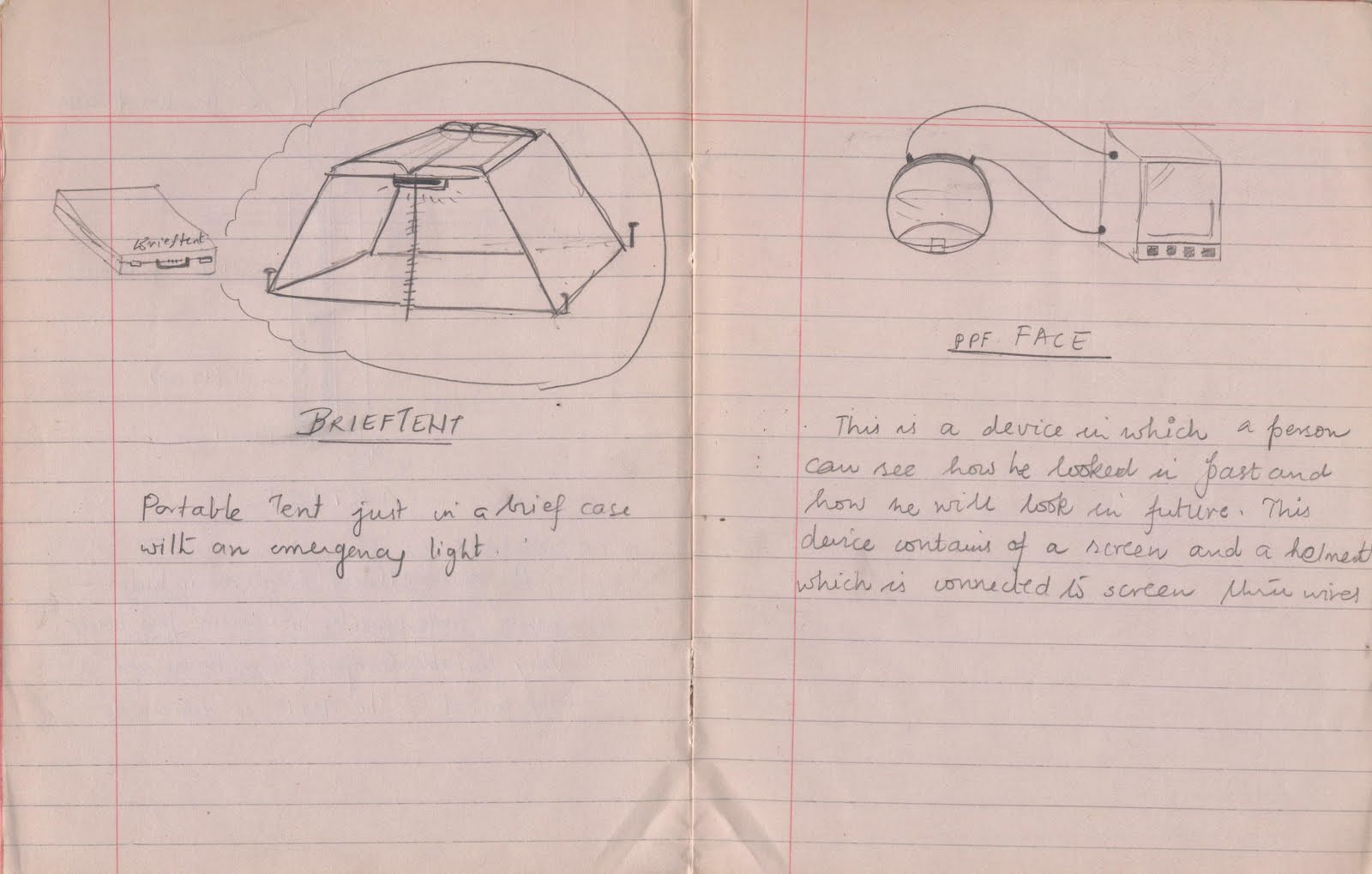
When I was about 12 years old, I used to maintain this book called "Things yet to be introduced". In this book, I used to sketch out things that might be useful, but not yet been made. I don't remember what was the inspiration for all of them? The cartoons perhaps. Also sometimes they came out of strong concerns of energy crisis. My maternal native place being Bihar (now Jharkhand), there were massive power cuts, sometimes for 5 days in a row or telephone lines would not be there for months. We used to visit our native place in summers when it would be terribly hot and without electricity, the place would be as good as hell. Some of these techniques were therefore a resolution towards these issues. Others came out of pure fascination for mechanics, or techniques or some science fundas. I used to draw them out, in plans, sections, elevations or even views. Today when I look back at them, I wonder how did I ever understand, at that age, "top view", "Section". At any stage in my drawing, I do not call them so...

Notice also the dotted lines that show displaced positions of moving parts...the nature of hard lines versus the soft (wires, cables, etc.). All of these contraptions were accompanied by a short writeup about what all they perform. Some things here might have even been introduced or been there in some other part of the world! They were only not exposed to me then!

And why would I so neatly keep them, archive them? It was the Diary of Anne Frank I guess. In 11th standard, we studied about Anne Frank and how she maintained her Diary during the Nazi war. And later all her writings were published by her father's efforts. I kept maintaining my things after that, thinking that one day all of my work will be published!!

However, what I do not understand is that why did I decide to draw (and not write)? And so accurately? And I wonder if all this was building up towards my choice to be an architect?


Saturday, April 09, 2011

Surrealism & Privacy

Along with visibility, the internet also makes possible a lot of privacy. Privacy by hiding / faking. But the interesting part is that it allows privacy visibly. That's quite an interesting aspect of it. The dimensions that internet allows for the manifestation of privacy are multifarious and interesting. Taking forms of second life, alter egos. The internet thus allows a lot of reality to exist in its original form. It it was not to exist, people would definitely take on those changes onto themselves, to hide their real selves. (something like make-ups).  But at the same time, we may confront ourselves in being someone else. In that confrontation lie questions of identity and self-hood.

In our architecture theory class, George Jose spoke about Bataille and the Surrealist movement in much detail. At some level, the surreal movement was quite brutal / cruel in confronting the self. I think the surrealists enjoyed the discomfort they created within people's mind (and themselves?). To discomfort is to push the boundaries of knowledge, they felt. The matrix of people that influenced each other across disciplines is also very crucial to understand how one form of knowledge / understanding transgresses into another. For the surrealist movement, it was the three disciplines of literature, art and film making. How they brooded over each other could be a real interesting study. 

However, studying the works of these people will allow artistic expression of privacy that exists in the soft world. Quite paradoxical. A person who is able to confront his/her private world should be ideally very strong. I don't know if the society allows this strength. Rather, what form of strength it gets moulded in the space of the society remains an aspect to observe. 

Friday, April 08, 2011

Look at me


Saifee Hospital. Charni Road. Mumbai
Blinding Brightness / Longest building in Mumbai
Architect: Hafeez Contractor.
Lighting: ?
Interior: ?
Structural Consultant: ?
Area: ?
Earlier, they had multicoloured rainbow lights

Thursday, April 07, 2011

Strangeness

I felt immense strangeness as I re-entered my class today. I felt like a stranger. Those faces that I saw for 9 months - why did they all appear new? The feeling was exactly like that on the first day in this class. Did I mentally decide to not look back at time? What had changed? Was there a breach of relationship? Was there a relationship in the first place?

Atul asked me the other day: "Have they all disappeared?" - as if it was a give and take thing all this while? I remember; that day when I put the final list: they yelled, cried, were overjoyed, some disappointed. Immediately that time, some did come to me to talk, and perhaps I was not in a frame of mind to talk. I gave them monosyllabic answers. Why? Because I know they still need to work so hard. And I felt incomplete, since my objectives weren't achieved. But I keep telling myself: "You tried." Although it does not satisfy me.

Going back to the question of exchange - was this such a give and take? Give submissions take marks, and get out! But even I don't remember going back to my class coordinator ever. But I think that's how it is. I am unnecessarily thinking too much about it. Yes, why should I be taking it so seriously. May be it comes from this utopic mission to bring a change. And who has ever changed any thing? And why do I think I can change! These are all things stemming from my idealism. I have to detail it out!

But this strangeness was disturbing. Why did I need to feel comfortable? Why the hell did I want to feel at ease? Did it really make any difference to anyone of that last week of immense negotiation?

There are more important things to do. Focus Anuj. May be that was my initial year with such an intense full-time engagement. Regulate it. And I keep talking to my mind. It's almost this alternative person. He always seems more logical, more right, more balanced, more strong...I wish I could be like him.

(this post has been edited on 8th April 2011)

Sunday, April 03, 2011

Synecdoche

INDIA won the WORLD CUP 2011.

Synecdoche:
It's a figure of speech which is used to refer a part of the whole of a whole of the part.

People danced naked on the streets and shouted slogans. They took out their cars and burst crackers. In the last week, strangers sitting next to you in buses or trains asked you match statuses while you were still listening to your good old collection of songs. When you answered "pata nahi" to their match related question, they would shrug their shoulders. They were peeping into tiny shopfronts having ultra-mini TV screens in queues to watch the "HOW" of cricket. How does he hit the ball, or take the run or take a wicket...it's about the how - and you enjoy it only if you understand the game. Just like the classical music. My brother clapped sitting in the living room peeping at the wall where he projected the world cup through a rented projector (to feel in the stadium) - and I felt as if it was his classical Indian music. Most cricket fans in India are this crazy. They critique the team at every ball such that it feels like a reality show! (how about if each move of the game was to be decided by an audience poll!). But invariably, if you found your palms hitting each other when the team won, you just echoed that "I am an Indian and I am proud that India won".

Event: 
That is what you require to activate a space. Events are essential for interaction. Can architecture be eventful? Then the building has to perform. It has to be performative. Ever changing, ever evolving / devolving. The cricket stadium holds a mass through an event. The theatre holds an audience through a virtual event. The rallies are held through speeches. Something that hold such a great mass together is actually all non-physical. The game, the show or the speech. Architecture is just a by product. It helps in encompassing the void - the hollow that holds the event. 

Architecture is the manifestation of synecdoches. part for whole / whole for part...

Out of 'Practice'

While working on a project that I am handling after a long time today, I realised that I have become tremendously slow at AutoCAD, and that I am slowly starting to just not like doing all this. I can think designs, sketch, but drafting on CAD is like hell. I just wondered only if I had an assistant, I could just sketch and tell someone to make the changes on the computer. Gone are the days when I would be on toes and do the finer changes jhatpat! I also have forgotten so much on Sketchup!! And I am feeling terrible about it!
Atleast practice keeps you up with your skill-speed, especially when you are skilled! But on the other hand, my typing speed has increased tremendously. I learnt typing from a typing institute after my 10th standard.

Typewriter fascinated me, more so, the sound and the tension on the keys. That's what I joined the class for. To feel the typewriter. I never learnt typing the right way. The right way is to look at the paper (where you read from to type in) and the fingers on the keys. I always kept looking at the keys while typing. After all, i wanted to see the mechanism of each printed word. Something going up when i pressed the key down - hitting the black ribbon and printing the letter - it had so much of character! The black south indian lady who was the supervisor would keep telling me: "idhar nahi dekhneka" - after she went, i again gazed at the lovely machine. Due to this, I never learnt the right way to type. As years passed by, I have learnt to correctly look in the paper and type - perhaps computer as a machine is not as fascinating as the typewriter. The keyboard is a softer interface though; as compared to the typewriter. It's too passive. I liked the older keyboards which made noise (tik tik tik), the sound made you realize how well you typed. Now they have all added these silencing devices to them, so you dont hear anything.

But well, AutoCAD has gone 6 years forward from where I started and it has become as complicated or organized as MS Office 2007. Sometimes I feel scared if I will be left behind. But may be this is a question of what I consciously want to prioritize...

Saturday, April 02, 2011

Design Methods

They crave for a method. And there are very few who can teach methodologies for design.  What methods do is that they allow form-al, spatial, structural, etc. progress of design logically. Design methods can be debated (unlike designs, where personal opinions come into picture). But that's the catch - methods are a very "modern" way of working. But it might be interesting to get different structures of thought from the modern thought itself.

Design methods doesnot figure anywhere in the curriculum of architecture.  "Criticism" has been a popular way of learning design at Academy of Architecture. Somehow, the reality of practice and the ability to handle it gives the alumni of the college a lot of confidence. But we need only some one to tell them how badly most of them do it!

Academic practice can be far more rigorous if we discuss academic issues instead of the practical. The practice is all for materializing the ideas. But the academic space needs to inculcate into students how to handle ideas and let them be produced. Meanwhile, we only have black squares towering up the sky. Design methods can help breaking the monotony.


(above: placing planes that indicate movement in the site owing to interests of view, climate, function and regulating their spacing and height through logic of circulation and context. The design ended up quite differently, but at the end, there was a reasoning for everything that was placed on the site)

Thursday, March 31, 2011

Grids of the Grocer


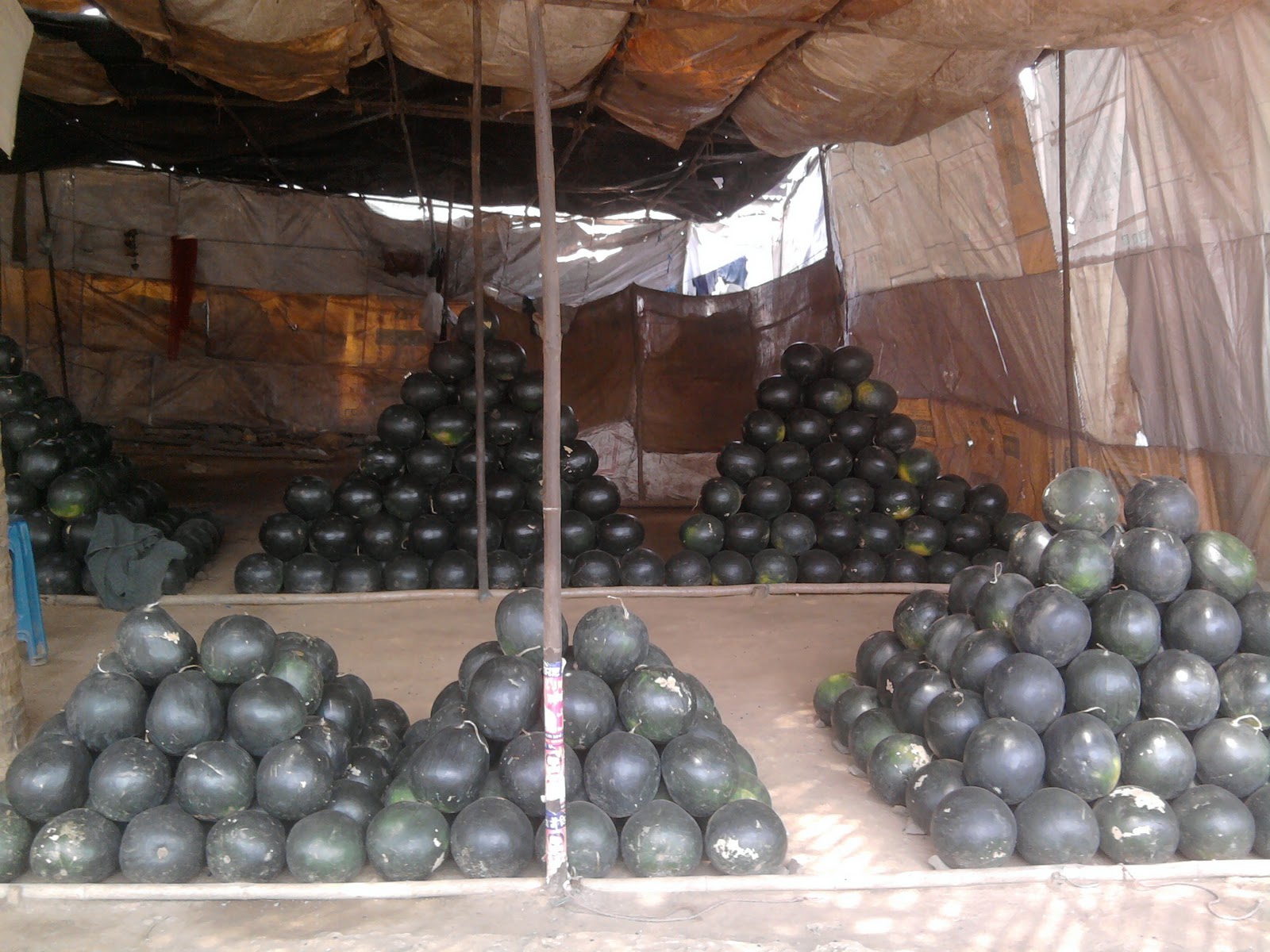
It's not only architects or artists who deal with geometries. Geometry I think is a part of every person. When I mention geometry, I am referring to complex patterns that are made out of basic shapes. While walking across the streets everyday, I look at how vegetable vendors arrange their pyramids of tomatoes, gingers, apples or other fruits. How neatly they make bundles of chillies, gingers, spinach in a grid. How nicely, the flower vendors make groups of a handful (palm-ful) of orange flowers and cap them with a red one. How they arrange the stack of leaves overlapping each other...

I wonder how the people who make the cane baskets make a multitude of shapes out of a single thread of cane...its like a complex structure of geometry used very simply. Looking at hats, baskets, containers all made out of basic long cane, I was surprised with the intensity with which they engage with an object (which is an everyday object for them). Bamboos, and the ways they cut it to make classes, cups, boxes and a range of other products...Wires - the way they shape it up into cycles, cars, trains, etc - or plastics, take anything. There is so much of it.

On one hand, where geometry is organizational (in the way of the grid) its also something that they structure their lives around.  It is also that they make into a structure (an object). Craft is thus important. It makes you realize of what you can do with objects, and how you can build on to them.

however, what i really like is that inspite of a rigid grid, the gingers are irregular. Inspite of the unstable rolling round tomato, it makes one of the most stable structure of the pyramid!! how interesing. They do it with a lot of love, in the heat of the sun, only waiting for all those pyramids to disappear at the end of the day! A basket of things to play - keep arranging, refilling their mats -the chickoos, the bananas...how they make the most interesting patterns.

Do they do it as a pass time? Or do they create an aesthetic of display? Does it appeal to people to see shining jaamuns as a regularised mountain of equal units? Making a mountain out of watermelons - and cutting a pyramidal cone out of it only to tuck it back in its profiled section? all of it suggests so much of articulation. I think we could learn from how these people deal with geometries...For articulation, for resolution, for finding ways of economising space, for finding out how spaces in-between are created, how colours interact... all of that.
And this only came up more strongly when I sat over a student's drawings resolving his circular space structure...if only he could inform him more with things around....

err...

But i would have almost missed the point...How does the grid so naturally come to the vegetable vendor? Sometimes I wonder how would Descartes react to this!? How would Euclid react to such natural instinct of making pyramids of papayas? And was the grid practised before it was discovered? Is the cartesian grid primordial? Perhaps questions which have been answered...i could just re-thread it...

Sunday, March 27, 2011

The Interesting City

Yes,
This is what I kept forgetting.

Why is this city interesting? Why everyone is plunging into it? Why everyone wants to study it? Why is it so fascinating? Why are people migrating into it?
Any object/ thing in making is always beautiful! Look at a building being constructed and it looks more beautiful than once it would be completed. (at least that's an architect's point of view). Mumbai, I feel, is still a city in making. Unlike other cities, Mumbai still struggles for a coherent image (out of its cosmopolitan). You see buildings amidst the shanties. You see the shanties just getting transformed into slightly taller buildings, and the slightly taller being converted into larger ones. There is debris all over, there is cement, reinforcement, bulldozers everywhere. Flyovers, skywalks, trains, buses, metros, buildings - all in the process. We see it happening all around us. I think although we hate engaging in all of this, this is that we love about it.
We still have wadis, villages, beaches, padas - how could it then be a city? Just go to the outskirts - say Bhayander and you will see a gamut of adopted culture from the main city. Someone once said: "Mumbai is a village" intending to say - there is no amount of city-like civilian built form here.
Can you imagine what it means to be in a city which is still in its making? 100 years later, when its full, we will be historical. They will write on us as "these people used to take a train from Goregaon to Dadar for their work" - quite possible. No, actually what I want to bring out is that while cities like say New york or London are all almost done, Mumbai is just midway. Now that Other cities are being reacted to, Mumbai is doing it all at the same time. It is building itself, critiquing itself, reacting to itself and growing simultaneously. I think that is what makes it interesting. And in between all of this lie a group of people called "architects", "urban researchers" and the whole group of "activists" and others. Some of them one day will be known as we know of the "surrealists/dadaists/situationist" today!
The only unfortunate thing is that while the other landmark cities that we study today were widely documented, Mumbai has already become far to complex to be documented. Documentation should be available for future study. And we need to still archive a lot of it. How do we begin to even look at this city in process. Is it correct to be evaluating it while it is still in process? To be able to talk about it more confidently, there should be some intensive effort in its documentation. There should be something like a City Document Society - something like a gazzetier. The gazzatier is far too limited in terms of its methods. May be new age tools could be used to start looking and recording the place we live in.

(this post needs to be formalized)

Passing thoughts

One of the reasons why I keep earphones plugged onto my ears all the time is that there are so many thoughts that come into my head all the time that one day they would drive me crazy. As i look around myself, I feel like I could document the whole world in my own way, in the way I observe. But it's impossible. Because thoughts come and go at electrifying speed. When I listen to the music through my earphones, I am only thinking of the song, and these days, I keep analysing all songs as I listen the tunes I've loaded into my phone - for the n-th time. I keep noticing the fine tunings, the overlaps of instruments, the nuances of singers, the beats, the composers...and its interesting how I have been able to comprehend my sensibility of understanding music.

The other thing that I feel wierd about is that my friends keep reminding me about my other friends' birthdays! That's really sweet of them! I mean how considerate can friends be? I think I am quite lucky to be between such people who understand that I just can not remember dates. I was terrible at historical dates! I still am, although I love the subject now!

Shadows in summers are beautiful. I think it's very recently that many of the people around have painted their walls in bright colours. So you can see crisp metals giving amazing sciography that one would like to draw on graphics plates! Sometimes, when they overlap over each other, or sometimes when flat lines make 3-dimensional shadows on folding planes, one wonders what wonderful spaces can be created using only light and shade...

On the other hand, summers are also for mounds of watermelons, parrots on cables, copper pods on black taxis, bottles of sherbets....all of which is also colourful!

These are also the times when I am preparing to separate myself from my first closest association with students - my second year batch. And I am feeling terribly uneasy to be able to dis-associate with them! I never thought that it would be such a hard feeling of loss. But one day, even I would go...and I don't know how important I am in their course of lives anyway - I was just a coordinator at the end of the day.

Hmm, just moving on now. Far too many things that hold back, and far too many things to look forward to...

Friday, March 25, 2011

Images <> Forms

In the past 3 days, I have happened to get into some intense discussions. One of them was the Interior design Jury for the second year-ites. The project was to intervene in the caves at Kahneri, Mandapeshwar, Elephanta and Mahakali. In a way, I felt that the project was a an interesting one to study interiority. The interior design studio during this entire year discussed quite mature issues. The first one was almost inspired by my fellowship research (though I may not completely claim it to be that way) and the idea of the first project developed from looking at domestic objects. Everyday objects were studied, analysed and new ideas were associated to them finally taking them to the next step for enveloping them into a space or a space that they could envelop (i shall confirm this with the faculty).

However, the two important arenas of discussion that the projects opened were: domesticity and interiority. Thus the projects were not really driven by the typical practice of interior design that happens in the city today. The arguments they generated were fairly academic. The intervention at the Kanheri Caves especially evoked a huge debate, where students decided to create a kind of historical journey through the various architectural landmark structures. These included the temple forms, the church forms, the mortuary temples at Egypt, the Moghul gardens, the Pantheon, the basilica, the Greek amphi theatre and so on. Imagine placing each of these (taking on different functions) against the Kanheri caves.

At one instance it may seem absolutely funny. Well, it is. It definitely is. But this discomfort allowed us to debate how we so strongly relate forms to functions / images to forms / meanings to images / and information to meaning. Atul's argument was not to look at the image of a church as church or not to associate the image of the temple with the temple. He argued that these functions (temple, church, etc.) were ideas that manifested into these forms. Today these ideas could be reinterpreted. Today, their manifestations could be different. (in fact, they have been different to quite an extent). Then the association between the image and the form is broken. How do we then re-constitute the image of a church? My argument was to go into the experential. But Atul cautioned me to do so! That's the beginning of a big search that we ended in.

Here are some pictures of the projects:

Tuesday, March 22, 2011

Animals


remaining posts

Actually I had to write a lot about my trip to Haridwar but as usual, things have evaporated by now. I had to talk about my uncle's retail steel products shop in detail. There was so much I learnt there about how reinforcements are dealt with. I wanted to elaborate on the idea of "bones of a building". Anyway, many thoughts are lost.
On the other hand, there were some things that I had to also talk about Palghar (especially new constructions). I have no zeal to write about these now. 

Open Jury at AOA


The open jury at AOA during the last week seemed fascinating. I saw such a charged up chaos at AOA after quite some time (or have I seen it ever before?). Models were all around and the back area was almost crammed up. Some students were all dressed up while others had just finished putting the north on their plans. There was a big panel of jurors - right from construction, structures, humanities to the design faculty. While students shivered, they handled and accepted 'criticism' quite bravely.
Although I still heard some grumblings from jurors on ill designed toilets, ducts, missing section lines, wall elevations as I passed along the panels, there was some really inspiring work. the one model below (yet to be put on a ground base) reminded me of Rem Koolhaas's sleeping buildings.


Forms, materials, shapes, shiny surfaces, file card, thermocole - all around. Still, I feel open juries have to be more open forums. Students still do not attend juries of their peers. Dialogue amongst students will transform the whole scene. Students must overthrow / push their faculties to perform through dialogue. Many of them craved to talk, but were unfortunately conversed only about BHK or toilet ducts. But I am sure this is to change...


Saturday, March 19, 2011

A Poem / thoughts

जेव्हा मी मोठा होईन आणि माझी मुलगी मला विचारेल- '' पप्पा, तुमचं पहिलं प्रेम कोण होतं हो....??'' तेव्हा मला गुपचूप उठून कपाटातला एखादा जुना अल्बम काढून दाखवायचा नाहीये...तर हात वर करून अभिमानाने बोट दाखवून बोलायचंय की- '' ती जी किचन मध्ये उभी आहे ना तेच माझं पहिलं आणि शेवटचं प्रेम आहे...''
-Gaurav Gaikwad

Can aspirations be as simple as just being simple? Can one be different by being just like everyone else? Can one glorify the everyday like everyday? I felt the above text did that.

जेव्हा मी मोठा होईन
when i grow up
आणि माझी मुलगी
and my daughter
मला विचारेल
asks me
'' पप्पा, तुमचं पहिलं प्रेम कोण होतं हो....??'
"daddy, who was your first love...??"
तेव्हा मला गुपचूप उठून
then, quietly getting up

कपाटातला एखादा जुना अल्बम काढून दाखवायचा नाहीये
i dont want to bring out from the cupboard - an old album
तर हात वर करून
but, i'll raise my hand
अभिमानाने बोट दाखवून बोलायचंय की
and proudly point out and say that
'' ती जी किचन मध्ये उभी आहे ना
"she who's standing at the kitchen platform
तेच माझं पहिलं आणि शेवटचं प्रेम आहे...''
...is my first and last love..."

(English translation mine)

Marriages are extremely political affairs in our social space. With marriage is the marriage of two families, thoughts, work patterns, lifestyles, bodies of two groups of people. These groups may be from the same caste or different. When they are same, its called "arranged marriage" while the second is "love marriage". The poem for me gives an allegoric account of one hidden below the other.
Does it really mean what it means? Why this contemplation that one will get married when one grows up (here, grow up implies an age beyond the normal)? And the dream of a girl child (a subtle unlikely choice - I refer to the political social space) asking the father - "who was your first love?" - and why would a daughter pose her father such a question? How old is she? Did she just ask him after he encountered a fight at home, or he's feeling low, or she read something or her mother told her some old incident....?
Procrastinating the answer, the author/father chooses not to go to the cupboard and bring out an album, but simply assumes to point at the lady in the kitchen. Why? What does the album hold? What emotion does the gesture hold? Of regret of the past? Was there someone? Who was she? Why it did not work out? Why the compromise? On the other hand, what is the 'pride' for? Why would he proudly point out? Things that put me in thought.

And families live like that. In our society, love marriages are still so hard to be convinced, especially if the boy and girl are of different castes.

More than that, this is the picture that the poem frames for me:

The daughter sitting on the father's lap - who is waiting for the dinner to be served. He's wearing a white loose pyjama and a brief staring out of the window. The kitchen is a room made by the curtained separation. The cupboard lies in the other half. Bare minimum requirements. Yet, the daughter (you seems to be very young) maintains the innocently serious tone. The father reacts like every other father - a father who is like the closed cupboard - reticent, rather someone, who would not open the cupboard and discuss that album, which might have hidden stories. Instead, he would foucs on the present - the reality of life, the reason of his own existence - the lady across the kitchen.
Don't we live in this domesticity?
But on the other hand, it may also mean completely the opposite.  Isn't that beautiful?

(I do not know the poet)

Thursday, March 17, 2011