Thursday, May 26, 2011

Discussing Drawings


(the above text is by Pratik Dhanmer)


me:  what do you think may be an answer to the question he raises?
 sidthemonster:  this is a very complicated question
 me:  hai naa
...
 sidthemonster:  actually a bit of it reminds me of this article on ayn rand
she was an extreme individualist
 me:  idealist...
 sidthemonster:  and her books' heroes/heroines are based on her
 me:  yeah
 sidthemonster:  no no
idealist yes
but individualist
 me:  ok
 sidthemonster:  and she was so extreme that she actually praised a serial killer who raped and murdered little girls
 sidthemonster:  effectively saying he is being individualistic (i.e. doing what he likes)  and not letting "society" come in the way of what he wants to do
 me:  no, but i dont agree to this simplistic resolution of his
 sidthemonster:  and that's my problem too
and my problem with ayn rand
having too many rules is an issue
having none is a major issue
 me:  why does this process of preparing architectural drawings become so tedious?
 sidthemonster:  for that matter everything routine gets tedious. fact of life
when u drew as a kid it was ur escape from routine
now drawing is your routine
like i actually enjoyed studying for gre
i used to hate it in school
i was the last minute study types
also at work, i basically manage projects. Barely draw
for the last 2 weeks I've been drawing continuously without needing to manage projects
 me:  but it think, its more to do with the thought before putting it on paper - we think too much before we draw as architects
 sidthemonster:  and it's been so phenomenally exciting
 me:  exactly
 sidthemonster:  i wouldn't say so
kids think before they draw too
 me:  ummm
 sidthemonster:  only they perhaps dont think aloud:)
 me:  kids don't have the burden of responsibility in drawing
we have it
 sidthemonster:  true                                          
 me:  there is a correctness that has to be adhered to
a code
 sidthemonster:  but that would be a personal thing
some ppl love the responsiibility
some ppl dont
 me:  ummm
i do think it's more than routine
routine is definitely there
 sidthemonster:  what do u think
it is the reason why i stress on the routine thing is perhaps by nature i don't like to get tied down to one thing and I've experienced the same love/hate with drawing very intimately
 me:  do painters get bored of painting?
 me:  what makes us decide then to do architecture?
isnt it drawing?
or is it what?
i dont konw
it wasnt drawing for me
 sidthemonster:  it wasnt for me either
i.e. drawing
i duno why the link between arch and drawing is so tight
drawing is just one of the means
i mean rem koolhas is a journalist by profession
 me:  yeah, how else do you claim B Arch?
 sidthemonster:  and his language to describe/invent/create arch is writing
 me:  interesting
 sidthemonster:  or take even kenneth frampton
or any of the photographers who do such beautiful work with space
 me:  well
so it's the eye
 sidthemonster:  the issue is drawing is our tool of creation
 me:  the eye makes you the architect
 sidthemonster:  or the brain
 me:  so are you suggesting there could be a blind architect
?
 sidthemonster:  and just like engineers cannot fetishize their instruments, architects shouldnt too
yes of course!
i mean we talk of experiences
all the time
and experience is related to all 5 senses
 me:  ummm
brain is a very vivid answer
 sidthemonster:  u dont hear engineers going into paroxysms about beautiful java code
 me:  ?
never
  sidthemonster:  in a way what happens
i thnk is like how when ur a kid and ur trying to learn a strange new language
like say english for ppl our age
 me:  hmm
 sidthemonster:  and ppl talk to u in English
jus so u get better at it i thnk in a  way its the same with drawing for us
that a lot of the fetishizing is to get an interest and acquaintaance with a new way of expressing urself
 me:  hmmm
but what happens to this language?
we dont get fed up of it?
do we?
 sidthemonster:  eventaully it becomes a part of u
 me:  do we get fed up of english?
then why get bored?
 sidthemonster:  it becomes a way of expression
because drawing is also our tool
and just as ppl get bored of dal-rice
(i should have a better metaphor there)
oh oh
writers
they get bored of writing
van gogh almost killed himself with booredom frm painting
 me:  my god
there are traces
only you could recount!
 sidthemonster:  lol
 me:  but i do feel it is something to do with cognition
think of the tribal artists
 sidthemonster:  ok
 me:  dont they get bored of painting, if thats their work in life?
well they must be
but if one gets bored, it reflects in work
 sidthemonster:  the thing is, it ISNT
 me:  you can see that in architectural drawings
 sidthemonster:  madhubani paintings are done during diwali, traditionally
and warli paintings are also to celebrate religious occasions
so its not their job
its like drawing a rangoli
or lighting a diya every evening


and we went on...

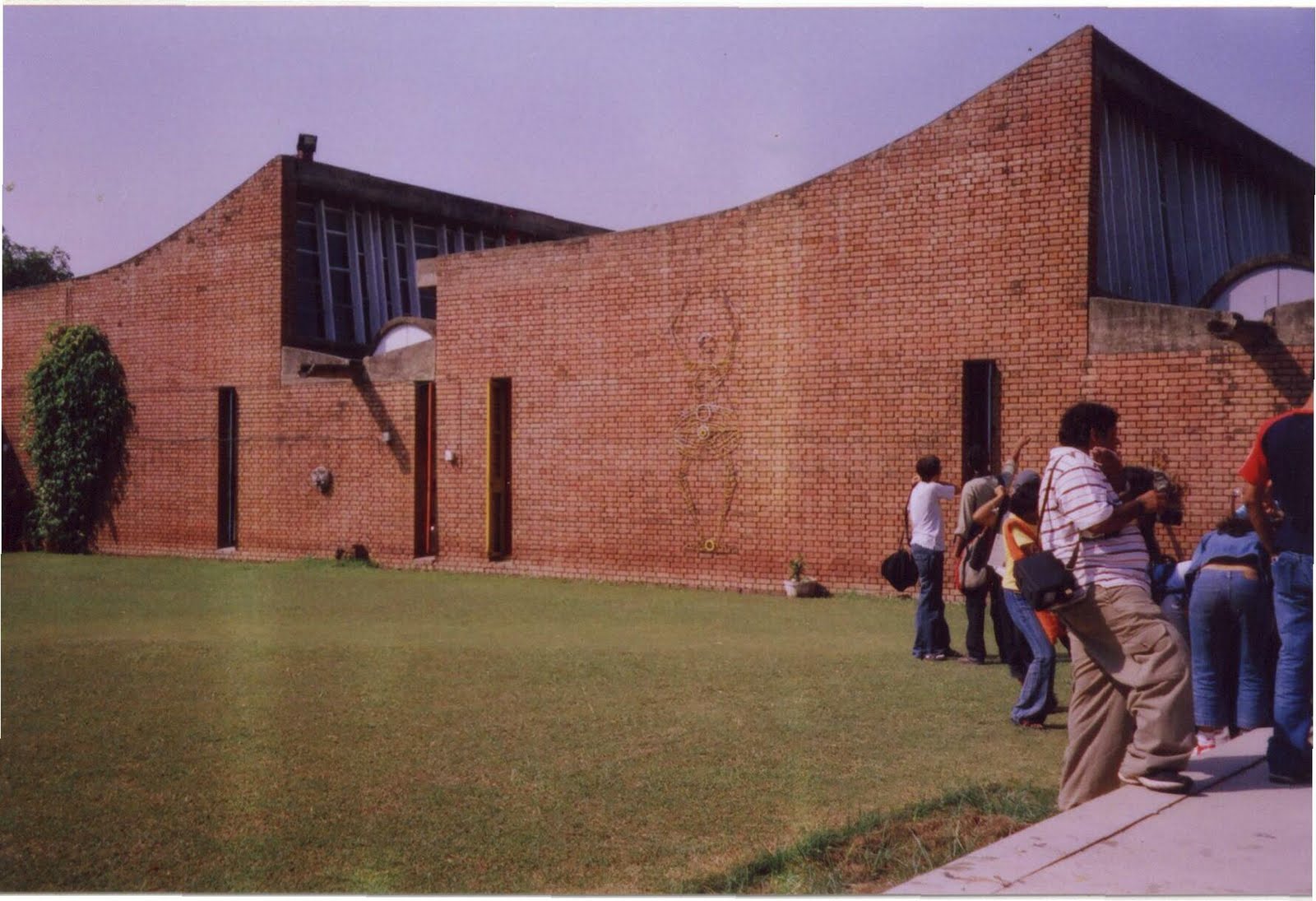
The Architecture of Architectural Institutes III

Chandigarh College of Architecture:
(4 years ago)
Architect: Le Corbusier


Centre for Environmental Planning & Technology (CEPT) once again:
(7 years ago)


Writing

Is being emotional important for any one to be able to write well? Emotions help you place your opinions so convincingly. Does it make one strong, or does it make one weak? Do thoughts die if they are not expressed? How many thoughts do we lose every day?

When one is highly emotional, the very act of writing becomes a dialogue, which in reality, is a monologue. Every piece of writing is probably a conversation with oneself. Asking questions again and again to oneself - "is this what i want to say?". But still, they say, that a writer writes for an assumed audience. An audience which shall probably never be available to the writer. Since this  conversation with his / her audience is always so mute. And it manifests into new forms. 

And all i ask again is:
"Is this what I want to say?"

Wednesday, May 25, 2011

Research Fellowship Proposal – UDRI 2008


melancholy memories
of the city

The idea for the research is taken from Salman Rushdie’s book Haroun and the Sea of Stories - an allegorical account of perception of a city set in a sad backdrop…
"…a sad city, the saddest of cities, a city so ruinously sad that it had forgotten its name", which is located beside "a mournful sea full of glumfish, which were so miserable to eat that they made people belch with melancholy".
Mumbai has always been projected as a city of dreams. For an outsider, Mumbai has always been a city of hopes, the opportunistic city, the popular Bollywood, the city of Amitabh Bachchan and Shah Rukh Khan. A popular notion amongst outsiders is that every Mumbaikar is a neighbour of a filmstar. A ready question on any outsider’s list at the first meeting with a resident of the city would be “How many hero / heroines have you seen?” Mumbai’s history more or less follows these questions. We talk about the Gateway of India, the Marine Drive, romanticize about the colonial past, the cosmopolitan culture, and more recently the enterprise and the Bollywood, which is documented very well. The popular history of the city always talks about the seven islands, the colonial rule, the beginning of a metropolis and growth of a commercial hub – a morphological understanding of the place. However, it cannot be neglected that the city has many more events to recollect that just these. When we are talking about events and people, we are talking about memories. Good memories are always generalized and compiled. However, something amidst all this remains untold – the bad memories.

Never is Mumbai’s history seen in the light of its dark events. The research paper is geared towards breaking the notion of Mumbai being a city of dreams. The purpose of the research is to construct an experiential history of the city by collecting memories of people, which are not good in taste. We remember the dark events of Mumbai only when another unpleasant event occurs in the city. These distasteful memories are merely collected as journalistic records and published every time another bomb blast would occur, or the city is filled with water in another downpour, or so on. However, these impressions never contribute towards a significant part of Mumbai’s history. What still attracts people is the new lifestyle, the modern buildings, and the city lights – as projected by traditional history.

Research Problems and Questions

The project will try to explore new ways of reconstructing the city, the prime questions being - Why should the history of the city only be celebrated by the glorious events of the past? Why does the history need to recollect only the good times? Why does the city of Mumbai attract so many people inspite of the fact that it is actually a machine? The aim of the thesis is to look at our city of Mumbai as it is – in the most pragmatic manner. Once we break away from the projected positive image of the city, we may be able to capture important fragments of history through collecting memories, which are not much talked about. The less talked about memories will discuss problems that the everyday inhabitant of the city deals with. At the same time, it will give an insight into the problematic past of the city. These recollections of the past hide into themselves
a conception of a city space, which has never been talked about. The objective of the research is therefore to construct a city space, which seems to be unacceptable, but is still lived in. The project would attempt to make the difficult history of the city more agreeable to natives as well as outsiders for whom; the city of Mumbai has always been a city of celebration and fantasy.

Aims and Objectives

The objective of the thesis would be to collect stories from different kinds of people, of them having unpleasant historic memories of the city and stitch a new layer of history for the city – the difficult narrative. These stories will question the idea of the outsider’s image of the city versus the problems of the native. These stories will also delve into the change in the perception of an outsider becoming a native of the city.
Thus, the scope of the thesis is to methodically use narratives to capture experiences contributing towards a difficult, more unpleasant history and on the other hand deconstruct the idea of Mumbai as a city of Enterprise.

The compilation of these varied experiences may be extremely interesting to read just as stories, but at the same time, the thesis will attempt to draw a picture of the space which each story would create for the city. These pictures, coming together as a storyboard will help in imagining a physical manifestation of the “bad” city through individual memories.

So once the bitter bytes of the city are scanned, one might just get a complete different perception of the city. A city playing in the hands of various interests and nurturing itself on biases. A city thriving on so many interests can not be silent. It is boiling. Different people living in different times in different parts of the city will contribute to a palimpsest of images. The city of Mumbai is therefore no more has the nice man’s image; and neither does it have that glitz and glitter of the Bollywood. It becomes a city which lives on the edge, with every working person contributing towards a memory - a collective memory that is deep hidden since a long time. The common man wants to share his bad memories. But conventional history does not provide the opportunity to do so – because histories are always written in good taste.

The research will allow the inhabitants who are associated with the city to share their bad memories of the city. The research will undergo an ethnographic study of experiences of the people in the city. These experiences will be collected in the form of stories or narratives. The narratives thus collected will help in re interpreting the history of the city in an alternative way – where the city of Mumbai will no longer be available as a platter for beautiful dreams. The research allows the city to reflect upon its unpopular past by looking through the bitter everyday memories of the ones who make the city.

Methodology

The research will adopt a qualitative mode of collecting data including in depth interviews as the prime generator of stories. Therefore, the study will primarily depend on ethnographic surveys and learn about the city through people’s past. These stories will be collected from people who share memories with the city.
These would include people from different areas dislocated during the numerous rehabilitation drives. Stories may pertain to the rise of slums or the rise of the working class in the city and therefore look at a particular economic section of the city, which drives it. The increasing migration in the city calls for having interviews with people who have been outsiders since a very long time. The research may look into stories of existence of people in the city, the struggle for space. An interesting aspect of the study could be to study the increasing fear with the city as an instrument. These would include the experiences of everyday travel, a comparative analysis, and in more recent context the fear of crime and the underworld within peoples mind. The everyday negotiations and the tensions that these create – exploring the meaning in – “I need my space”. The purpose of the research is to bring these difficult narratives together to stitch a history of the city, which may not be pleasant. In other words, the idea behind the proposal is to construct a history of the city through bad memories.

The ideas discussed above may seem to be more contemporary, but the research suggests that there existed times when Mumbai went through a difficult phase. Secondary sources for the project would be newspapers discussing stories of individuals, which will be used as pointers, local magazines that discuss works of local people and events and other relevant books from libraries where stories can be studied.

Studying and tracking blogs of people might also be an interesting way to understand their perception of the city. The nature of these people would be difficult to detail at this instance.

The research aims at collecting these bad historic memories of the city, which are never discussed considering them to be offensive / harmful or distasteful. Such memories do not contribute to the touristy image of the city; neither would it allow freedom for envisioning a dream but will be very realistic. Hence, these historic memories are never talked about. Thus, the thesis will try to construct images of the city through layers of experiences instead of physical markers and at the same time, it will try to break the popular notion of the city being a dreamer’s island.

***
A proposal that did not take off.
(I now realize how it could have been so much better!! I lacks major literature review. But the proposal was almost prepared in no time...)

Monday, May 23, 2011

Energy + Design

I was talking to Parameshwar this morning and he told me about his post graduation course in sustainability with TERI. He had some interesting facts to share with me.
I had always assumed that windmills are those vertical fans. We make gross assumptions here. Wind mills were mills - they used the mechanical energy to do work. (one such tableau model can be seen at the Nehru Science Centre). That means, the rotation of the fan would be used to do mechanical work (and it was not converted into electricity). What we confuse them with, are wind turbines. Wind turbines convert rotation of the fan into electrical energy. Unlike the vertical fans, there are also horizontal ones, which are very beautiful and perhaps more efficient. It would be really interesting if we started incorporating them in our designs. There are so many types of wind turbines - the helical, horizontal, vertical, etc. We don't even know half of them...These are extremely sculptural and would make great design elements instead of installing dead statues on our sites... 
You can just google them as 'types of wind turbines'

He also said that for tapping geothermal energy, one has to dig almost 10 kilometres below the earth surface. India almost does not have any scope to tap geothermal energy because there are no volcanic bellies here. The ones which we had, have now gone dormant, and hence not really usable. Iceland, which he said is the land of fire and ice, is fetching a lot of geothermal energy. Why I am writing this here is because I was assisting the Services course last year. While teaching Electricity, we pass by these facts so breezily, and students make it petty when then reproduce then in their answer sheets. However, we could possible engage such details in building design. The building forms could become huge machines generating electricity. We haven't considered inhabiting machines that probably could sustain our projects...

Regarding hydroelectric power stations, I had always presumed that the turbines must be placed directly under the water fall. But it's not so. Water collected in the reservoir is taken through pen stocks to the power station. Pen stocks are 2 metre wide pipes which push the huge turbines that produce electricity. 

The biggest problem with renewable energy sources is that they are intermittent. We do not have constant supply of sunlight, wind, etc. So, Parameshwar said that we actually end up installing 4 times equipment required to actually generate the basic energy that we consume. 

I am absolutely fascinated with all these technologies. Perhaps the static nature of the buildings disturbs me now...but i think we can creatively engage with exciting technologies which not only help us in addressing the question of sustainability, but also of creating exciting forms in architecture.

Wednesday, May 18, 2011

Notes: S,M,L,XL

DRAMA
It often happens that the real tragedies of life occur in such an inartistic manner that they hurt us by their crude violence, their absolute incoherence, their absurd want of meaning, their entire lack of style. They affect us just as vulgarity affects us. They give us an impression of sheer brute force, and we revolt against that. Sometimes, however, a tragedy that possesses artistic elements of beauty crosses our lives. If these elements of beauty are real, the whole thing simple appeals to our sense of dramatic effect. Suddenly we find that we are no longer the actors, but the spectators of the play. Or rather we are both. We watch ourselves, and the mere wonder of the spectacle enthralls us.

DUTCH GREY
A Dutch friend asked me if I would like to see the tulip fields. Inwardly I really did not want to see the tulip fields. For some reason I thought that seeing so many tulips - red, yellow, white and purple would be too much. In any case, I did not want to see the tulips. My friend persuaded me to go with him. I am glad that he did. He brought me into a deep view. When we rode along the roads which moved through the tulip fields, I began to understand Mondrian. I always thought him to be an international painter. It was not the colour of the tulips but the density of the sand and earth where the bulbs were planted which reminded me of Mondrian. It was the atmosphere of opacity. The place, the land, the earth was dense opacification. The coloured flowers were not the issue, it was the infinite penetration and the compaction of trapped light crystals in the earth which illuminated the air into a grey solidity...dutch grey.

IMAGE
A picture esp. in the mind.

LOGIC
  1. The science of reasoning by formal methods.
  2. A way of reasoning.
  3. Reasonable thinking.
MORAL
There are no moral phenomena at all, only a moral interpretation of phenomena.

Claiming Ideas

We don't live in a space that values / respects other people's ideas. Ideas are generated, and shared with good intentions but there is always a 'someone else' that capitalizes on it without crediting the person who originally thought of it. What is the incentive then, to the person who thinks of an idea, for sharing and expanding knowledge?

A few months ago in my conversation with a colleague studying abroad, I came to know that any kind of data is precious and needs to be preserved and protected only because it may be crucial for the ideas one produces. This data is the proof if you wish to every curate an idea or delve into a deeper research. I realized only later, what crucial data I was handling at Charles Correa Associates during the archival process. Imagine holding a letter written by Rajiv Gandhi in your own hands discussing matters of architecture...I think although I understood its importance, I missed out on capitalizing at the opportunity...Tremendous records of stories of important buildings lie in the archives of Mr. Charles Correa. I don't know how much of it would be really retained as 'useful' material at the end of his archival process. But one could even do a research on how tenders were made 60 years ago in the country if someone decides to work on all the junk that Mr. Correa decides to throw away all his correspondences of old commissions that he executed.

No, the post is not about Mr. Correa - it is about the practice of archive and mobilizing it through ideas. I introduced the idea of translating "Form, Space & Order" by Francis D K Ching in Marathi to facilitate deeper architectural thought into the minds of non-English speaking student body here. There are layers to the importance of this idea. But some one has already been thinking on it surreptitiously. Anyway, if it's translated, it would do only good to the community. But sometimes, I do feel that I let out a lot of ideas.

In a space where people build their careers out of such capitalization, one must be really aware and careful about acknowledgement. In being modest, we build up a lot of uncalled-for frustration for ourselves. It is important to claim right over the things you do today - its unfortunate (and sometimes petty), but that is the world we live in.

The Architecture of Architectural Institutes

If we understand architecture in terms of its aesthetic value, then one can say that no Architectural college in the city of Mumbai has any architectural value.

I have visited almost 7 out of the 11 architectural colleges of the city and found that they do not even suffice the spatial requirements of the course, forget the visual ones. Institutes seem to be crumbling under the pressure of accommodating more and more students imposed upon them by the council. However, we were producing almost 4000 architects per year till the last year nationally, the number shall soon rise by double in the next two years. Still, this shall not suffice the need for architects in the country. It is projected that we need about a lakh architects to comprehend the kind of development the nation is going through. Amongst those who pass out, we can clearly rule out 50% graduates who either don't end up practicing architecture or pick up an alternative stream of engagement.

Given these logistics, it is crucial that we have a a fair number of architects who can collectively give an cohesive architectural direction to the country. The aestheticization of this production begins from the environment they are themselves trained in. If we are to discuss the architectural production in the future with this premise in mind, the physical output of the profession is questionable. 

A rough breezing survey of the architectural institutes in the city of Mumbai will show how uninspiring spaces they are. Inspite of being the oldest architectural college of India in the city - the J J college has not produced any strong responses to its site in the recent times. The building is an old introvert heritage which manages to fetch huge amounts of grant from the Government (recently it was offered a sum of 5 crore rupees) for its developmental and other activities. The campus is fascinating, but reasonably dead. Other colleges do not enjoy such huge grants, still, a college like Academy of Architecture has been struggling with its image. The history of the institute has been interesting with the land transforming from a silk mill to a modern building. However, the internal planning of the building is absolutely orthodox which does not allow any flexibility of activities pertaining to the architecture course. The institute is unable to decide its stance over more intake or better education. But it is negotiating this dilemma through the projection of seductive images of its future make-over and extension.

The Indian Education Society in Bandra is a building block worked out in plan and extruded over 7 floors. It has dead wells (courtyards) that are fairly out of proportion within its layout. Hiray college of architecture was almost deserted when I last visited it a few years ago. It did not have any formal spaced out entrance and felt like a municipal hospital. Rizvi college fortunately had a campus but its space did not evoke any kind of pleasant response. Kamla Raheja (in Vile Parle) has a strong introvert planning which looks over to its own landscaped mound. It has huge hollowed spaces which the faculties use in all possible ways. But it has to be noted that the architectural quality of the building may not have any effect in the making of an architecture graduate. 

Campuses in New Bombay enjoy a good expanse of land, but buildings on the campus seem to be planned in a childish way. D Y Patil college has passive landscaped patches and its Architecture block is very glocal in character. It is a cross between a mall and a municipal office. I have not really seen Bhartiaya Vidyapeeth, so I may not be able to comment on that.

Amongst the recently opened colleges - Balwant Seth COA is just a floor of the building dedicated to the course. It is thus, fairly an interior experience to be in the college. I haven't visited Asmita or LS Raheja.

It is a paradox that buildings that produce architects are themselves not architecturally rich (according to me). And I have already specified that I am only trying to look at the physical being and environments of the buildings. It's appalling!

Wednesday, May 11, 2011

On Cartoons

Tom & jerry / rat race
Road Runner / 
Jungle book / Animals
Popeye / strong, spinach
Donald Duck / Impatience
Duck Tales / miserliness
Shinchan / Celebrating brathood

(i have to elaborate the idea of cartoons here)
Roland Barthes might be useful here!

Tuesday, May 10, 2011

Blind Sound

Since the past two months, I have been observing two blind beggars on the railway footover bridge/s in Goregaon. Both of them play musical instruments.

The first one plays the bulbul tarang. I don't know where he got it from...probably it was a rejected piece from someone's house or from his own house, or may be its an age old hierloom from his family back home - I absolutely don't know. What I know for sure is that he has no clue of what he is doing to it / with it! He produces sound, not music. The bulbul tarang is thoroughly abused (like the beggar) - its buttons are eroded, strings are lost, case is broken and the feather through which he strikes the strings has lost shape. He strikes each of the remaining buttons and strings continuously multiple times trying hard to make a tune! Whenever I pass by this man, I try to identify what raag might be just possible from the remaining buttons on his instrument! It's rather funny - but what fascinates me is what he can still do with the instrument possibly! But he continuously keeps on playing it, playing it, playing it...

On the other hand, the other blind man plays the dholak. His dholak is intact - definitely seems someone gifted him. Neat. It has a fairly good naad. He always tries and sings with the random beats he produces! Although all songs (kirtans) he sings seem familiar, he just alters their rhythms to suit his silly musical beats! He hits the dholak with a certain amount of uninterest. Probably he just heard John Cage and was absolutely inspired by him.

Both these men compel me to wonder if this is how the first people who engaged with these instruments in the history of civilization behaved! They interact with the instrument as the nomads in the film Gods must be Crazy - as if somebody flying in the air dropped these magnificent musical instruments in their lap which they fiddle with non-visually (by virtue of them being blind) to produce random sound. What aesthetic of sound do the blind understand or create? Do they like to just move hands on it? Do they like to engage with the instrument purely because it allows them that tactile sensation? I am sure one can beg without the formality of playing an instrument.

Further, I kept relating it to the idea of a 'practice'. If practice is about perfecting something, then how are these  people not able to even strike one harmonious chord yet in their engagement? Or is our sense of harmony and aesthetic of sound structured by the classical rules of music? I keep trying to like the 'blind' music they create, but I have yet not been able to come to terms with it.

Finally, I am fascinate with this interesting condition of 'blind sound' and where these blind men go with their timeless exploration of the instruments - playing for the world that remains their audience (whom neither they see, who neither listen them back)!

(I haven't taken their photographs thinking that it will be too sadist to take photographs of blind men)

Saturday, May 07, 2011

Untitled

In support of my "technology" blogpost earlier, I want to present how librarians at Academy of Architecture handle or look at books. Here is a newly ordered-for book "Atlas of Novel Tectonics". A lovely black book with rounded corners. It has pages which are somewhat handmade type. 
Look at how carelessly the bar-code sticker has been stuck, hiding the name of the book. Inside, in the first page, the tape sticking the bar-code is folded, crooked and everything that goes contrary to the care that the book maker must have taken while making the book. The stamp and the handwriting that decorates the book add to the irritation I go through every time I take this book in my hand.
Our people personify the saying "Kaala Akshar Bhains Barabar" ( काला अक्षर भैंस बराबर). And this gets termed, quite simplistically as "Indian Culture". 

Thursday, May 05, 2011

Answer sheets

Correcting examination papers is like solving the same question paper 40 times (the number of students you have). It is like improvising on every answer each time and evaluating yourself till the last paper. Like how a musician would keep doing till he could sustain the speed. Like music, it has its own highs and lows - a point where you suddenly start writing "YES" or "NO!" on the sheets of students! Its hallucinating - since it takes you back to the exam hall. If you know the students, it feels that they are speaking off the answers to you! In the mind, you keep nudging - "no, just a bit more, a bit less"...It makes you do aha if all what is expected is there...a strange kind of confidence that arises in you. Checking a well written / well answered paper is delightful, since it reassures you of your knowledge, that you shared with the students.

And there are mercies with borderline cases, where you question your own morals, but give in to an assumed larger interest of the time of the student, hoping that eventually all will be well. No one goes beyond, to check what ever happened to the border line cases. In the pragmatics of the world, all pass. They make their means, sometimes, even without the (academic) examinations.

And with cases of either extreme, you end up feeling disgusted or silly and just end it with a shrug. How do you build up that reasonable amount of interest such that a ward is just able to manage and pass...it's not that difficult.

But sometimes, (since I am so much into reading and research at this point of time), I get into unnecessary and unrequired semantics of language, which I myself reconsider and reevaluate again....

Tuesday, May 03, 2011

Courses & Course Structures

I see that more and more people are wanting to design semester long or year long "courses" to teach architectural subjects. Courses can be meticulously drafted with a lecture-wise and topic-wise schedule with reading lists and tasks or loosely structured giving a broad idea of what would the faculty want to cover. In designing a course, the tutor assumes an "ideal" student in mind. This ideal student would read all the essays for the course on time, prepare for all lectures and work out all assignments in time. The course would keep on reeling throughout the term where the faculty would keep imparting data/knowledge to the entire class at a time. There is a certain generalization of the intellect of the entire class. This generalized body is the ideal student, not necessarily the average student. It could vary depending on the ego of the faculty.

Courses help build faculties a good amount of research material and stray questions that could build up papers for argument. Generally, such is the agenda in the graduate courses designed abroad. The making of courses is quite a graduate study idea. I am not sure if the same works in the undergraduate field where students are still grappling with basic ways of working and thinking. In preparing a course, the reading list is imposed on all those who might not be inclined towards such study. These students would least contribute to the discourse. Courses ideally are product oriented, unless the faculty is aware enough to understand it as a process. 

While choosing post graduate courses, students are aware what they would possibly want to invest more of their time with. Hence, the idea of a course makes a lot of sense then. Courses in graduate studies not only help the researcher faculty, but also the student the privilege to access the researcher. However, at the undergraduate level, all of this could be so vague for the student that although the faculty might be able to put any kind of information generated in the studio in some perspective, the student has large chances of being on the flip side. 

But courses help structuring knowledge. They must be used to open up fields of inquiries. Courses could be broad enough to suit each one's interests. Ofcourse, it largely depends on the tutor how he/she conducts the course. Passive interactions never help, unless you have a great set of students. But why am i writing all this? Because I want to get out a lot of garbage out of my head. I have been somehow strongly thinking that course modules are being "tested" on students here, improvised and applied to "better" places thereof. I may be horribly wrong here, but as I said, this is just to remove all the junky debate that I have been having in my head since some time now. There is so much ambiguity in the course structures itself that I have been seeing (since one could interpret all of it in so many ways and do it in so many different types) that I have come to believe that the focus is not that the student gains, but the focus is pointed inward to the faculty.

Why do I think all this? I have become quite suspicious of things around me...May be it's all because of the political games that intelligent people keep on playing all the time. It's better to be aware than feel bad later! Atleast the impact of shock is lesser...

Monday, May 02, 2011

Basic Design Jury at AOA 2011

I was called for the external jury for the Basic Design work of the aided wing of AOA today. I have never evaluated Basic Design work earlier. I have never taught Basic Design before. I never felt there was any thing to teach in BD. Anything you do in BD is an exploration. So what do you actually critique? The projects that have been going on in AOA since ages are the Line Dot Curve or the Draw a simple machine-sketch-pattern-3D. None of the faculties ever explain the students what the purpose of that exercise is. I softly complained (during a core meeting) about the same  project we did 8 years ago (in our first year) to one of the senior faculties who taught us BD (ofcourse now, after that I've graduated, and being in a stronger position to pose a question to him). He cleverly escaped the question by answering that "you were not supposed to know the purpose then"! It's a completely escapist technique he used then - I refuted. But then I chose to not pinch him enough. They themselves were not sure what they wanted to impart then! They still don't know. If they knew, they would show us Escher, they would show us Renaissance paintings, they would show us what is composition, they would show us what is balance in composition, they would bring in art theorists, visual communicators -  they did not do any of this. They feel as architects they are too high to call people from these streams.

Well, I am not talking about the present BD team. I am talking about a team which taught us. And conveniently, when I asked this grey-head for answers, he tried to ask me who was the faculty team then. Basically he wanted to put all the unclarity of the course on the other members of the team. The hypocrisy with which the oldies operate in our college is commendable. No one questions them what they teach - what they say is a dictum. Very conveniently, they paint a completely floral picture to the higher authorities of what they are doing. That is only because they are able to theorize the entire process. The students struggle in the hindsight. They do not know what to speak! They cannot justify their thought processes. The answers you get are: "I did so because the faculty told me to do so..." On the other hand, the oldies boast about themselves and put down others blatantly (there is to comparison to the effrontery) say that they have "30 years of experience". The fact is that in the span of thirty years, they haven't developed their minds at all as teachers - or else, why do you see the same exercises being repeated for decades to come? The ego of a teacher must never allow repetition of any project that they did with students in their history.

New experiments face severe criticism and loss of a number of interesting faculty. Perhaps I have been too harsh with my comments on them above, but I am frustrated over the fact that I had nothing to carry back home after spending a good 12 hours with 20 students today! It was almost a formality to comment on each project which almost had very little content, which did not even push their imagination further with a plethora of things that surround them! No references, no criticality, no theorization - and this is the result of the kind of exercises that we as faculty develop for students. I do not blame the students at all. It is the intellect that drives the students. There has been no drive. You could see 65 excellent minds being wasted only because a certain senior faculty decides their fate, a faculty that is stuck to a time period 30 years back in history.

How can students allow this? Students have to rise up against this! They have to make us realize how much more we can do! The whole world is open to them - they can listen to lectures, talks on the internet, books are available, library is loaded, references and friends are around, art galleries are all open - when will they engage with all this? When will the ask intelligent questions to the faculty? I could detail out problems with each projects along with their merits. May be I could do it later. But the key to such processes is the amount of time to spend with a particular project. There need to be intensive form building exercises in Academy - they never teach you how to evolve form - and hence you have Hafeez Contractors. Students love to make forms, they crave to do interesting looking objects - why not dedicate one project on form building? It's only when the enter the practice that they meet "design-hungry" people who push them to give "interesting" objects.  So we have forms that have no meaning. Had we engaged with a meaning generation - form based exercise, we would have a lot of interesting stuff around.

But, all that can go on.

I shall upload some pictures - the only activity that kept us busy apart from listening to similar sounding explanations that we got from students. They all were highly skilled, talented and had a lot of potential.


Saturday, April 30, 2011

Arguments on Technology

Can this aversion for neatness or organization (being organized) be attributed to the advent of computer technology?

The first thing perhaps my father taught me was to be neat. The first thing he would do when he got a new book was to cover it in a nice brown paper. He would bring in stock, rolls of brown paper, plastic coated sheets sometimes, and neatly cut it to size with a cutter. Cutters would be brought in stock, so that they are replaced once they lost their sharpness. Bad cuts would not work and techniques of cutting was to be learnt through practice. He passed this value to us. He would not allow corners of any of our textbooks or note books to be folded. He would never like papers torn incorrectly. After covering a book, it had to form crisp, pointed corners - no misaligned corners. The covers had to be tight.

On the other hand, he would never allow us to use a pen on a book (text book/printed text), and as far as possible, not even allow pencil marks on the books. Books were to remain fresh till they escaped your life. This, I think was impressioned into our personalities. We would never be allowed to wear un-ironed clothes. the trousers would never have more than one crease. The collars had to be stiff. The hair had to be combed straight....

We grew up with these values. And such values create an immense trouble when I see someone casual about all such things. In some ways, learning architecture or being an architect has amplified this distress. I can not stand misaligned sheets, badly torn papers, ill formatted drawings, crumpled tracings, dirtied and smudged sheets, folded rolls, corners of sheets dissolving due to glue tapes....

What I essentially want to say is that it wasn't architecture that taught me to be crisp, it was my basic family values. You don't find many people following such culture these days. I wonder if it is because there is a software / soft-ness to all these activities. Till the year 2000, we almost dealt largely with physical communication devices. Computer largely caught up only after 2000. I remember, it was only in 2001 that Information Technology was introduced as a vocational subject in the colleges. Today, there is a software for every kind of activity that you once did physically: remember photo albums? the old ones with black tinted papers where one would have to stick each photo carefully, or insert them into their photo holders. Or take for example  writing, where if you had to write, you would carefully select paper, depending on whether you are going to use a ball pen or an ink pen....Today, you have a software to type - where everything is flat. You have a photo album maker, where you just 'upload'. There is no sense of 'care' that goes into it. Unlike the album books where once you stuck a picture, you stuck it for ever (and you ruin it if you try to remove it), in the computer, you can keep on removing or adding / editing picture. Infact, the software detects smiles and faces or crooked photos...it suggests you what could be done to supposedly 'improve' your content. Word software has spell checks as well as grammatical suggestions. There are templates for portfolios. You just feed in data. Everything is ready where a user has to remain a passive information provider.

Is technology making us dumber? I say that because even after having such facilities, you don't find the physical space improving around you. (Can you imagine your camera not taking a picture unless the subject smiled?). Infact, the inconsistencies that we have in understanding such interfaces increases errors which damage our surroundings. Are we all a dumber race? Prof. Punde had a very interesting observation, where he said that our lives are 'embedded' today. Till a few years back, if you missed a telephone call, you would miss it forever - you would never know who called you. Today, even if you missed it, you have the entire history of that event on your calling machine. If you were listening to a lecture earlier, where if you skipped a word, you lost out the meaning of the sentence, you just ended up misinterpreting it, today, talks are on youtube/internet videos. You can rewind them n number of times and keep listening to one statement until you finally understood it. The idea of revisiting the past, the idea of holding a lot of past and carrying it into the future has drastically affected our whole engagement with time.

How does one see this condition - as a distraction or as an opportunity? Information is piling up, the whole world is in your palm, you know who is where all the time, you can control a person in America from India, working hours have changed, communication ways have changed....as teachers, how do you intervene with their world of technology? (well, I  have asked Prof. Punde to write a formal paper on this).

But technology is very considerate. It doesn't back-answer you / question you back at all! It allows you to do tremendous mistakes and takes all the balme on itself. (the computer would crash if you mishandled it. You are not affected by this physically in any way). It remains within the physicality of a dumb machine. Could you possibly impersonate a machine? A machine's attitude is what we have around - an emotionless, insensitive and dumb race. Are they mistaking machines as their role models? Since machines never make mistakes. Ever listened to a person from a call centre? They talk like machines - "Good morning sir, I am calling from ICICI bank, would you be interested in a loan?" - all in one breath, maximum 2 seconds to finish all that talking. They answer you like dumb people, there is never an emotion in their voice - they are just simulated.

As a teacher, I find it extremely troubling to adjust with this newness. I am uncomfortable, sometimes scared. Because I feel responsible. And my idealism is rooted in a space and time which is completely different from today's generation. Is it this feeling that makes you aloof, alone and single? Is it history's safe space that makes me interested in it? I hope interesting debates come up. I could have written a lot more here, but i realize that this will require a larger body to discuss and detail.

Friday, April 29, 2011

Alternative Histories

If at the end of Second year in an architecture course, one doesn't know

that pointed arches do have keystones
who is B V Doshi
that its Frank Lloyd Wright and not Frank Llord Wright
you can not pronounce Antonio Gaudi
the significance of Vitruvian man
Le Corbusier's Modular theory
that Le Corb's Mill Owners' Association is in Ahmedabad, which is in India and not abroad
that Le Corb designed Chandigarh and not Jaipur
that Egyptian pyramids have 4 sides and not 3
that Gallerie des Machines is a Gallery for Machines (the name is the function)
that Triumphal Arches were for the triumph of the Emperors (answer hidden in the question)
that Kanchanjunga is in Peddar Road and not in Colaba and is designed by Charles Correa
that IIM was designed by Louis Kahn
that IIMA is in Ahmedabad; IIMB in Bangalore
that Le Corbusier means "The Crow" and his name is Charles-Édouard Jeanneret
that Mona Lisa was painted by Leonardo da Vinci (having seen the film Da Vinci Code)
that the column beam structure of the Parthenon is called Trabeated system
that the St. Peter's square is an oval (after showing the picture)
that Charles Correa is the last one to be amongst the pioneers of Modern Architecture
that "Less is More" was the statement by Mies Van Der Rohe
that the prime contribution of Romans to our social space is democracy
that Mosques have no idols

that Renaissance was before Industrial Revolution / Modernism
that Eiffel Tower has no vertical but inclined lifts
that escalators are conceptually 'lifts'that iron was discovered and not invented!

then
what does one actually know for one's future  architectural practice?

No, it's not to laugh. It's the reflection of the interest level. In an age of media, where one has access to information 24x7, we see students killing all their time on facebook! But one can even share these facts and discussions on FB! Perhaps, our fundamental perceptions of FB do not match. But FB is killing the age of 12-25. Atleast the others know how to use it! and how much to use it. But it's not only FB. The whole of Internet.

Media has restructured the whole of society. I dont know what it would do to the average architectural practice? Are we just supposed to "learn from them" finding out newer patterns of the market? Its rubbish - what is the content in it - there is not intellectual thought. Should meaninglessness be always proven through a rubbish physical manifest? Our engagements with technology are so half-ripe. At least the developed countries use it right from their birth. We have a condition where such access is not even available to everyone. Weird conditions that the current dynamics of space and time has created. Where children struggle with language, basic spellings (the don't even care for them), what do they really want to do? Are they lost? then why don't they express that they are lost? how will they resolve it? why dont they speak up? what is their problem? I am worried about my place and my space which they could possibly ruin with ugly meaningless monsters! I hope the next three years open them up with their true goals!


(all responses from History VIVA at AOA)

Tuesday, April 26, 2011

Desires

Heart's earnest desire is always fulfilled.
-Mahatma Gandhi

Passing thoughts

Since the past few days, i have been feeling extremely exhausted and bored to upload anything here. There are lots of thoughts that come and go, but articulating it into text is becoming difficult. Also perhaps because my theory classes have started becoming heavy and they have puzzled my a bit. There is a lot of abstruse stuff that people are thinking...I am wondering if i must indulge myself in all this hi fi gyan.

However, there are other new things that have opened up. Like this book of Kapila Vatsyayana. Prof. Punde says she is like Kishori Amonkar in classical music. Kapila's command on history, he said is excellent. I read some essays from that 1000 page huge book, and they seemed interesting. I hope to catch up on that book again from the library.

We discussed Kracauer and Heidegger in the past classes and nothing of it was absolutely clear. I need to re look at all of it. We need to also make a time line of some 20 people who we have discussed by far in our class. We also have to write an essay on "What is design process? " for Sen Kapadia's class and I just cant get myself to write anything. Although I started to write something on design.
Everytime I think of a new idea to theorize, I talk about it to some people and immediately that idea is rejected, or seems not to make any sense, However, I think thats a part of the learning process.

I feel like traveling extensively now and just write descreptive things about a place. But that never materializes. Anyway, i think i am just putting the random thoughts that are arriving in my mind, but this is the fastest that i have written my blog.